Core Networking · Study deck
Wi-Fi Access: Standards and Link Budget
This first route develops Wi-Fi standards, band choices, link margins, and device power constraints.
Packet Pete is your guide for this deck.

After studying this chapter
Learning objectives
You will be able to:
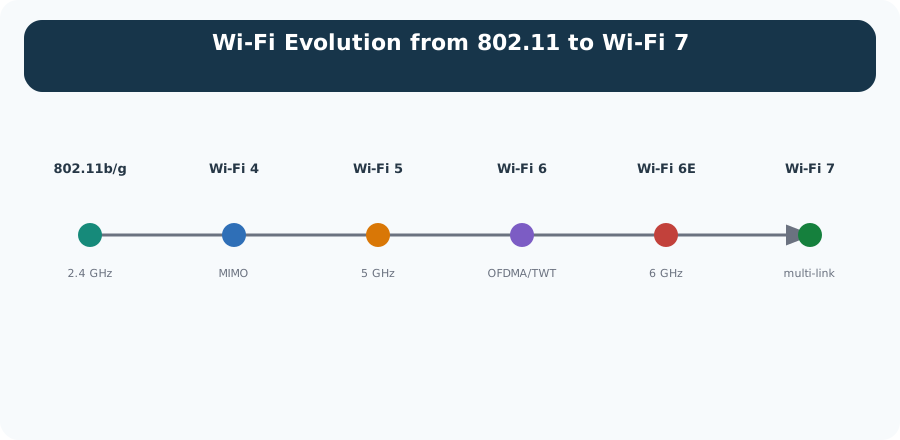
- Summarize the evolution of IEEE 802.11 Wi-Fi protocols from 802.11b to Wi-Fi 7
- Compare Wi-Fi standards (802.11 a/b/g/n/ac/ax) for IoT applications across speed, range, and power trade-offs
- Evaluate IoT-specific Wi-Fi standards: Wi-Fi HaLow (802.11ah) and Wi-Fi 6 (802.11ax)
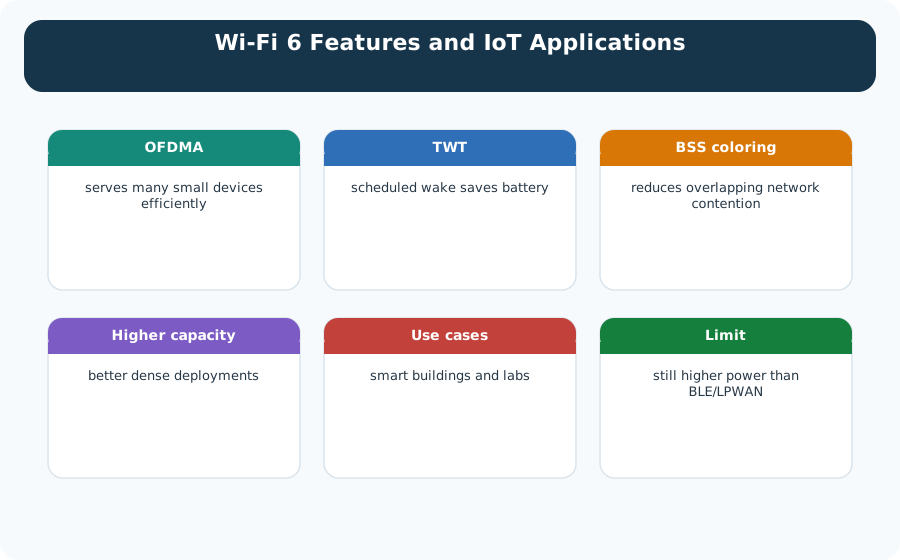
- Explain how OFDMA and Target Wake Time (TWT) optimize Wi-Fi for IoT device density and battery life
Major section
Start With a Device Joining Shared Air
Shared air, walls, other users, and sleep timing can change the link without changing the device code.
- An access point means the local radio station that Wi-Fi devices join.
- Modulation means changing a radio signal over time to carry information.
- This runway does not prove coverage, security, or battery life for every site.
Major section
Start With a Device Joining Shared Air (continued)
Received signal strength is a device's estimate of received radio power; RSSI means received signal strength indicator.
- A working bench connection is only the first proof.
- “Good signal strength is not the same claim as room on the channel — prove both before you call it delivered.”.
- Here Pete follows the shared air itself: what it costs to join, what it costs to stay heard, and what the record needs to show.
Major section
For Beginners: What is Wi-Fi?
Wi-Fi is how devices connect to a local network wirelessly - like invisible cables made of radio waves!
- That network may also provide internet access.
- When your phone connects to your home router without a cable, that's Wi-Fi.
- Wi-Fi uses radio frequencies (like a radio station) to send data through the air.
Major section
Wi-Fi Speed, Power Saving, and Frequency Bands
"But speed is not the only improvement for IoT," noted Temperature Terry. "Wi-Fi 6 has two features I love.
- "Wi-Fi keeps getting faster and smarter!" said the microcontroller. "The original 802.11b from 1999 topped out at 11 Mbps.
- With hundreds of IoT devices in a smart building, that is essential.".
- 5 GHz is faster and less crowded, but does not travel as far.
Major section
IEEE 802.11 Wi-Fi Overview
IEEE 802.11, commonly known as Wi-Fi, is a protocol replacing wired Ethernet for wireless communications.
- It uses the unlicensed radio band for data transmission.
- The first entry is simply the 2.4 GHz band.
Major section
IoT-Specific Wi-Fi Standards
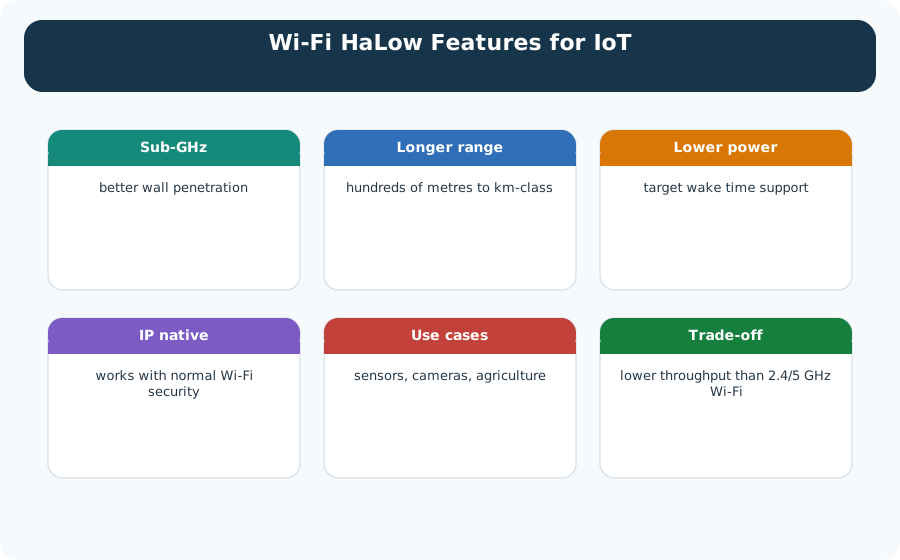
The change is the band.
- HaLow works below 1 GHz, and the two boxes beside it are consequences of that: better wall penetration, and range that moves from tens of metres to hundreds, or further.
- Throughput is lower than 2.4 or 5 GHz.
- OFDMA can schedule several small transmissions in one channel exchange.
Major section
MVU: Target Wake Time (TWT)
Core Concept: TWT lets an IoT device and access point schedule service periods so a capable device can sleep between them.
- The power saving depends on radio hardware, traffic, wake interval, and the older power-save mode used for comparison; 90% is a possible scenario result, not a standard guarantee.
- Key Takeaway: When relying on TWT, verify support and negotiation on both the sensor and access point.
- TWT can coordinate less frequent wake periods where traffic and AP policy allow; measure battery life on the actual device.
Major section
Compare Wi-Fi Modulation
The gateway sends 10 KiB data bursts to the cloud every 30 seconds.
- Building has 8 competing Wi-Fi networks causing channel congestion.
- Result: The illustrative 802.11n MCS 6 (64-QAM 3/4) threshold is met with 29: 25 = 4 dB margin, below this design's preferred 5 dB minimum.
- For comparison, MCS 6 would offer 58.5 Mbps (65 Mbps with a short guard interval) and 1.40 ms bare payload airtime, but less fade margin.
Deck summary
Key takeaways
Shared air, walls, other users, and sleep timing can change the link without changing the device code.
- Received signal strength is a device's estimate of received radio power; RSSI means received signal strength indicator.
- Wi-Fi is how devices connect to a local network wirelessly - like invisible cables made of radio waves!
- "But speed is not the only improvement for IoT," noted Temperature Terry. "Wi-Fi 6 has two features I love.
- IEEE 802.11, commonly known as Wi-Fi, is a protocol replacing wired Ethernet for wireless communications.
Retrieval practice
Recall check 1 of 2

Packet Pete says: answer from memory, then check your reasoning.
Q1A dense sensor fleet sends small packets and spends too long listening for service. Which pairing addresses both problems?
Show answer
Answer: D One mechanism shares airtime efficiently; the other lets compatible devices plan sleep.
Retrieval practice
Recall check 2 of 2
Packet Pete says: answer from memory, then check your reasoning.
Q2A hospital deploys 300 patient monitors across 5 floors (100m x 80m each). Devices transmit vitals every 2 seconds with <100ms latency requirement. Which is the strongest access candidate to test against those requirements?
Show answer
Answer: B see answers page
Print reference
Answers
Answer key.
- D · One mechanism shares airtime efficiently; the other lets compatible devices plan sleep.
- B · Wi-Fi 6 (802.11ax) is the best candidate here because OFDMA can help a dense fleet share airtime. The <100 ms end-to-end requirement still requires a site test; Wi-Fi 6 has no fixed latency guarantee. LoRaWAN and Sigfox need a rate and latency justification absent here; a battery-powered Zigbee mesh also lacks a demonstrated relay and timing plan for this five-floor workload.