Core Networking · Study deck
Wi-Fi Access: Scanning and Deployment
A link budget estimates whether a radio signal can reach each device.
Packet Pete is your guide for this deck.
After studying this chapter
Learning objectives
You will be able to:
- Explain: A temperature sensor, badge reader, camera, and commissioning laptop may all be "low bandwidth" in application terms, but each association, DHCP lease, TLS handshake, multicast burst, and acknowledgment still consumes channel time.
- Explain: Keeping one SSID across every AP in a coverage area lets client radios roam to the strongest AP on their own, instead of a person choosing between differently named networks by hand.
- Explain: Operations evidence proves the design can survive firmware updates, credential rotation, AP replacement, and site changes without forcing a truck roll for every sleeping device.
Major section
Illustrative Airport Wi-Fi 6 Case
The following hypothetical airport case is a worked planning scenario, not a report of a Denver International Airport deployment.
- Its 4,200 devices, 340 access points, delays, battery results, and costs are illustrative assumptions to test with site evidence.
- Utilization alone does not prove the cause of delay; a real investigation would also inspect airtime, retries, queues, and application timing.
- Actual power draw must be measured; Wi-Fi 5 clients can also sleep.
Major section
Wi-Fi Fit Record
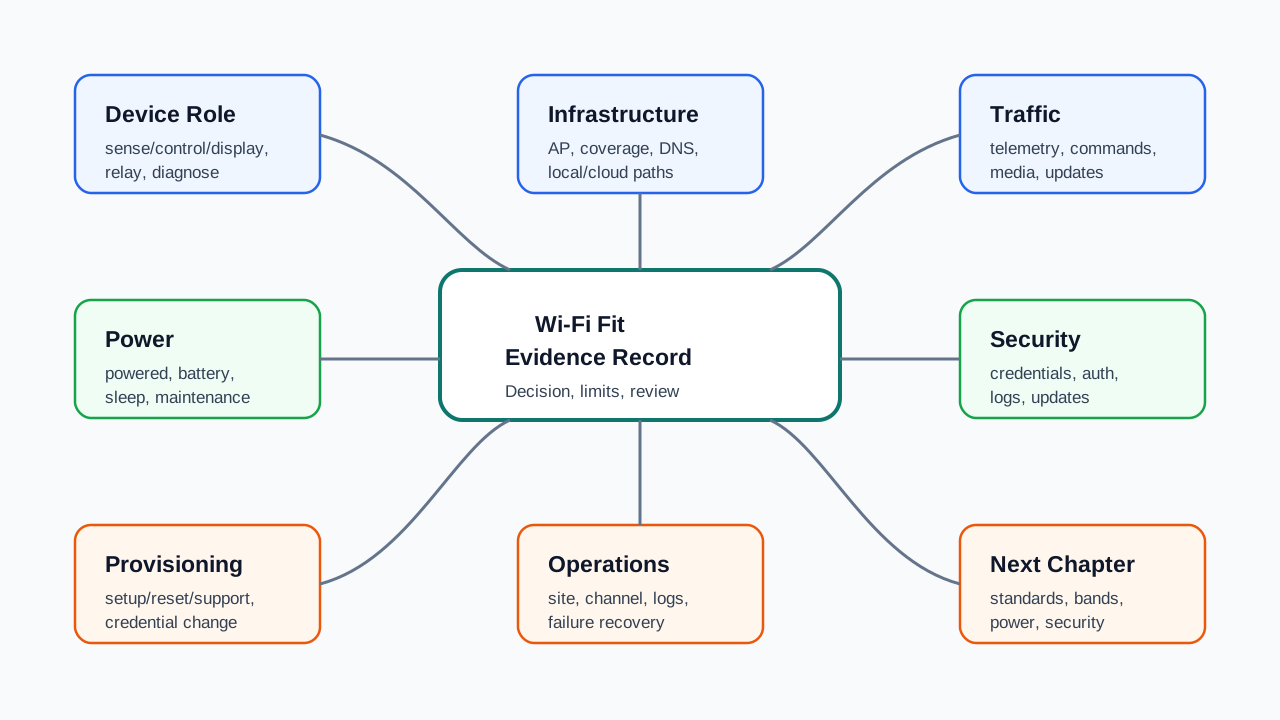
The Wi-Fi decision must include the access point, channel width, band, security method, client power behavior, and backhaul path as one service contract.
- Wi-Fi is not just a range or speed choice.
- Each retransmission spends more airtime before the application receives a single useful payload.
- A good fit record separates coverage, capacity, and operations evidence.
Major section
Wi-Fi Fit Record (continued)
A temperature sensor, badge reader, camera, and commissioning laptop may all be "low bandwidth" in application terms, but each association, DHCP lease, TLS handshake, multicast burst, and acknowledgment still consumes channel time.
- Coverage proves the client can hear and be heard.
- Capacity proves the channel has enough airtime during busy periods.
- Nothing is measured yet.
Major section
Wi-Fi Fit Record (continued)
Operations evidence proves the design can survive firmware updates, credential rotation, AP replacement, and site changes without forcing a truck roll for every sleeping device.
- Address: a device can show acceptable signal strength and still lose service when the channel is busy.
- Receipt: coverage proves the client can be heard -- capacity proves the channel has time to hear it back.
- Coverage proves the client can be heard.
- Operations proves the design survives updates and site changes.
Major section
Wi-Fi Fit Record (continued)
Work through Figure: Wi-Fi fit evidence record linking device role in its three numbered stages to see why a signal reading on its own cannot close a Wi-Fi decision.
- Stage three writes the decision, the limits and the retest trigger.
- The escalation rule at the foot of Figure: Wi-Fi fit evidence record linking device role is the one to memorise.
- An acceptable average with high retries is a capacity or contention problem, so do not raise transmit power first.
- IoT makes this sharper because many devices send small messages, wake briefly, or reconnect after long sleeps.
Major section
Wi-Fi Capacity Record
It should show what each device sends, how often it wakes, which access point serves it, what minimum signal quality is acceptable, and what happens when the channel is busy.
- Keeping one SSID across every AP in a coverage area lets client radios roam to the strongest AP on their own, instead of a person choosing between differently named networks by hand.
- The record should also document what the design will not support.
- A 2.4 GHz-only sensor may be acceptable for low-rate telemetry, but it competes with legacy clients and neighboring networks.
Major section
OFDMA and TWT Schedule Contention
Wi-Fi 6 improves dense IoT service by giving the access point better tools for scheduling.
- OFDMA divides a channel into resource units so multiple clients can send in a coordinated transmission window.
- Target Wake Time lets clients agree on sleep and wake schedules instead of listening constantly.
- Those tools do not remove the shared medium.
Major section
OFDMA and TWT Schedule Contention (continued)
Beacons, probe traffic, acknowledgments, retransmissions, hidden nodes, low modulation rates, and neighboring networks still consume airtime.
- Classic Wi-Fi access is contention-based.
- A station listens before transmitting, waits through interframe spacing, chooses a random backoff when the medium is busy, and expects an acknowledgment for unicast frames.
- Target Wake Time is also a contract.
Major section
OFDMA and TWT Schedule Contention (continued)
If the acknowledgment is missed, the frame is retried at additional airtime cost.
- OFDMA changes the scheduling granularity, not the need for planning.
- That helps dense small-packet workloads, but it depends on compatible clients, firmware behavior, AP scheduler policy, channel conditions, and whether the traffic arrives in patterns the scheduler can combine.
- The AP and client agree when the client can wake for service, so the device spends less energy listening between events.
Deck summary
Key takeaways
The following hypothetical airport case is a worked planning scenario, not a report of a Denver International Airport deployment.
- The Wi-Fi decision must include the access point, channel width, band, security method, client power behavior, and backhaul path as one service contract.
- A temperature sensor, badge reader, camera, and commissioning laptop may all be "low bandwidth" in application terms, but each association, DHCP lease, TLS handshake, multicast burst, and acknowledgment still consumes channel time.
- Operations evidence proves the design can survive firmware updates, credential rotation, AP replacement, and site changes without forcing a truck roll for every sleeping device.
Retrieval practice
Recall check 1 of 3

Packet Pete says: answer from memory, then check your reasoning.
Q1A site scan shows several strong access points on the same channel near a planned sensor. What is the sound next step?
Show answer
Answer: C Strong signal alone does not show whether shared-channel contention leaves enough airtime.
Retrieval practice
Recall check 2 of 3
Packet Pete says: answer from memory, then check your reasoning.
Q2A theme park deploys 2,000 wearable wristbands across 1 km². Wristbands need 16-hour battery, location updates every 30s, and <2s payment latency. Which is the strongest candidate for a site trial?
Show answer
Answer: A Wi-Fi 6 with planned AP coverage is the strongest candidate here because OFDMA and TWT can support dense access and scheduled sleep.
Retrieval practice
Recall check 3 of 3
Packet Pete says: answer from memory, then check your reasoning.
Q3What schedules Wi-Fi client airtime and bridges the shared wireless cell?
Show answer
Answer: A It schedules client airtime and bridges the wireless cell.
Q4A warehouse Wi-Fi IoT deployment has strong RSSI at most sensors, but uploads stall when forklifts move through the aisles. What should the capacity record check first?
Show answer
Answer: B Good RSSI alone does not prove usable Wi-Fi capacity.
Print reference
Answers
Answer key.
- C · Strong signal alone does not show whether shared-channel contention leaves enough airtime.
- A · Wi-Fi 6 with planned AP coverage is the strongest candidate here because OFDMA and TWT can support dense access and scheduled sleep.
- A · It schedules client airtime and bridges the wireless cell.
- B · Good RSSI alone does not prove usable Wi-Fi capacity.