Core Networking · Study deck

Choosing the Right Network Type

Bandwidth is the amount of data a link can carry in a given time.

Packet Pete is your guide for this deck.

networkphysicalclassification
Packet Pete, the module guide, in a scene from this chapter.
iotclass.org

After studying this chapter

Learning objectives

You will be able to:

  • Explain: The first decision is the communication job: how far the device must reach, how much data it sends, how often it wakes, whether it moves, who owns the infrastructure, and what happens when coverage is weak.
  • Explain: Cellular and LPWAN (LoRaWAN, Sigfox, NB-IoT, or a narrower option such as Weightless) can reach remote assets, but SIM provisioning, roaming policy, regional spectrum rules, gateway density, payload limits, and operator lifecycle become design dependencies.
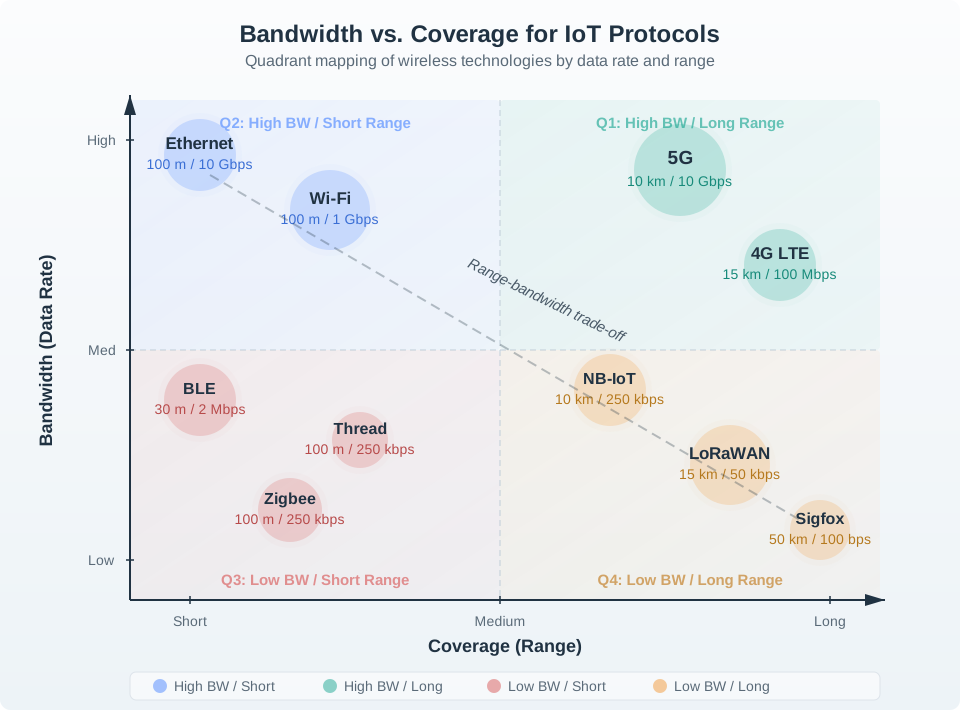
  • Explain: Those diagram labels establish the scope of the common trade is reach versus throughput, with power and ownership deciding which option is realistic.
iotclass.org

Major section

Start With the Deployment Shape

A network name is not evidence of reach or safe recovery.

  • Classify the Job Before Choosing a Network: Bandwidth is the amount of data a link can carry in a given time.
  • A gateway is a device or service that joins different parts of a system.
  • The distance bands in this chapter are guides, not promises.

Key terms

Choosing a network type
Choosing a network type is easier when the deployment shape is clear.
iotclass.org

Major section

Start With the Deployment Shape (continued)

These devices share a site, but they do not share one network job.

  • The deeper sections compare physical media and network classes so each choice can be tied to a measured site and a named owner.
  • Choosing a network type is easier when the deployment shape is clear.
  • Range, rate, energy, reliability, ownership, installation effort, and troubleshooting evidence decide whether a short wired bus, Ethernet, Wi-Fi, LPWAN, cellular, or a mix is the right fit.
iotclass.org

Major section

Overview: Classify The Requirement, Not The Brand
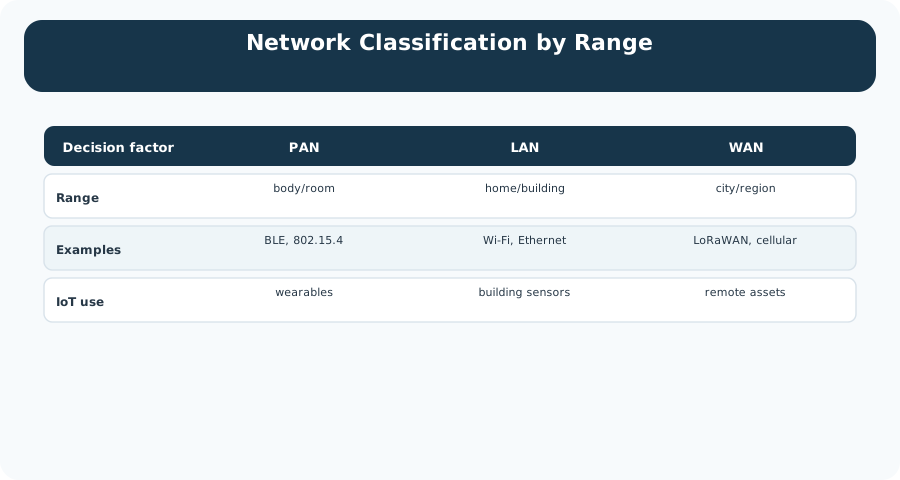
Network classification is a shortcut for reasoning about reach, bandwidth, power, ownership, mobility, and failure boundaries.

  • A wearable badge, a PoE camera, a campus gateway, and a field soil sensor may all belong to one IoT system, but they should not use one network class.

Why it matters

A soil sensor may prefer LPWAN because reach and sleep time matter more than throughput.

PAN, LAN, and WAN describe useful reach bands, but each band still contains several technology choices.
iotclass.org

Major section

Overview: Classify The Requirement, Not The Brand (continued)

The first decision is the communication job: how far the device must reach, how much data it sends, how often it wakes, whether it moves, who owns the infrastructure, and what happens when coverage is weak.

  • A class label is therefore an engineering filter, not a product category.
  • A wearable badge may prefer a PAN path because local readers keep the radio and battery budget small.
  • That sequence keeps overview: classify the requirement, not the brand tied to what is visibly labelled.
  • The "link" is often just proximity to a reader, not an addressed connection.
iotclass.org

Major section

Overview: Classify The Requirement, Not The Brand (continued)

Those diagram labels establish the scope of the common trade is reach versus throughput, with power and ownership deciding which option is realistic.

  • Coverage for IoT Protocols to: Q2: High BW / Short Range in Figure: The common trade is reach versus throughput; verify: Q1: High BW / Long Range before concluding.
  • Together those labels make the common trade is reach versus throughput, with power and ownership deciding which option is realistic testable.
  • The usual question is how the PAN crosses into the rest of the system through a phone, hub, router, or gateway.
iotclass.org

Major section

Overview: Classify The Requirement, Not The Brand (continued)

Near Field Below PAN range, typically under 10 cm, a device is read or tapped rather than joined to a network: RFID tags, NFC pairing or payment taps, and QR or barcode scans.

  • LAN Local-area networks fit buildings and campuses, typically 50 m to roughly 1 km per segment.
  • Wi-Fi and Ethernet can move more data than low-power radios, but they need access-point, switch, power, and coverage planning.
  • WAN And LPWAN Wide-area options fit city, rural, mobile, or operator-backed deployments beyond roughly 1 km, out to tens of kilometers for a well-sited LPWAN gateway.
iotclass.org

Major section

Practitioner: Build A Classification Record
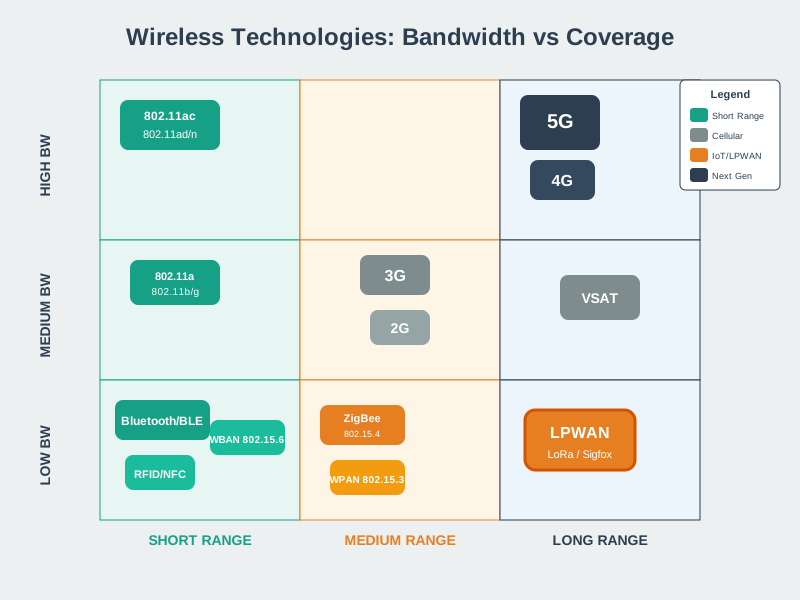
A useful network classification record is a small design artifact.

  • For each device type, name the class, the next boundary, the normal payload, the peak payload, the wake or mobility pattern, the owner of the infrastructure, and the field test that would falsify the choice.
  • The mistake is forcing all devices into one class for diagram neatness.
Coverage and throughput are only the first two axes; power, topology, and ownership decide whether the tier is deployable.
iotclass.org

Major section

Under The Hood: Each Class Hides A Boundary
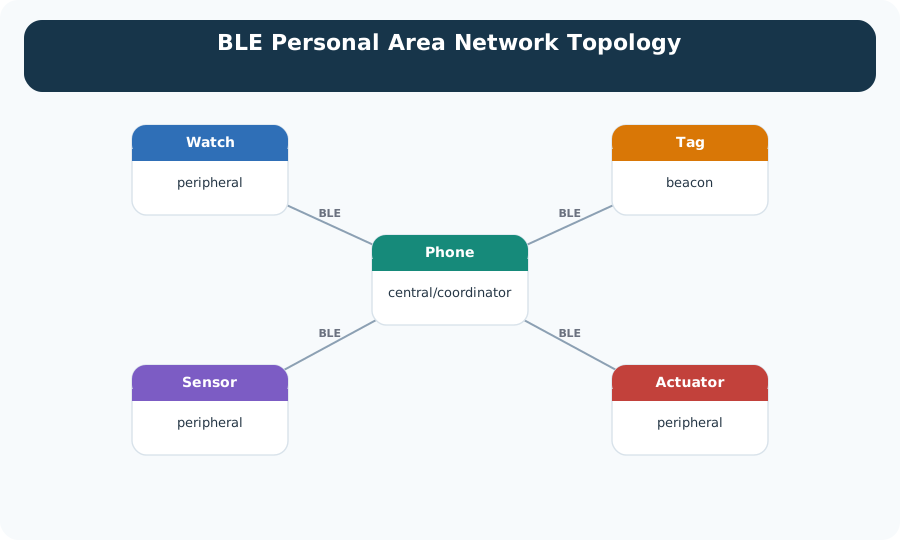
Classification is not a protocol stack.

  • A PAN device still needs local addressing, pairing, channel access, and a bridge to wider services.
  • A LAN device still needs switch or access-point capacity, power, VLAN or security policy, and backhaul.
  • The hidden work is usually translation and ownership.
PAN boundaries are usually reader, phone, hub, or coordinator boundaries.
iotclass.org

Major section

Under The Hood: Each Class Hides A Boundary (continued)
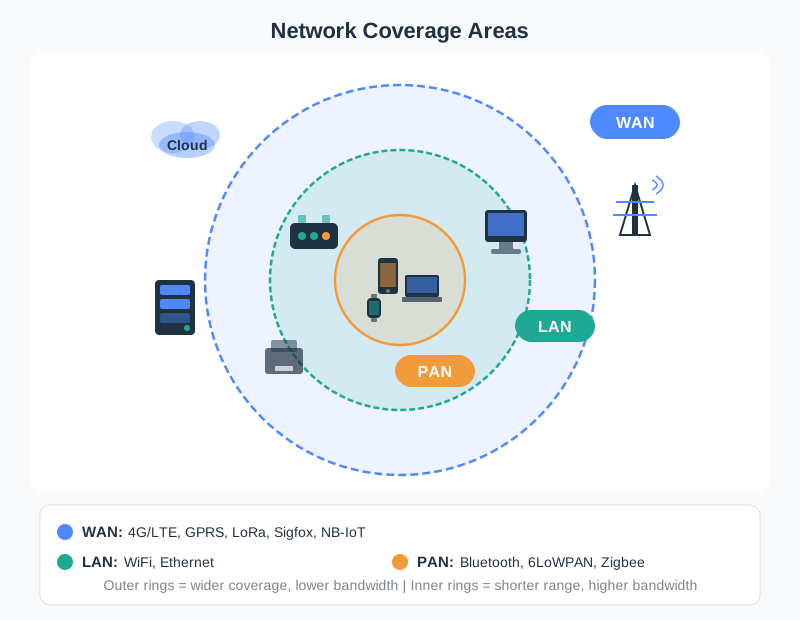
That labelled check bounds wan boundaries are gateway, operator, backhaul, roaming, and service-continuity boundaries.

  • A WAN device still depends on gateway density, operator coverage, spectrum rules, provisioning, and lifecycle continuity.
  • A short-range device may speak Bluetooth LE, Zigbee, Thread, or another local protocol, but the enterprise system often expects IP topics, HTTP APIs, MQTT messages, or database records.
  • Capacity Boundary A class can be correct while a deployment is still overloaded.
iotclass.org

Major section

Under The Hood: Each Class Hides A Boundary (continued)
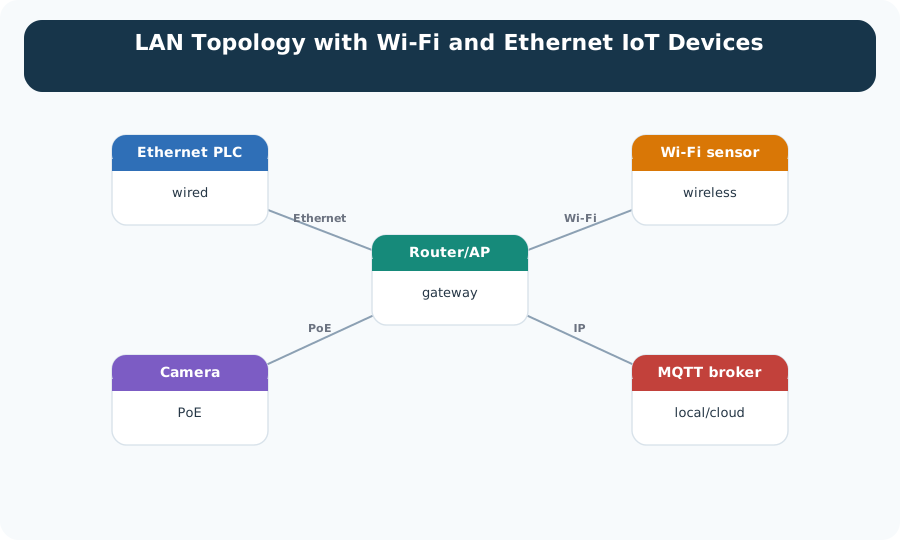
The phone, hub, border router, or gateway that performs that handoff changes addressing, trust, timing, retry behavior, and failure visibility.

  • When that boundary is not recorded, teams blame the "network class" even though the real problem is a pairing policy, gateway queue, credential rotation, backhaul outage, or missing device-to-cloud mapping.
  • Ethernet can remove radio uncertainty, but it introduces cable plant, PoE budget, switch-port, VLAN, and maintenance boundaries.
  • Wi-Fi can reuse building infrastructure, but access-point placement, channel planning, roaming behavior, and client density decide whether the class is actually adequate.
iotclass.org

Major section

Under The Hood: Each Class Hides A Boundary (continued)
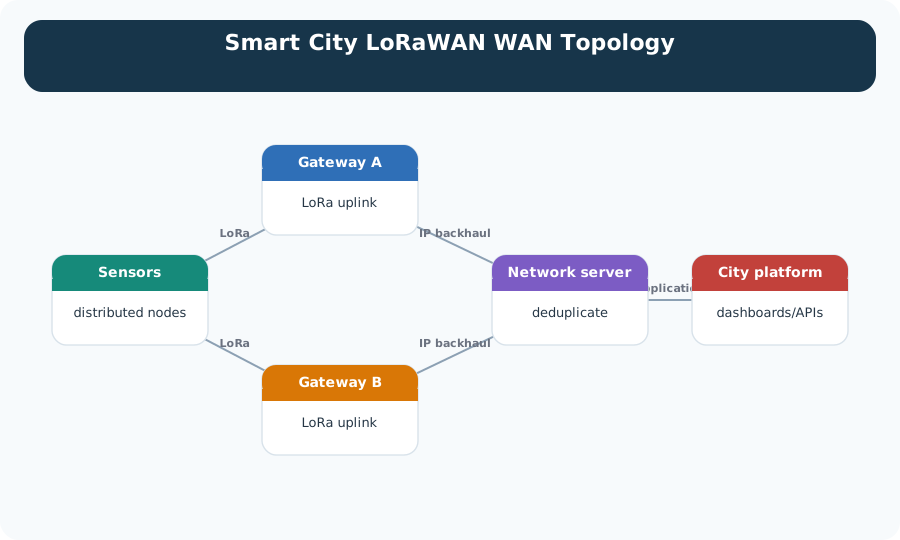
Cellular and LPWAN (LoRaWAN, Sigfox, NB-IoT, or a narrower option such as Weightless) can reach remote assets, but SIM provisioning, roaming policy, regional spectrum rules, gateway density, payload limits, and operator lifecycle become design dependencies.

  • The classification is credible only when those dependencies are visible and testable, so boundary review becomes part of the architecture rather than a note for later.
  • The decision in under the hood: each class hides a boundary must preserve that labelled boundary.
  • That visual pairing grounds lan boundaries are access-point, switch, cable, power, and building-coverage boundaries in named evidence.
iotclass.org

Major section

Under The Hood: Each Class Hides A Boundary (continued)

Locate LAN Topology with Wi-Fi and Ethernet IoT Devices on Figure: LAN boundaries are access-point before checking: Ethernet.

  • The visual's third anchor,: Wi-Fi, completes lan boundaries are access-point, switch, cable, power, and building-coverage boundaries.
  • Carry: LAN Topology with Wi-Fi and Ethernet IoT Devices into under the hood: each class hides a boundary; use: Wi-Fi as its limiting condition.
  • Smart City LoRaWAN WAN Topology supplies one named condition;: LoRa supplies the necessary comparison for wan boundaries are gateway, operator, backhaul, roaming, and service-continuity boundaries.
iotclass.org

Major section

Phoebe's Field Notes: Why a Weak Path Costs Battery, Not Just Signal

The mathematical gist.: A 2400 mAh, 3.6 V cell stores a nameplate 8.64 Wh, but five years of 0.7% annual self-discharge plus a 15% reserve leaves about 1970 mAh.

  • LoRa symbol time is $2^{SF}/BW$, so moving from SF7 to SF12 multiplies airtime and the matching transmit-energy term by $2^5=32$; reach, rate, and energy must therefore be classified together.

Numbers to remember

3.6 V3.6 V cell stores a nameplate 8.64 Wh
8.64 Wh3.6 V cell stores a nameplate 8.64 Wh
iotclass.org

Major section

Physical Media and the Interface Boundary

The IP payload survives, but each link removes and creates its own link frame and physical symbols.

  • The same packet can cross copper, fibre, and radio without the application changing its meaning.
  • The controller adds or checks link framing and moves bits to the PHY.
  • A network interface card is one implementation of that boundary.
iotclass.org

Deck summary

Key takeaways

A network name is not evidence of reach or safe recovery.

  • These devices share a site, but they do not share one network job.
  • Network classification is a shortcut for reasoning about reach, bandwidth, power, ownership, mobility, and failure boundaries.
  • The first decision is the communication job: how far the device must reach, how much data it sends, how often it wakes, whether it moves, who owns the infrastructure, and what happens when coverage is weak.
  • Those diagram labels establish the scope of the common trade is reach versus throughput, with power and ownership deciding which option is realistic.
iotclass.org

Retrieval practice

Recall check 1 of 3

Packet Pete says: answer from memory, then check your reasoning.

Q1A badge sends a small identifier to a phone or doorway reader inside a building. Which classification question should come first?

AWhich cellular plan gives the badge the highest peak WAN rate?
BCan a PAN path meet badge range, battery, gateway, and handoff needs before adding LAN or WAN?
CCan the badge skip gateways and send each identifier directly to cloud services?
DCan the badge use the building's default class without checking reader boundaries?
Show answer

Answer: B Classify from the device's real communication job: reach, payload, power, gateway boundary, mobility, ownership, and reliability.

iotclass.org

Retrieval practice

Recall check 2 of 3

Packet Pete says: answer from memory, then check your reasoning.

Q2A campus design includes low-power room sensors, PoE security cameras, and shuttle tracking. Which classification decision is strongest?

APut every device on LPWAN because the campus is physically large.
BPut every device on Wi-Fi because the campus already has access points.
CChoose the class with the broadest advertised coverage and ignore payload cadence.
DUse PAN or mesh for low-power sensors, LAN or Ethernet for cameras, and WAN for moving shuttles.
Show answer

Answer: D IoT systems often combine PAN, LAN, and WAN tiers.

iotclass.org

Retrieval practice

Recall check 3 of 3

Packet Pete says: answer from memory, then check your reasoning.

Q3Which review finding should fail a network classification decision before rollout?

AThe decision records range, payload cadence, power target, gateway boundary, ownership, and field coverage evidence.
BThe design mixes PAN, LAN, and WAN tiers because different devices have different traffic and mobility requirements.
CA range-only class choice with no field evidence.
DThe design uses Ethernet for high-bandwidth fixed cameras and a low-power mesh for sparse room sensors.
Show answer

Answer: C Classification decisions fail when they rely on class labels or range slogans instead of measured deployment requirements and boundary evidence.

iotclass.org

Print reference

Answers

Answer key.

  1. B · Classify from the device's real communication job: reach, payload, power, gateway boundary, mobility, ownership, and reliability.
  2. D · IoT systems often combine PAN, LAN, and WAN tiers.
  3. C · Classification decisions fail when they rely on class labels or range slogans instead of measured deployment requirements and boundary evidence.
iotclass.org