Core Networking · Study deck

Packet Switching and Performance

Picture an alarm waiting behind a large device update on the same link.

Packet Pete is your guide for this deck.

networkmechpacket
Packet Pete, the module guide, in a scene from this chapter.
iotclass.org

After studying this chapter

Learning objectives

You will be able to:

  • Explain: Output-only queueing exposes the extreme case: if every input sends to the same output at once, the output side would need speedup equal to the number of ports to absorb the whole burst.
  • Explain: A link can have enough nominal capacity and still fail a control-loop requirement if useful packets wait behind bulk traffic or spend too much of the budget on overhead and recovery.
  • Explain: IP routers at the core solve that differently: they build a forwarding table from routing protocol exchanges before traffic ever arrives, so a table lookup replaces a flood.
iotclass.org

Major section

Start With Many Small Decisions · Overview: Shared Links, Independent Packets
Both flows may arrive eventually while the alarm still misses its useful deadline.

  • Firmware means the software stored on a device that controls its hardware.
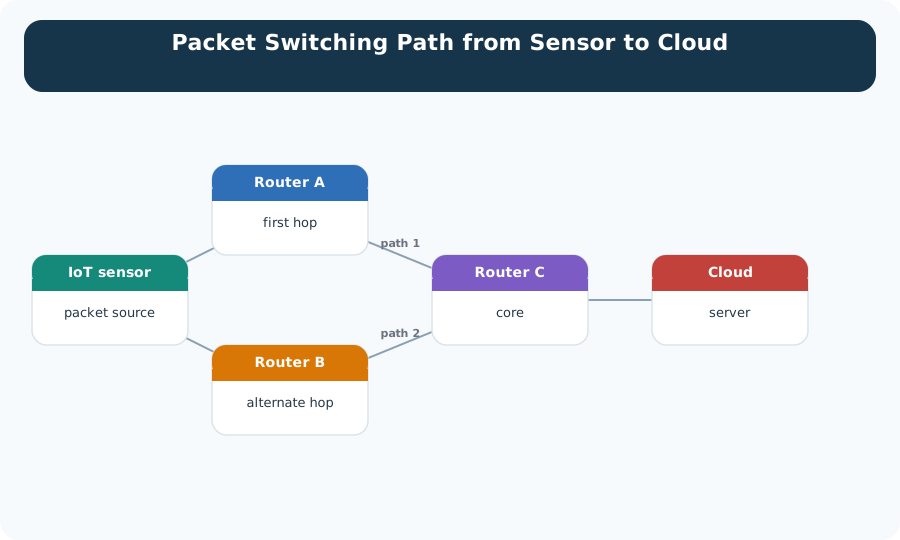
  • Each hop makes a local decision using addresses, tables, queues, and current load.
  • A router does not need to know the full application conversation.

Key terms

Packets from different devices
Packets from different devices are interleaved on the same link.

Why it matters

Packet switching works because a long conversation is split into small pieces that can be forwarded independently.

Each router forwards the packet based on header information and its current routing knowledge.
iotclass.org

Major section

Practitioner: Plan for Useful Capacity, Not Just Link Speed
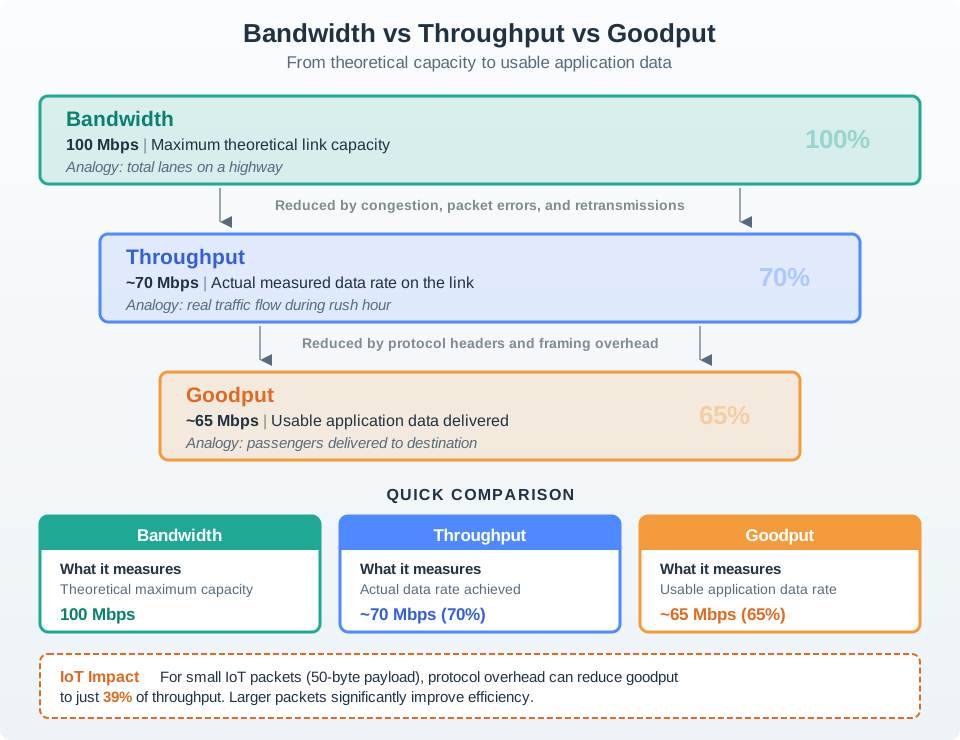
A packet-switched link can look healthy on a spec sheet and still disappoint an IoT workload.

  • The practical question is not only "how fast is the link?" It is "how much useful application data arrives on time while other flows, headers, retries, and queues are present?".
Bandwidth is capacity, throughput is what crosses the link, and goodput is the useful application data after overhead and recovery costs.
iotclass.org

Major section

Practitioner: Plan for Useful Capacity, Not Just Link Speed (continued)

Payload size, message rate, header stack, acknowledgement pattern, and useful records received.

  • Shared media rules, channel width, modulation, duplex limits, and physical impairments.
  • Contention, retransmissions, congestion, routing changes, and device processing limits.
  • The application payload rate after protocol overhead and failed delivery attempts are excluded.
iotclass.org

Major section

Practitioner: Plan for Useful Capacity, Not Just Link Speed (continued)

Small payloads, verbose encodings, security headers, acknowledgements, fragmentation, and duplicate sends.

  • Output queues, bursty traffic, radio sleep schedules, gateway CPU load, and path changes.
  • Timestamped send and receive events, queue depth, priority class, and route observations.
  • Separate small control traffic Control commands and alarms often need predictable delay more than raw bandwidth.
iotclass.org

Major section

Under the Hood: Forwarding Is a Series of Local Decisions

Packet switching feels end-to-end from the application view, but the network executes it as a chain of local choices.

  • At each hop, a device receives a packet, checks enough metadata to decide what to do, waits for an output opportunity, and either forwards, marks, delays, or drops the packet.

Key terms

When an output link
When an output link is busy, packets wait.

Why it matters

Combined input-output queueing reduces that demand and can improve utilisation, but requires harder scheduling and backpressure logic.

Input interfaces and output interfaces connect through an internal backplane, which can be shared memory, a shared bus, or a switched bus depending on router capacity.
iotclass.org

Major section

Under the Hood: Forwarding Is a Series of Local Decisions (continued)

Queue: If the output is busy, the packet waits according to buffer limits and scheduling policy.

  • Those local choices depend on tables and state that are smaller than the full application conversation.
  • None of those devices needs to reconstruct the whole sensor workflow.
  • Recovery must come from transport or application behavior.
iotclass.org

Major section

Under the Hood: Forwarding Is a Series of Local Decisions (continued)

Queue placement changes the failure mode.

  • A router may use a forwarding table, a neighbor cache, a next-hop record, a hop-limit or TTL update, and optional quality-of-service markings.
  • Forward: The packet leaves on the selected interface, often with updated hop metadata.
  • The tradeoff is setup cost.
iotclass.org

Major section

Under the Hood: Forwarding Is a Series of Local Decisions (continued)

Queues create variable delay When an output link is busy, packets wait.

  • A constrained gateway may also decide whether a packet should cross from a low-power mesh into Ethernet, Wi-Fi, or a cellular backhaul.
  • They need enough header evidence to choose the next interface, enough buffer space to wait safely, and enough policy to reject traffic that should not pass.
  • The two layers forward packets by different rules.
iotclass.org

Major section

Under the Hood: Forwarding Is a Series of Local Decisions (continued)

Receive: The interface accepts a frame and performs link-layer checks before handing the enclosed packet to the forwarding path.

  • The wait changes with burst size, scheduling policy, retransmissions, and the traffic already ahead in the buffer.
  • Drops are part of the contract If a buffer is full, a link fails, or a policy rejects a packet, the packet can be discarded.
  • Ethernet switches at the edge are plug-and-play.
iotclass.org

Major section

Under the Hood: Forwarding Is a Series of Local Decisions (continued)

A high-capacity chassis uses switched fabrics and line cards so several ports can move traffic at once.

  • Not every hop makes its local decision the same way.
  • A network router is more than one input port and one output port.
  • That record connects forwarding mechanics to user-visible performance.
iotclass.org

Major section

Under the Hood: Forwarding Is a Series of Local Decisions (continued)

IP routers at the core solve that differently: they build a forwarding table from routing protocol exchanges before traffic ever arrives, so a table lookup replaces a flood.

  • An Ethernet switch needs no configuration to start forwarding; an IP router needs its routing state to be correct before it can look anything up.
  • A device that behaves correctly on one site's flat network can still need explicit routing to reach another building or a cloud region.
  • A small router may share memory or a bus for this transfer.
iotclass.org

Major section

Under the Hood: Forwarding Is a Series of Local Decisions (continued)

The data plane applies those tables at line rate: classify, queue, forward, mark, or drop.

  • Physical interfaces receive frames, line cards hold queues and forwarding hardware, and an internal backplane or switch fabric moves packets between those interfaces.
  • A switched backplane behaves like a small point-to-point network inside the router: disjoint input-output pairs can transfer simultaneously.
  • The control plane computes routes, learns topology, and updates forwarding tables.
iotclass.org

Major section

Under the Hood: Forwarding Is a Series of Local Decisions (continued)

Carry: Typical router architecture into router internals: queues, backplane, and planes; use device as its limiting condition.

  • Output-only queueing exposes the extreme case: if every input sends to the same output at once, the output side would need speedup equal to the number of ports to absorb the whole burst.
  • That visual pairing grounds input interfaces and output interfaces connect through an internal backplane, which can be shared memory, a shared bus, or a switched bus depending in named evidence.
  • The decision in router internals: queues, backplane, and planes must preserve that labelled boundary.
iotclass.org

Major section

Under the Hood: Forwarding Is a Series of Local Decisions (continued)

The visual's third anchor, device, completes input interfaces and output interfaces connect through an internal backplane, which can be shared memory, a shared bus, or a switched bus depending.

  • An input-queued router can be simple, but a packet waiting for one busy output can hold packets behind it that were destined for free outputs.
  • Output queues avoid that particular block by collecting packets at the egress side, but they require enough fabric and buffer capacity to absorb bursts.
  • That sequence keeps router internals: queues, backplane, and planes tied to what is visibly labelled.
iotclass.org

Major section

Summary · Key Takeaway

Packet switching lets many IoT flows share the same network by forwarding independent packets instead of reserving a dedicated circuit for each conversation.

  • Routers make local forwarding decisions from packet headers, while queues, retries, overhead, and path changes determine the performance that applications actually experience.
  • A link can have enough nominal capacity and still fail a control-loop requirement if useful packets wait behind bulk traffic or spend too much of the budget on overhead and recovery.
  • Packet switching scales IoT because shared links can carry many bursty flows, but shared links also create queueing, overhead, and loss tradeoffs.
iotclass.org

Deck summary

Key takeaways

Both flows may arrive eventually while the alarm still misses its useful deadline.

  • A packet-switched link can look healthy on a spec sheet and still disappoint an IoT workload.
  • Payload size, message rate, header stack, acknowledgement pattern, and useful records received.
  • Small payloads, verbose encodings, security headers, acknowledgements, fragmentation, and duplicate sends.
  • Packet switching feels end-to-end from the application view, but the network executes it as a chain of local choices.
iotclass.org

Retrieval practice

Recall check 1 of 3

Packet Pete says: answer from memory, then check your reasoning.

Q1A building gateway carries camera packets, thermostat readings, and control acknowledgements over the same uplink. Which packet switching idea makes that sharing possible?

APackets from different flows can be interleaved on a shared link
BEach device receives a dedicated physical circuit for the full conversation
CRouters must inspect every application payload before forwarding
DAll packets from one conversation must follow exactly the same route
Show answer

Answer: A Packet switching uses multiplexing: each flow sends packets when it has data, and the shared link carries those packets in turn.

iotclass.org

Retrieval practice

Recall check 2 of 3

Packet Pete says: answer from memory, then check your reasoning.

Q2A factory dashboard reports that command messages arrive with uneven delay during a camera upload, even though the uplink has enough nominal bandwidth. What should you inspect first?

AQueue depth, retry evidence, and goodput for the command traffic
BOnly the advertised bandwidth of the uplink
CWhether every packet follows a reserved circuit through the network
DWhether camera packets and command packets use identical payload sizes
Show answer

Answer: A Uneven delay usually points to contention, retries, or queueing.

iotclass.org

Retrieval practice

Recall check 3 of 3

Packet Pete says: answer from memory, then check your reasoning.

Q3A router receives an IoT packet while the selected output link is busy. What packet-switching behavior best explains the extra delay?

AIt queues until the output link can forward it.
BThe router reserves a new private circuit before any other packet can move
CThe packet header is removed so the payload can choose its own route
DAll later packets must be blocked forever because one output was busy
Show answer

Answer: A Queueing delay is introduced when a packet has a chosen output path but must wait behind other traffic or scheduling rules.

iotclass.org

Print reference

Answers

Answer key.

  1. A · Packet switching uses multiplexing: each flow sends packets when it has data, and the shared link carries those packets in turn.
  2. A · Uneven delay usually points to contention, retries, or queueing.
  3. A · Queueing delay is introduced when a packet has a chosen output path but must wait behind other traffic or scheduling rules.
iotclass.org