Core Networking · Study deck

Datagrams and Packet Structure

A payload is the useful data carried inside a message.

Packet Pete is your guide for this deck.

networkmechdatagrams
Packet Pete, the module guide, in a scene from this chapter.
iotclass.org

After studying this chapter

Learning objectives

You will be able to:

  • Explain: Those diagram labels establish the scope of packet overhead is a release constraint, not just a network detail. The same payload can have very different efficiency on different stacks.
  • Explain: Its diagram makes Datagram Structure and: Source explicit within a datagram separates delivery metadata from payload data, so routers can forward the packet without understanding the application message.
  • Explain: That labelled check bounds encapsulation wraps the payload at each layer. A small sensor value becomes a larger frame after transport, network, and link metadata are added.
  • Explain: A size calculation cannot prove delivery on its own.
iotclass.org

Major section

Start With the Packet Budget

The program reports ten bytes, but the link must also carry addresses, order details, checks, and security data.

  • If the packet does not fit, it may split into parts, and losing one part can waste the whole message.
  • A size calculation cannot prove delivery on its own.
  • Every datagram has a size, a set of headers, and a path that may or may not tolerate fragmentation.
iotclass.org

Major section

Overview: Datagrams Make Packets Self-Contained
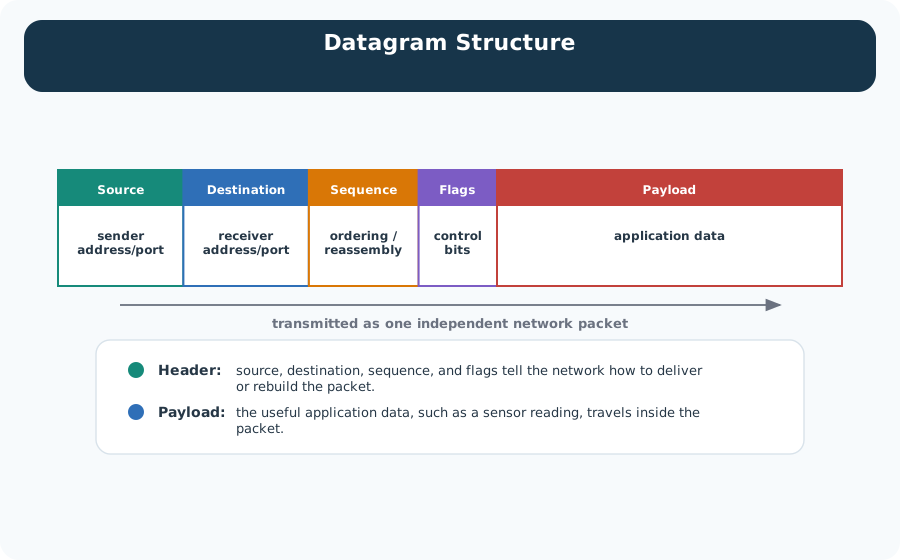
Its diagram makes Datagram Structure and: Source explicit within a datagram separates delivery metadata from payload data, so routers can forward the packet without understanding the application message.

  • The decision in overview: datagrams make packets self-contained must preserve that labelled boundary.
A datagram separates delivery metadata from payload data, so routers can forward the packet without understanding the application message.
iotclass.org

Major section

Practitioner: Budget the Packet Before Release
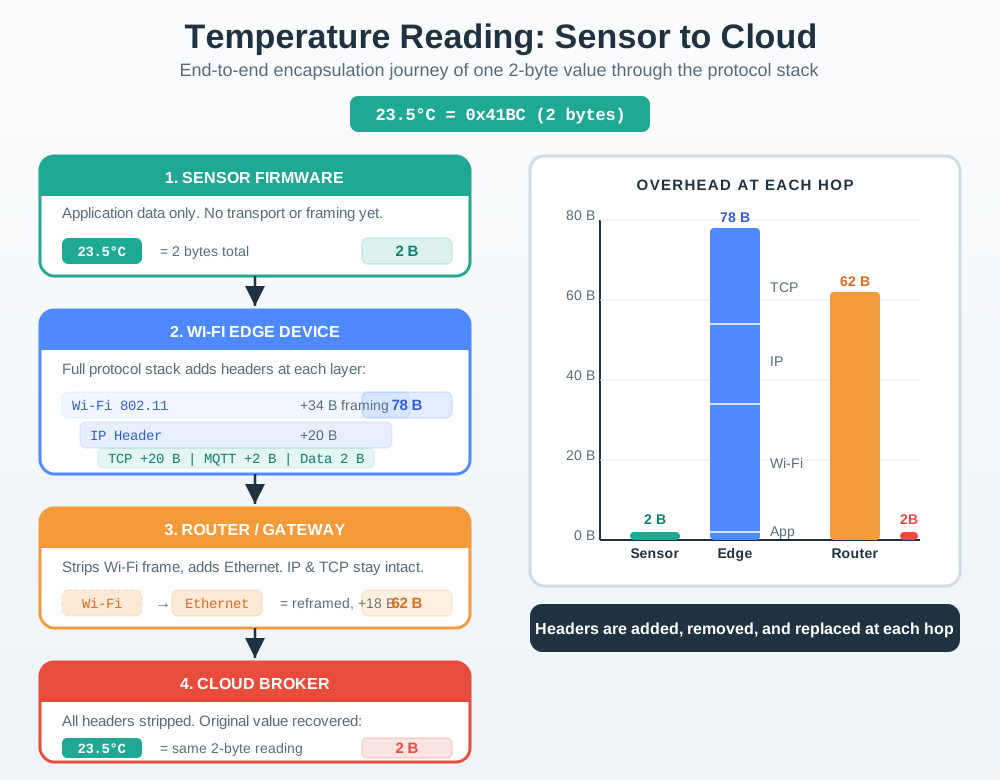
That labelled check bounds encapsulation wraps the payload at each layer. A small sensor value becomes a larger frame after transport, network, and link metadata are added.

  • Those diagram labels establish the scope of packet overhead is a release constraint, not just a network detail. The same payload can have very different efficiency on different stacks.
Encapsulation wraps the payload at each layer. A small sensor value becomes a larger frame after transport, network, and link metadata are added.
iotclass.org

Major section

Budget a Seventeen-Byte Reading

With a 20-byte IPv4 header and an 8-byte UDP header, the network datagram is 17+20+8=45 bytes before link overhead.

  • Packet structure routes bytes; the payload contract gives those bytes meaning.

Numbers to remember

170 bytesSending ten readings together would make the payload 170 bytes
A datagram separates delivery metadata from payload data, so routers can forward the packet without understanding the application message.
iotclass.org

Major section

Summary

Datagrams are the packet unit that makes packet-switched IoT networking practical.

  • A datagram carries delivery metadata in its header and useful application data in its payload.
  • Each layer wraps the payload it receives, so the final frame on the wire includes transport, network, adaptation, security, and link overhead.
  • For IoT systems, packet structure is a design constraint.
iotclass.org

Deck summary

Key takeaways

The program reports ten bytes, but the link must also carry addresses, order details, checks, and security data.

  • Its diagram makes Datagram Structure and: Source explicit within a datagram separates delivery metadata from payload data, so routers can forward the packet without understanding the application message.
  • That labelled check bounds encapsulation wraps the payload at each layer. A small sensor value becomes a larger frame after transport, network, and link metadata are added.
  • With a 20-byte IPv4 header and an 8-byte UDP header, the network datagram is 17+20+8=45 bytes before link overhead.
iotclass.org

Retrieval practice

Recall check 1 of 3

Packet Pete says: answer from memory, then check your reasoning.

Q1What is the main reason a datagram carries addressing information in its header?

ASo each packet can be forwarded independently without a pre-established circuit
BSo the application payload can be encrypted by every router on the path
CSo all packets from one message must follow the same physical path
DSo UDP can guarantee delivery order without extra application logic
Show answer

Answer: A A datagram is self-contained: routers can inspect the network-layer header and forward the packet without reserving a path first.

iotclass.org

Retrieval practice

Recall check 2 of 3

Packet Pete says: answer from memory, then check your reasoning.

Q2A sleepy mesh sensor sends a status message that becomes larger than the smallest link MTU after security and adaptation headers are added. What is the best first design response?

AKeep the message as one packet and rely on IP fragmentation for routine delivery
BReduce or split the application payload so each chunk fits the path budget
CRemove destination addressing from the header to recover payload bytes
DAssume the gateway will always reassemble fragments without extra latency or loss
Show answer

Answer: B Application-aware chunking gives you control over message boundaries, retries, and priority while avoiding accidental lower-layer fragmentation.

iotclass.org

Retrieval practice

Recall check 3 of 3

Packet Pete says: answer from memory, then check your reasoning.

Q3A gateway receives UDP packets from a sensor, but the application sometimes sees missing or out-of-order readings. Which interpretation is most technically sound?

AThe network layer is broken because datagrams are required to arrive in order
BUDP should be expected to reorder the stream before handing data to the application
CThe application should include a sequence or message ID if ordering and loss detection matter
DAdding more header bytes always improves ordering because routers can store more state
Show answer

Answer: C A sequence number or message ID lets the receiver detect gaps, duplicates, and reordering without assuming the network provides those guarantees.

iotclass.org

Print reference

Answers

Answer key.

  1. A · A datagram is self-contained: routers can inspect the network-layer header and forward the packet without reserving a path first.
  2. B · Application-aware chunking gives you control over message boundaries, retries, and priority while avoiding accidental lower-layer fragmentation.
  3. C · A sequence number or message ID lets the receiver detect gaps, duplicates, and reordering without assuming the network provides those guarantees.
iotclass.org