Core Networking · Study deck
Data Representation in Networks
Picture a sensor sending the two bytes 00 FA through a site bridge to a dashboard.
Packet Pete is your guide for this deck.

After studying this chapter
Learning objectives
You will be able to:
- Explain: That visual pairing grounds encoding and decoding are boundary contracts. A payload is not complete until the receiver validates the decoded meaning in named evidence.
- Explain: A cold-room sensor sends two bytes, 09 C4, and the cloud must turn them back into the same temperature the device measured.
- Explain: The returning evidence rail sends failed vectors or contract changes back to the definition, connecting one golden payload to rollout and rollback decisions.
- Explain: Reversing the bytes gives 196 × 256+9=50{,}185, or 501.85 °C, which is valid arithmetic but the wrong data representation.
Major section
Start With What the Bits Mean
The bytes may arrive unchanged while one system reads 250 and another reads 25.0 degrees.
- A broker means a service that accepts and routes messages.
- A gateway means a device or service that joins two system paths.
- A payload means the useful reading or command carried inside a message.
Major section
Start With What the Bits Mean (continued)
Swap byte order, omit the unit, send an older layout, repeat a missing value, and restart the gateway.
- This runway does not prove trustworthy identity or delivery from correct decoding alone.
- The deeper sections explain bits, numbers, text, schemas, time, translation, version change, and boundary tests.
- A network can deliver bytes perfectly and still fail if the sender and receiver disagree about what those bytes mean.
Major section
Practitioner: Build the Encoding Review Record
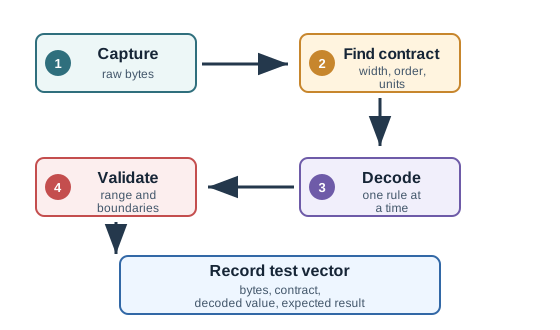
The fixed example makes sender and receiver agreement testable rather than leaving the schema as prose.
- The returning evidence rail sends failed vectors or contract changes back to the definition, connecting one golden payload to rollout and rollback decisions.
Major section
Under the Hood: Representation Fails at Boundaries
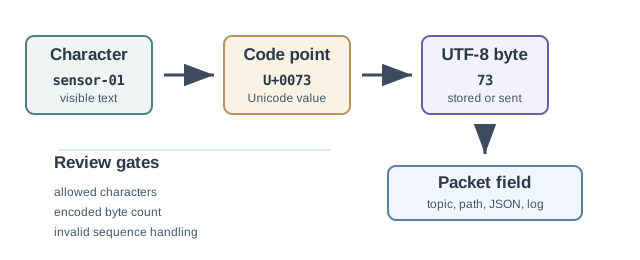
That visual pairing grounds encoding and decoding are boundary contracts. A payload is not complete until the receiver validates the decoded meaning in named evidence.
- That sequence keeps under the hood: representation fails at boundaries tied to what is visibly labelled.
Major section
Decode One Temperature Without Guessing
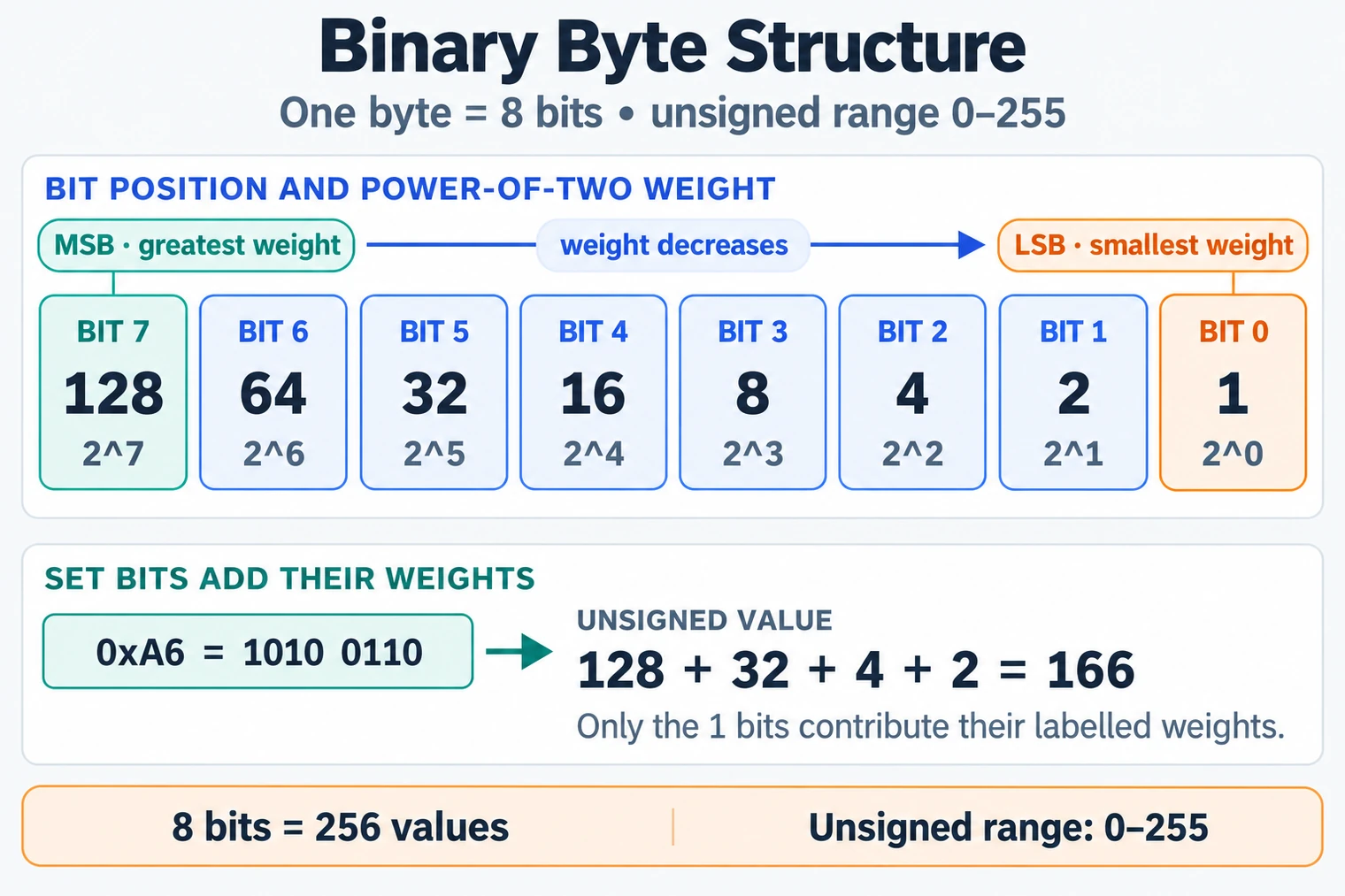
A cold-room sensor sends two bytes, 09 C4, and the cloud must turn them back into the same temperature the device measured.
- The value is 0x09 × 256+0xC4=9 × 256+196=2500.
- If the payload contract says hundredths of a degree, the decoded result is \(2500/100=25.00\ ^\circ\text{C}\).
Major section
Decode One Temperature Without Guessing (continued)
The schema decision changed how their top bit and remaining pattern were interpreted.
- Reversing the bytes gives 196 × 256+9=50{,}185, or 501.85 °C, which is valid arithmetic but the wrong data representation.
- The two bytes did not change.
- Transport can preserve every bit while the text encoding contract still fails.
Major section
Summary
Network data is useful only when raw bytes can be decoded into the intended field meaning.
- Bits and bytes provide the container; units, scale, byte order, schema, and versioning provide the interpretation.
- Encoding reviews should include sample payloads, decoder tests, invalid examples, and boundary notes.
- Gateways and storage systems can silently change identity, timestamps, units, precision, quality, and schema version.
Deck summary
Key takeaways
The bytes may arrive unchanged while one system reads 250 and another reads 25.0 degrees.
- Swap byte order, omit the unit, send an older layout, repeat a missing value, and restart the gateway.
- The fixed example makes sender and receiver agreement testable rather than leaving the schema as prose.
- That visual pairing grounds encoding and decoding are boundary contracts. A payload is not complete until the receiver validates the decoded meaning in named evidence.
- A cold-room sensor sends two bytes, 09 C4, and the cloud must turn them back into the same temperature the device measured.
Retrieval practice
Recall check 1 of 3

Packet Pete says: answer from memory, then check your reasoning.
Q1A gateway receives the two bytes 00 FA from a sensor. What must the team know before treating the value as a temperature reading?
Show answer
Answer: B A payload is trustworthy only when the receiver knows how to decode the bytes into the intended field meaning.
Retrieval practice
Recall check 2 of 3

Packet Pete says: answer from memory, then check your reasoning.
Q2A team wants to replace readable JSON telemetry with a compact binary payload. Which review artifact is most important before rollout?
Show answer
Answer: C Encoding changes should be approved with a testable payload contract, not only with size or throughput arguments.
Retrieval practice
Recall check 3 of 3

Packet Pete says: answer from memory, then check your reasoning.
Q3A cloud service receives packets reliably, but values from one firmware family are decoded incorrectly after a schema change. What is the strongest diagnosis?
Show answer
Answer: D Representation failures often appear after delivery succeeds.
Print reference
Answers
Answer key.
- B · A payload is trustworthy only when the receiver knows how to decode the bytes into the intended field meaning.
- C · Encoding changes should be approved with a testable payload contract, not only with size or throughput arguments.
- D · Representation failures often appear after delivery succeeds.