Core Networking · Study deck
Converged Networks and QoS
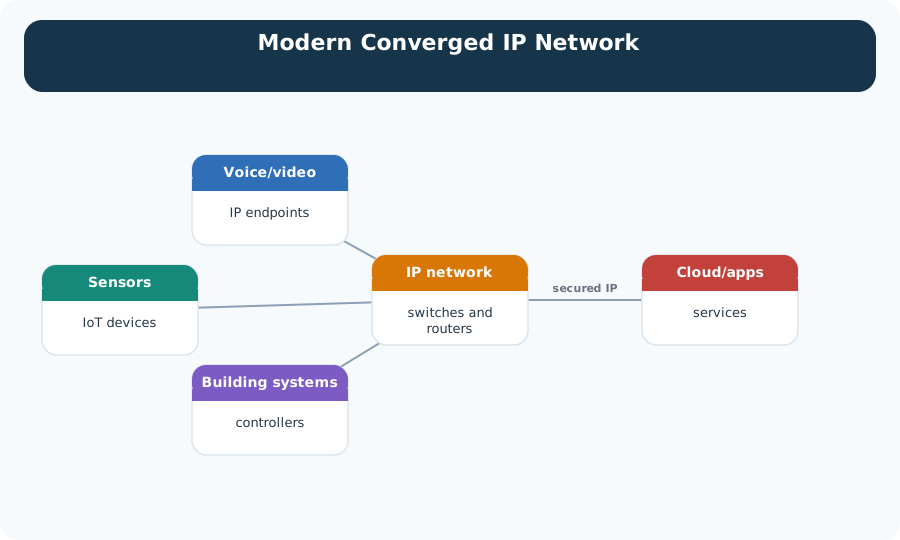
A building carries video, office traffic and door alarms over one network.
Packet Pete is your guide for this deck.

After studying this chapter
Learning objectives
You will be able to:
- Explain: For each hop, ask: where will this flow go, what will change, which mapping will be retained, and which policy may stop it?: A forwarding function needs a lookup result and outbound interface.
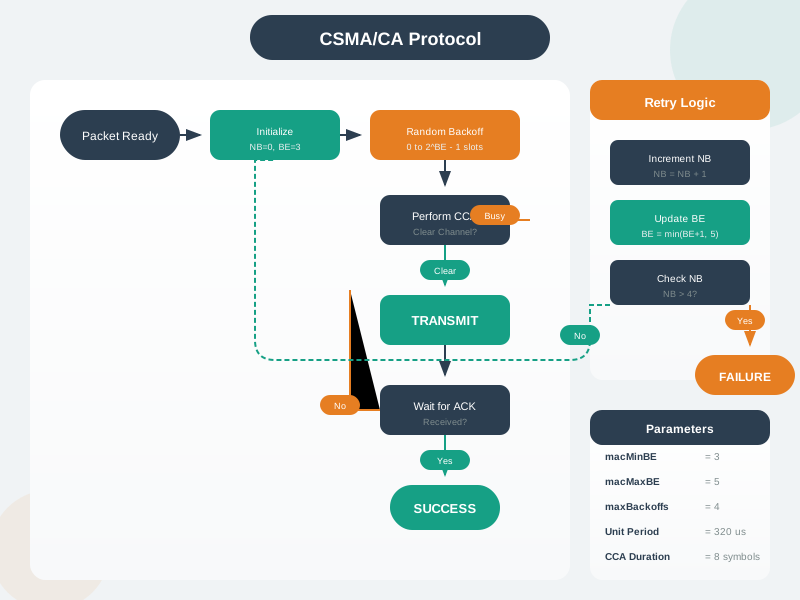
- Explain: The visual's third anchor,: MAC profile sets exact counters and timings, completes on shared wireless channels, devices listen before transmitting and use random backoff to reduce repeated collisions.
- Explain: A converged design can contain routers, Layer-3 switches, load balancers, firewalls, NAT, wireless controllers, voice gateways, intrusion-detection systems, proxies, access-control services, and many other named appliances.
- explain converged network tradeoffs
Major section
Start With Traffic That Competes
During an incident, the camera load rises and the door event waits behind less urgent work.
- A label alone does not reserve space.
- Firmware is the built-in software that controls a device.: Schedule a large firmware job in the trial, then break one path.
- One load test cannot cover every burst or shared queue.
Major section
Start With Traffic That Competes (continued)
A converged network carries different kinds of traffic over shared infrastructure.
- A sensor alarm, maintenance laptop, camera feed, voice call, and cloud sync may all want the same capacity at the same time.
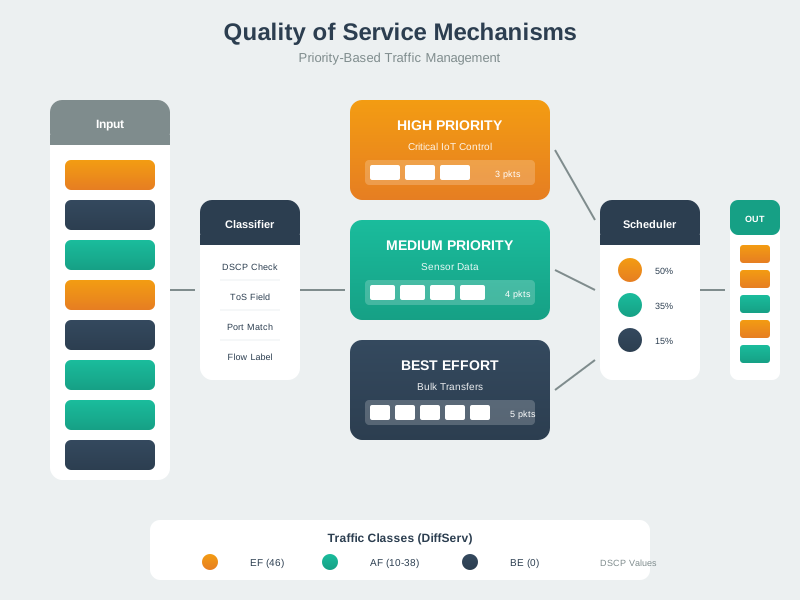
- QoS is the decision about what gets protected when the network is busy.
- The useful design story names the traffic classes, proves the bottlenecks, and shows how priority rules behave under load.
Major section
Overview: One Fabric, Many Traffic Classes
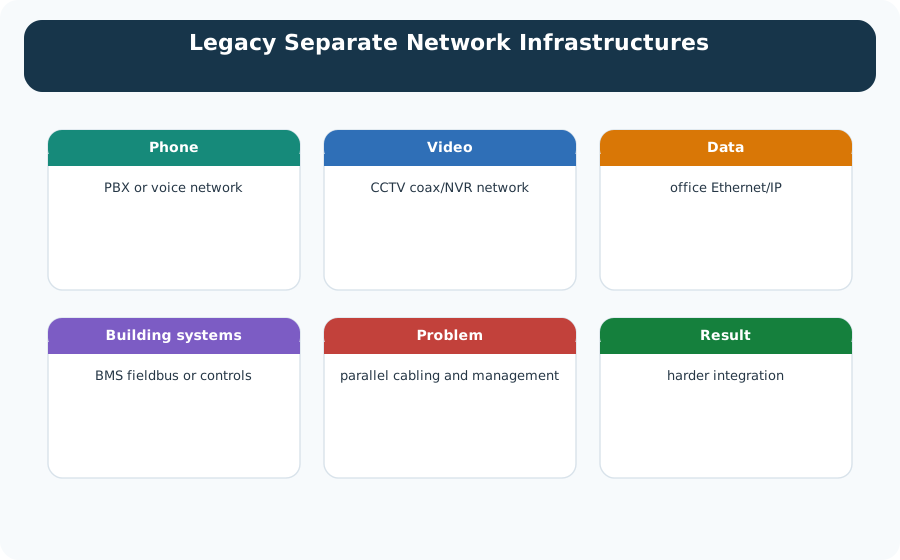
The visual's third anchor,: PBX or voice network, completes separate networks provide natural isolation, but they duplicate cabling, tools, skills, and maintenance contracts.
- Carry: Legacy Separate Network Infrastructures into overview: one fabric, many traffic classes; use: PBX or voice network as its limiting condition.
Major section
Under The Hood: Shared Media And Shared Queues
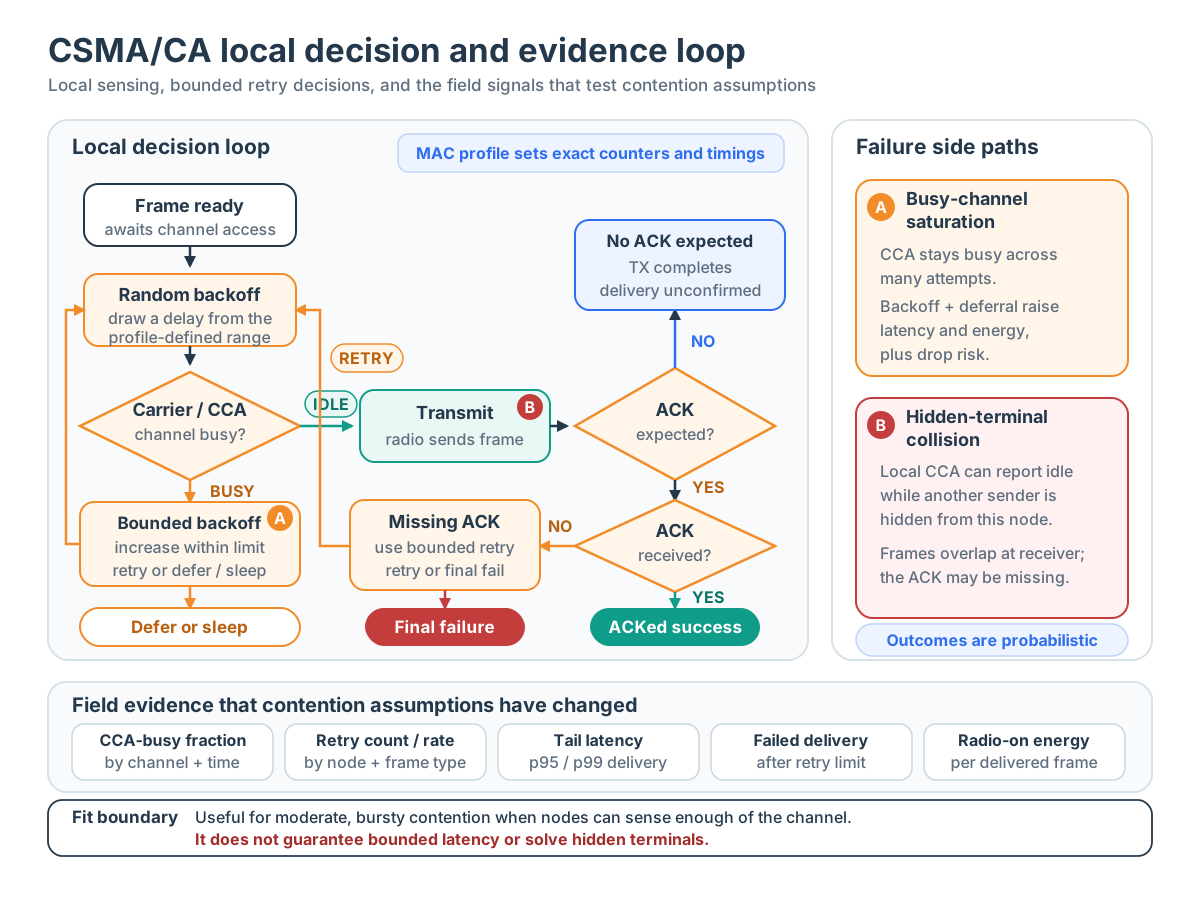
The visual's third anchor,: MAC profile sets exact counters and timings, completes on shared wireless channels, devices listen before transmitting and use random backoff to reduce repeated collisions.
- The visual evidence for under the hood: shared media and shared queues sits in Figure: Segmentation and queue policy let multiple services share.
Major section
Classify Network Functions Before Device Names
A converged design can contain routers, Layer-3 switches, load balancers, firewalls, NAT, wireless controllers, voice gateways, intrusion-detection systems, proxies, access-control services, and many other named appliances.
- The source's useful simplification is to review the function separately from the box.
- Shared hardware and network-function virtualization can place several functions on one platform, while one product name can hide several different decisions.
- One device can occupy more than one row.
Major section
Under the Hood: Four Runtime Questions
For each hop, ask: where will this flow go, what will change, which mapping will be retained, and which policy may stop it?: A forwarding function needs a lookup result and outbound interface.
- Processing needs an operation and proof of the resulting content.
- Translation needs the before-and-after form plus any retained state.
- Isolation needs the fields examined, matching rule, and final forward-or-filter decision.
Major section
Keep a Camera Burst out of the Alarm Queue
The upload contains 8,000,000 bits, so draining it takes 0.8 s before other traffic and overhead.
- A small alarm placed behind the whole backlog can therefore wait far longer than its own transmission time.
- A 100-byte alarm is only 800 bits, taking 80 microseconds at that link rate before overhead.
- The complete delay still includes classification, switching and later hops.
Major section
Keep a Camera Burst out of the Alarm Queue (continued)
Priority queueing can move the alarm ahead of waiting low-priority packets, but it does not automatically interrupt a frame already being transmitted.
- Under an illustrative 1,500-byte frame size, that serialization delay is 12,000 bits divided by 10,000,000 bits per second = 1.2 ms.
- The chapter's four function classes make the treatment inspectable.
- Forwarding selects the output; processing may mark traffic; translation may change headers; isolation applies the policy that admits or rejects priority use.
- An unpoliced priority queue can become another congested queue, so the classifier needs a trusted basis and enforced limits.
Major section
Keep a Camera Burst out of the Alarm Queue (continued)
Segmentation may isolate traffic policy, but it does not create another physical path around that dependency.
- A policy name such as high priority is not evidence that every hop gave the flow the same treatment.
- The module's convergence argument is about sharing managed infrastructure while retaining distinct service needs.
- Video can often wait for bulk transfer; a door alarm has a tighter timing contract.
Deck summary
Key takeaways
During an incident, the camera load rises and the door event waits behind less urgent work.
- A converged network carries different kinds of traffic over shared infrastructure.
- The visual's third anchor,: PBX or voice network, completes separate networks provide natural isolation, but they duplicate cabling, tools, skills, and maintenance contracts.
- The visual's third anchor,: MAC profile sets exact counters and timings, completes on shared wireless channels, devices listen before transmitting and use random backoff to reduce repeated collisions.
- The upload contains 8,000,000 bits, so draining it takes 0.8 s before other traffic and overhead.
Retrieval practice
Recall check 1 of 3

Packet Pete says: answer from memory, then check your reasoning.
Q1A smart building moves phones, cameras, HVAC controllers, access-control panels, guest Wi-Fi, and environmental sensors onto one IP network. Which design statement is strongest?
Show answer
Answer: B Converged IoT networks reduce duplicated infrastructure, but they still need logical segmentation, QoS, and monitoring evidence to preserve service behavior.
Retrieval practice
Recall check 2 of 3

Packet Pete says: answer from memory, then check your reasoning.
Q2A factory gateway sends emergency-stop commands and routine temperature telemetry across the same uplink. During firmware rollouts the uplink becomes congested. What should the converged-network evidence record show?
Show answer
Answer: B A practical converged-network record ties each traffic class to segmentation, queue treatment, rate controls, and load-test evidence.
Retrieval practice
Recall check 3 of 3

Packet Pete says: answer from memory, then check your reasoning.
Q3Which finding should fail a converged IoT network review?
Show answer
Answer: C Converged networks fail reviews when they collapse isolation, trust unverified priority markings, or lack load-test evidence for critical traffic classes.
Print reference
Answers
Answer key.
- B · Converged IoT networks reduce duplicated infrastructure, but they still need logical segmentation, QoS, and monitoring evidence to preserve service behavior.
- B · A practical converged-network record ties each traffic class to segmentation, queue treatment, rate controls, and load-test evidence.
- C · Converged networks fail reviews when they collapse isolation, trust unverified priority markings, or lack load-test evidence for critical traffic classes.