Design Methodology · Study deck
Network Design: Tail Risk and Scope
A network that meets its average target may still fail its worst users.
Blueprint Bina is your guide for this deck.

After studying this chapter
Learning objectives
You will be able to:
- Explain why IoT network design follows an evidence route rather than a single topology drawing.
- Identify the questions that must be answered before choosing a protocol, topology, gateway plan, or simulator.
- Distinguish paper design, simulation, packet capture, field pilot, and operations evidence.
- Recognize when a network claim is too vague to support deployment.
Major section
Start With One Message That Must Arrive
A gateway is the local point that joins device links to another network.
- Latency is the time a message takes to arrive.
- A payload is the useful data in that message.
- A short path may have a weak link.
- A strong radio may waste battery.
Major section
Start With One Message That Must Arrive (continued)
A fast plan may fail when many alarms start together or when the local link to the wider network is lost.
- This one-message story cannot choose a full design.
- Models can answer some questions, but only bench and field work can settle physical claims.
- A neat map is only a first guess.
Major section
Start With Communication Promise
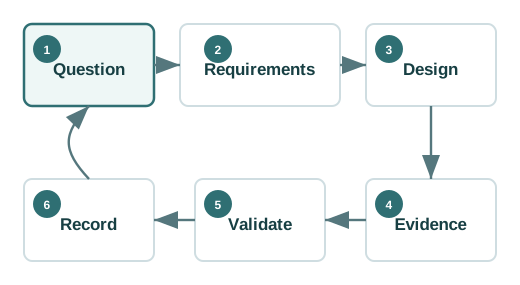
Network design begins by naming what communication must reliably happen, not by choosing a fashionable topology.
- A freezer alarm, a soil sensor, a smart-lighting command, and a factory vibration stream all need different latency, power, reliability, ownership, and recovery behavior.
- The freezer case turns the need into delivery within two minutes during shift change.
Major section
Start With Communication Promise (continued)
Hard-case proof, not a protocol name or mean result, must support the network.
- A warehouse freezer alarm might promise that an exception reaches the dashboard and duty phone within two minutes even during shift change.
- That claim can fail or pass.
- The review takes those results back to the first promise.
Major section
Start With Communication Promise (continued)
A campus air-quality node might promise that fifteen-minute readings are eventually delivered, flagged when stale, and locally buffered during a Wi-Fi outage.
- Those two promises can both be "IoT telemetry," but they lead to different protocol, power, storage, alerting, and support choices.
- The design record keeps assumptions, limits, and open risks.
- Evidence planning decides which claims need a paper calculation, site walk, RF survey, packet capture, simulation, pilot log, or operations metric.
Major section
Match Protocols to Site Risk
Different IoT networks fail in different ways, so the practitioner layer is about matching evidence to the failure mode instead of collecting generic artifacts.
- LoRaWAN star-of-stars designs depend on gateway placement, link budget, spreading factor, duty cycle, Adaptive Data Rate behavior, join capacity, duplicate reception, and gateway backhaul reliability.
- Evidence should match the risk.
- RF surveys help with placement and interference, but they cannot prove firmware sleep-state behavior.
Major section
Match Protocols to Site Risk (continued)
Zigbee, Thread, BLE Mesh, and RPL/6LoWPAN designs depend on powered-router density, parent choice, route repair, sleepy-node polling, multicast behavior, and interference from Wi-Fi or industrial equipment.
- RSSI/SNR logs and spreading-factor distributions help explain weak LPWAN links, but they do not prove application queueing or alarm handling.
- Packet captures help explain MQTT publish/ack timing, CoAP retransmissions, TCP reconnects, TLS handshake cost, DHCP lease recovery, or DNS lookup delay, but they do not show future seasonal coverage.
- Pilot logs show whether installation, maintenance, ownership, and support workflows can keep the network healthy after the first demonstration.
Major section
Validate Tail, Not Average
Mean latency can hide delayed alarms.
- Average packet delivery can hide one basement, freezer room, pump house, or loading bay.
- Average gateway load can hide a join storm after a power outage.
- Average current can hide retry bursts that shorten battery life.
- A poor SNR distribution might move a LoRaWAN gateway or change ADR policy.
Major section
Validate Tail, Not Average (continued)
Slow route repair might add powered Thread routers or split a Zigbee network.
- Long MQTT reconnects might change keepalive, session expiry, broker placement, or local buffering.
- A high current tail might change sampling rate, retransmission limits, firmware sleep states, or the battery-maintenance promise.
- The under-the-hood record should also state the model limits.
Major section
Validate Tail, Not Average (continued)
This prevents a design basis from overstating certainty.
- If a tool such as ns-3, OMNeT++, Cooja, TOSSIM, Wireshark, tcpdump, a gateway console, or a cloud IoT platform dashboard contributed evidence, record what it could and could not observe.
- If a packet capture was taken near one gateway, say which locations and failure modes remain untested.
- Security boundaries: Include device identity, key rotation, certificate expiry, broker ACLs, network segmentation, and support access in the network design.
Deck summary
Key takeaways
A gateway is the local point that joins device links to another network.
- A fast plan may fail when many alarms start together or when the local link to the wider network is lost.
- Network design begins by naming what communication must reliably happen, not by choosing a fashionable topology.
- Hard-case proof, not a protocol name or mean result, must support the network.
- A campus air-quality node might promise that fifteen-minute readings are eventually delivered, flagged when stale, and locally buffered during a Wi-Fi outage.
Retrieval practice
Recall check 1 of 3

Blueprint Bina says: answer from memory, then check your reasoning.
Q1A team wants to choose a mesh protocol before defining the alarm service. What should it write first?
Show answer
Answer: B The communication promise sets the criteria for later topology and protocol choices.
Retrieval practice
Recall checks 2–3 of 3
Blueprint Bina says: answer from memory, then check your reasoning.
Q2An LPWAN survey shows good signal strength. What does it still fail to prove about an alarm service?
Show answer
Answer: B RF evidence explains link behavior but does not establish the full application path.
Q3A network has good mean latency but misses alarms in a freezer room. Which review best exposes the problem?
Show answer
Answer: D The chapter warns that averages can hide weak places and delayed alarms.
Print reference
Answers
Answer key.
- B · The communication promise sets the criteria for later topology and protocol choices.
- B · RF evidence explains link behavior but does not establish the full application path.
- D · The chapter warns that averages can hide weak places and delayed alarms.