Design Methodology · Study deck
A Repeatable Design Method
A gateway is a point that joins device links to the next part of the system.
Blueprint Bina is your guide for this deck.

After studying this chapter
Learning objectives
You will be able to:
- Build an IoT network methodology around a specific decision, not a generic simulation exercise.
- Translate requirements into scenarios, model assumptions, metrics, and acceptance criteria.
- Select the right evidence level: paper analysis, simulator, packet capture, RF survey, pilot, or operations data.
- Review simulation results for reproducibility, sensitivity, validation, and decision relevance.
Major section
Start With the Decision Record · Phoebe's Field Notes: Why "Gateway Count" Is a Decibel Budget
A gateway is a point that joins device links to the next part of the system.
- Its site, load, power, and owner are part of the design.
- The real decision is not which tool can draw the best coverage map.
Major section
Network Evidence Methodology
A network design method prevents the team from treating a diagram, simulation run, or vendor claim as a decision.
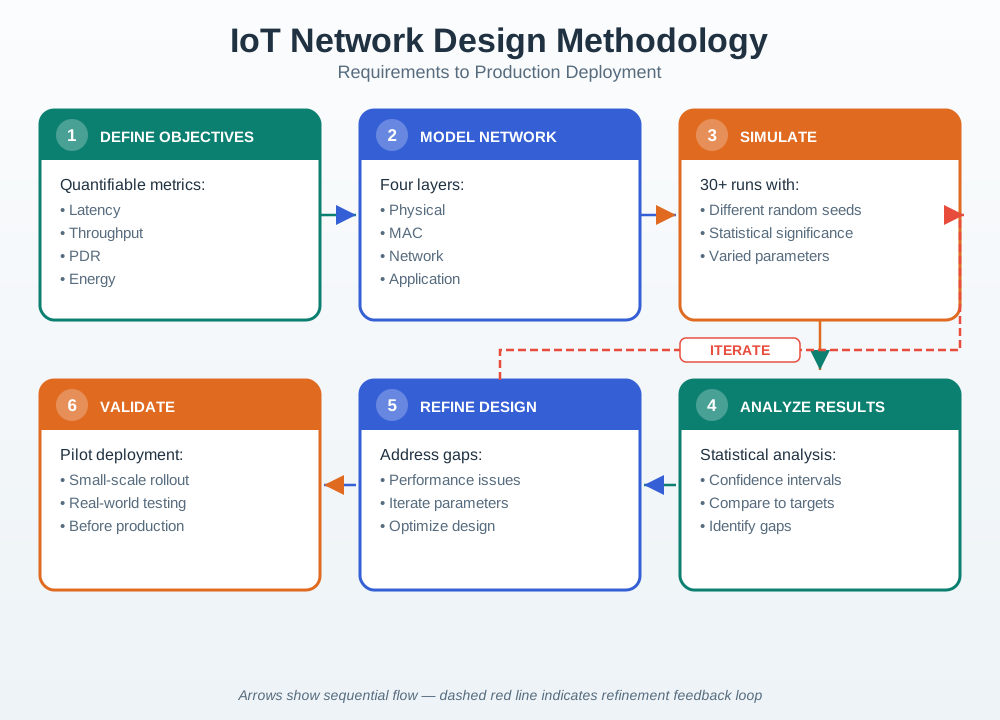
- The method starts with the decision to be made, defines the system boundary, chooses scenarios that represent real operating conditions, and records what the evidence can and cannot prove.
- The important point is not the tool family.
Major section
Network Evidence Methodology (continued)
A Thread or Zigbee study might begin with powered-router density, parent selection, route repair, multicast behavior, sleepy end devices, and commissioning ownership.
- A methodology keeps those traffic classes visible instead of allowing one attractive average to stand in for the whole deployment.
- This stops the model from solving a different problem.
- The methodology loop is intentionally repetitive.
Major section
Network Evidence Methodology (continued)
The same method can support a LoRaWAN gateway plan, a Thread mesh, a Wi-Fi sensor deployment, an NB-IoT pilot, or an industrial Ethernet segment.
- The important point is that requirements, assumptions, scenarios, metrics, validation checks, and residual risks stay connected.
- A LoRaWAN study might begin with link budget, airtime, duty-cycle, join capacity, and gateway-backhaul questions.
- The check stage compares each result with a pass limit and records any gap.
Major section
Network Evidence Methodology (continued)
A Wi-Fi or Ethernet study might begin with DHCP/DNS reliability, AP placement, roaming, VLAN boundaries, broker reachability, and update traffic.
- A failed limit sends the design back for a changed input, case, need, or design choice.
- One pass may reject a paper gateway count.
- Each loop should narrow the choice or name the proof still missing.
Major section
Network Evidence Methodology (continued)
A later RF survey or pilot may expose weak access, support, battery, SIM, key, or cloud plans.
- A first pass may show that a paper gateway count is clearly inadequate.
- A second pass may use ns-3, OMNeT++/INET, Cooja, Wireshark, tcpdump, iperf3, broker logs, gateway counters, or an RF survey to test the riskiest assumption.
- Each pass should narrow the decision or expose what still needs proof.
Major section
Match Questions to Evidence
A LoRaWAN study can start with link margin, spreading factor, airtime, duty-cycle, join-accept timing, downlink limits, ADR assumptions, and gateway capacity checks.
- A Wi-Fi design can start with coverage, channel plan, roaming needs, backhaul limits, DHCP/DNS availability, AP controller behavior, and security posture.
- A Thread, Zigbee, BLE Mesh, or RPL/6LoWPAN design can start with router placement, hop count, parent choice, route repair, sleepy-node timing, commissioning flow, and failure recovery before a full simulation is useful.
- A cellular design can start with coverage, SIM/eSIM lifecycle, carrier contract, APN/VPN design, data plan behavior, and expected outage handling.
Major section
Match Questions to Evidence (continued)
When simulation is justified, choose the tool for the question. Ns-3 can model IP networking, queueing, wireless contention, and transport behavior when the scenario is expressed carefully.
- OMNeT++/INET can support detailed protocol scenarios and repeatable parameter sweeps.
- Cooja can help with Contiki-NG and low-power wireless experiments, especially when firmware and MAC behavior are part of the question.
- A simple MQTT, CoAP, HTTP, or WebSocket test rig may be more useful than a full simulator when the risk is application-layer timing, broker session behavior, retained messages, reconnect storms, or TLS handshakes.
Major section
Model Fidelity Is a Design Choice
Every network model leaves something out.
- A simulator may approximate radio propagation, traffic timing, duty-cycle behavior, device sleep, queueing, mobility, interference, gateway backhaul, or broker behavior.
- A packet capture may show the protocol exchange but miss the site geometry.
- The methodology should make those limits explicit.
Major section
Model Fidelity Is a Design Choice (continued)
A short pilot may reveal installation problems but not seasonal traffic, firmware rollout load, long-term battery behavior, certificate expiry, or support escalation.
- Model fidelity is therefore a design choice: spend detail on the mechanism that can change the decision, and state what remains outside the evidence boundary.
- Physical-layer assumptions include path loss, antenna orientation, wall materials, metal shelving, water absorption, weather, noise floor, RSSI/SNR, receiver sensitivity, spreading factor, channel plan, and transmit-power limits.
- Under the hood, the design record needs enough provenance that another reviewer can challenge or rerun the work.
Major section
Model Fidelity Is a Design Choice (continued)
If a report shows latency percentiles, say how timestamps were captured and whether gateway, broker, or application clocks were aligned.
- If a report shows packet delivery, say whether duplicate receptions, retransmissions, retained messages, and application-level de-duplication were counted.
- If a result depends on a default model, name that default rather than hiding it behind a chart.
- Decision state: Accepted margin, fallback plan, owner, deployment limit, monitoring requirement, known blind spot, and next review trigger.
Major section
In 60 Seconds · What Methodology Adds
A network design methodology is a controlled evidence loop.
- The goal is not a perfect model; the goal is a decision that can survive review.
- The introduction explains the route.
- The fundamentals chapter explains the design ingredients.
- Control Assumptions visible Record site, traffic, radio, firmware, energy, security, and operations assumptions before interpreting results.
Major section
Phase 2: Build the Assumption Register · Phase 3: Select Evidence by Question
The register makes them reviewable before they become design folklore.
- Floor plan, mounting height, materials, outdoor exposure, access limits.
- Application traces, packet captures, scenario load tests.
- Loss, delay, and energy are misread as topology problems.
- Provisioning, monitoring, key rotation, firmware update, support ownership, replacement process.
Major section
Phase 4: Plan Experiments First
A network study should have an experiment plan that another reviewer can reproduce or critique.
- For stochastic models, repeated runs are usually needed.
- The exact number depends on variability, risk, and the decision.
- If the interval is wide enough to change the decision, collect more evidence or narrow the question.
Major section
A Simple Reporting Pattern · Phase 5: Analyze for Decisions
If the model has not been validated for the site, say that directly in the design basis.
- The application can tolerate some missing telemetry or needs reliable commands.
- Commands, alarms, control loops, or dashboards depend on timely delivery.
- Counting only transmit energy while ignoring receive, sleep, join, retry, and update states.
Major section
Phase 6: Verify, Validate, and Decide
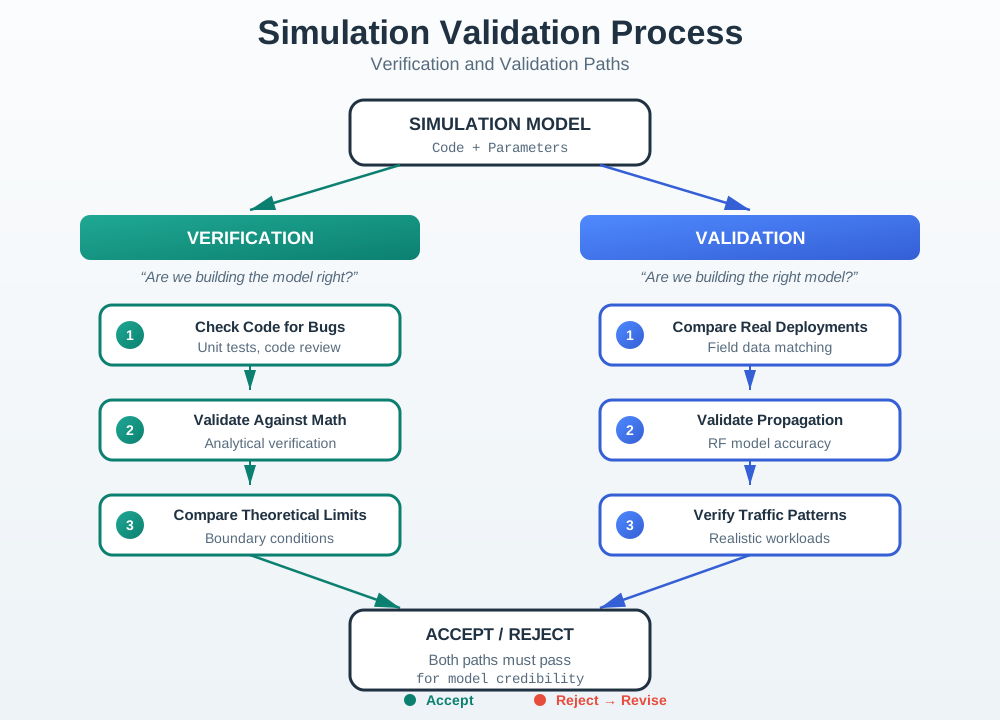
Verification asks whether the model was built correctly.
- Validation asks whether the model is useful for the real deployment question.
- The comparison turns Verification checks model mechanics; validation checks whether the model matches real deployment evidence before accepting or revising the design into a bounded: Phase 6: Verify, Validate, and Decide choice.
Deck summary
Key takeaways
A gateway is a point that joins device links to the next part of the system.
- A network design method prevents the team from treating a diagram, simulation run, or vendor claim as a decision.
- A Thread or Zigbee study might begin with powered-router density, parent selection, route repair, multicast behavior, sleepy end devices, and commissioning ownership.
- The same method can support a LoRaWAN gateway plan, a Thread mesh, a Wi-Fi sensor deployment, an NB-IoT pilot, or an industrial Ethernet segment.
- A Wi-Fi or Ethernet study might begin with DHCP/DNS reliability, AP placement, roaming, VLAN boundaries, broker reachability, and update traffic.
Retrieval practice
Recall checks 1–2 of 4

Blueprint Bina says: answer from memory, then check your reasoning.
Q1A simulator predicts radio coverage, but the team needs proof of wall loss on the actual site. Which evidence level fits?
Show answer
Answer: D Site measurements can challenge the coverage assumption.
Q2What makes uncertain network loads, environments and model dependencies explicit before a simulation run?
Show answer
Answer: D The assumption register exposes uncertain loads, environments, models, and dependencies before runs begin.
Retrieval practice
Recall check 3 of 4
Blueprint Bina says: answer from memory, then check your reasoning.
Q3A team reports that a simulated IoT network has acceptable average latency, but the report does not list scenarios, repeated observations, assumptions, or validation evidence. What is the main methodology problem?
Show answer
Answer: B A network methodology turns results into evidence by tying them to decisions, assumptions, scenarios, repeated observations, and validation.
Retrieval practice
Recall check 4 of 4
Blueprint Bina says: answer from memory, then check your reasoning.
Q4Which item belongs in an assumption register before interpreting a network simulation result?
Show answer
Answer: C The assumption register records the variables that could change the design decision if they are wrong.
Print reference
Answers
Answer key.
- D · Site measurements can challenge the coverage assumption.
- D · The assumption register exposes uncertain loads, environments, models, and dependencies before runs begin.
- B · A network methodology turns results into evidence by tying them to decisions, assumptions, scenarios, repeated observations, and validation.
- C · The assumption register records the variables that could change the design decision if they are wrong.