Design Methodology · Study deck
Network Design: Evidence and Architecture Workflow
A network choice should follow the device, traffic, place, and failure evidence.
Blueprint Bina is your guide for this deck.
After studying this chapter
Learning objectives
You will be able to:
- Explain: The worked building case shows why: environmental and occupancy sensing may start with a star-of-stars layout, but walls and equipment rooms still call for a site survey and pilot gateway logs.
- Explain: The evidence route must include gateway placement, RSSI/SNR by freezer row, spreading factor distribution, join success after a power event, alarm latency percentiles, and battery current during retry bursts.
- Explain: The sequence makes Star, mesh, tree, and hybrid topologies solve different deployment constraints; none is automatically best for every IoT system auditable for: Why IoT Network Design Is Different.
Major section
Why IoT Network Design Is Different
IoT networks often add constraints that make those assumptions weak.
- Devices may be behind walls, inside equipment, outdoors, underground, mobile, or installed by non-network specialists.
- Battery nodes cannot always listen, retry, scan, or relay without affecting maintenance intervals.
- Traffic inventory, peak scenario, queue and retry assumptions, timestamped tests.
Major section
Why IoT Network Design Is Different (continued)
A design that cannot be provisioned, monitored, updated, or troubleshot will fail even if the topology is sound.
- Runbook, ownership map, alerting plan, key rotation process, support boundaries.
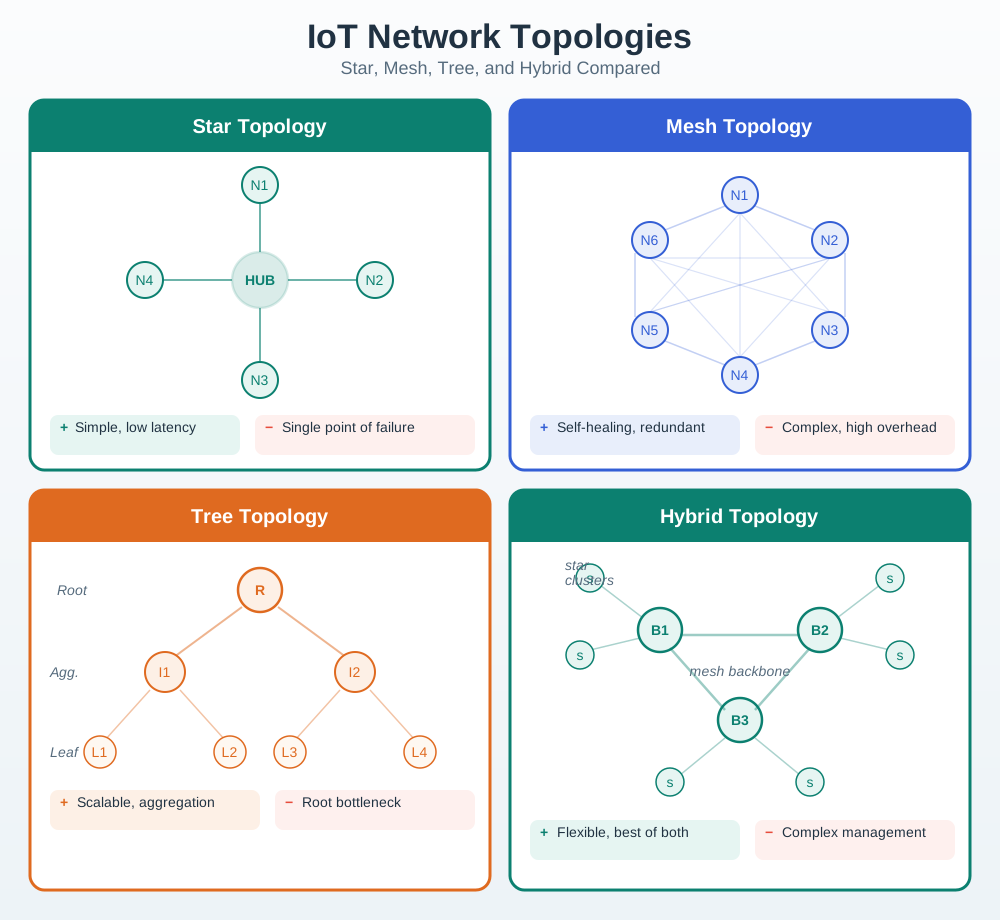
- A topology choice has to fit the site and the service.
- In Figure: Star, star, mesh, tree, and hybrid are options, not a ranking.
Major section
Why IoT Network Design Is Different (continued)
The worked building case shows why: environmental and occupancy sensing may start with a star-of-stars layout, but walls and equipment rooms still call for a site survey and pilot gateway logs.
- The comparison helps the team ask which path is weak, which service depends on it, and what field evidence would change the proposed layout.
- The sequence makes Star, mesh, tree, and hybrid topologies solve different deployment constraints; none is automatically best for every IoT system auditable for: Why IoT Network Design Is Different.
- Later lighting control may need a separate resilient segment because its traffic and fallback needs differ.
Major section
The Evidence Types
You need the decision question and boundaries made explicit.
- That the model matches the site unless assumptions are validated.
- Physical testing is expensive or the team must compare scenarios before pilot work.
- You need to diagnose real traffic or validate a pilot.
- Coverage and placement are uncertain.
Major section
The Network Design Sequence
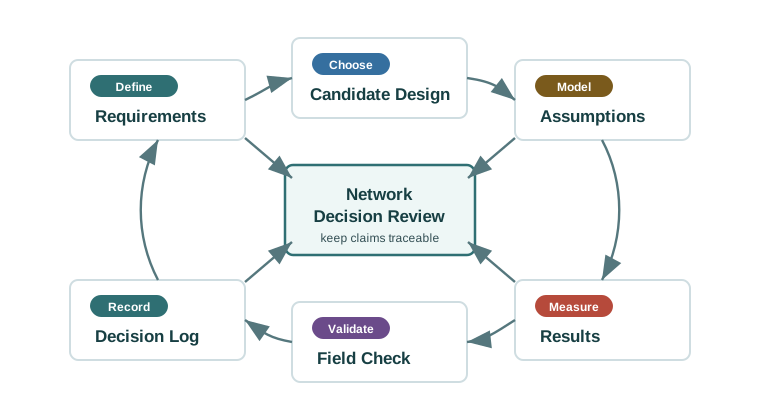
The design sequence is not strictly linear.
- Teams may loop back when evidence contradicts assumptions.
- Contrast: Decision Review against it to make The design loop keeps requirements, models, measurements, validation, and decisions connected reviewable rather than assumed.
- Star, mesh, tree, star-of-stars, and hybrid patterns are choices with tradeoffs, not maturity levels.
Major section
The Network Design Sequence (continued)
The comparison turns The design loop keeps requirements, models, measurements, validation, and decisions connected into a bounded: The Network Design Sequence choice.
- Sometimes a table and site walk are enough.
- Sometimes a simulation, packet capture, RF survey, or pilot is necessary.
- Scenarios should include normal, peak, failure, environment, maintenance, and growth cases when relevant.
Major section
Worked Example: A Building Monitor
Future control traffic may have different latency and fallback needs.
- Walls, equipment rooms, and floor separation can create weak paths.
- Monitoring can start as star-of-stars; powered lighting may need a separate resilient segment later.
- A single shared topology may overcomplicate low-power sensors or under-serve control needs.
Major section
Worked Example: A Building Monitor (continued)
A weak introduction-level response would be "use a mesh network because it is reliable." A stronger introduction-level response creates an evidence route.
- A small pilot may miss busy periods, maintenance windows, or seasonal conditions.
- The key lesson is not the exact topology.
- The key lesson is that each decision has a reason, a risk, and an evidence plan.
Major section
Incremental Examples
Beginner Example: A classroom temperature logger sends one MQTT message every five minutes through Wi-Fi.
- Intermediate Example: A freezer-alarm pilot uses LoRaWAN sensors across a warehouse.
- The evidence route must include gateway placement, RSSI/SNR by freezer row, spreading factor distribution, join success after a power event, alarm latency percentiles, and battery current during retry bursts.
- A topology diagram alone cannot show whether the coldest weak-signal corner is safe.
Deck summary
Key takeaways
IoT networks often add constraints that make those assumptions weak.
- A design that cannot be provisioned, monitored, updated, or troubleshot will fail even if the topology is sound.
- The worked building case shows why: environmental and occupancy sensing may start with a star-of-stars layout, but walls and equipment rooms still call for a site survey and pilot gateway logs.
- You need the decision question and boundaries made explicit.
- The design sequence is not strictly linear.
Retrieval practice
Recall check 1 of 3

Blueprint Bina says: answer from memory, then check your reasoning.
Q1What turns a network design question into measurable traffic, power, range and availability limits?
Show answer
Answer: B They turn the question into measurable traffic, range, power, security, and availability constraints.
Retrieval practice
Recall check 2 of 3
Blueprint Bina says: answer from memory, then check your reasoning.
Q2A team presents a polished topology diagram for a sensor deployment, but the review notes do not state device placement, traffic classes, latency needs, power constraints, failure scenarios, or validation evidence. What is the best response?
Show answer
Answer: A The introduction-level standard is traceability: the topology must connect to requirements, assumptions, scenarios, and evidence.
Retrieval practice
Recall check 3 of 3
Blueprint Bina says: answer from memory, then check your reasoning.
Q3When should simulation be used in an IoT network design workflow?
Show answer
Answer: D Simulation is one evidence method.
Print reference
Answers
Answer key.
- B · They turn the question into measurable traffic, range, power, security, and availability constraints.
- A · The introduction-level standard is traceability: the topology must connect to requirements, assumptions, scenarios, and evidence.
- D · Simulation is one evidence method.