Core Networking · Study deck

Attenuation and RSSI

Picture a door sensor that works across an empty room but fails after a metal cabinet is installed.

Packet Pete is your guide for this deck.

propmaterials
Packet Pete, the module guide, in a scene from this chapter.
iotclass.org

After studying this chapter

Learning objectives

You will be able to:

  • Explain: Lower-frequency signals diffract around obstacles and penetrate materials such as walls, foliage, ground, and water more readily, which is one reason many sub-GHz LPWAN and cellular bands are chosen for exactly this penetration behavior.
  • Explain: Enclosures matter too: a radio that works on a bench may lose margin when the antenna is placed near a battery, metal bracket, wet housing, or grounded machine frame.
  • Explain: Different receivers report it differently, antenna orientation changes it, channel fading changes it, and reflected paths can make the same location look strong one moment and weak the next.
iotclass.org

Major section

Start With What the Signal Must Pass Through

Distance did not change.

  • A gateway means a device or service that joins two message paths.
  • Received signal strength means the power a radio sees at its input.
  • Received signal strength indicator, or RSSI, is the device estimate of that power.
  • Attenuation means signal loss along the path.
iotclass.org

Major section

Start With What the Signal Must Pass Through (continued)

This runway does not turn one signal reading into a coverage claim.

  • The deeper sections explain material loss, frequency effects, path geometry, measurement limits, and site evidence for the final installation.
  • A link that works in open air can fail once the signal has to cross walls, glass, racks, water, soil, people, vehicles, or enclosures.
  • The learner task is to separate what physics predicts, what the site adds, and what margin remains after installation.
iotclass.org

Major section

Overview: Walls And RSSI Are Part Of The Link, Not Afterthoughts

Wireless propagation does not stop at distance.

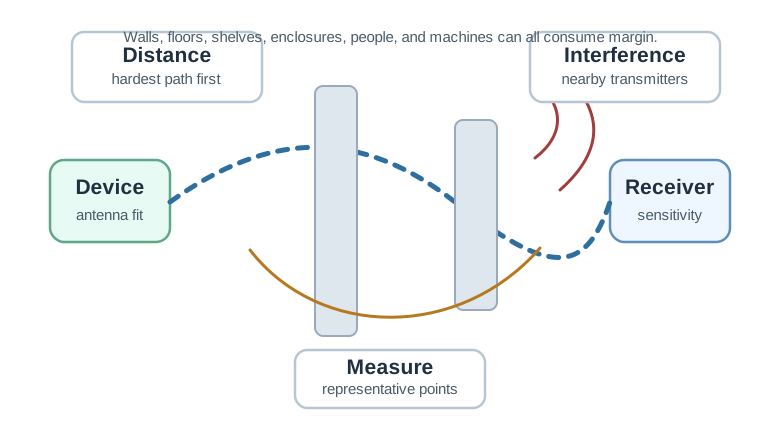
  • Walls, floors, water, metal, racks, people, enclosures, and antenna orientation all change the received signal.
  • RSSI reports the received signal level after the path has done its damage.
  • RSSI gives the field team a way to check those assumptions.

Key terms

RSSI
RSSI is the receiver's signal-strength reading in dBm.

Why it matters

A single reading is weak evidence because fading and receiver reporting vary, but repeated readings tied to location and condition are useful.

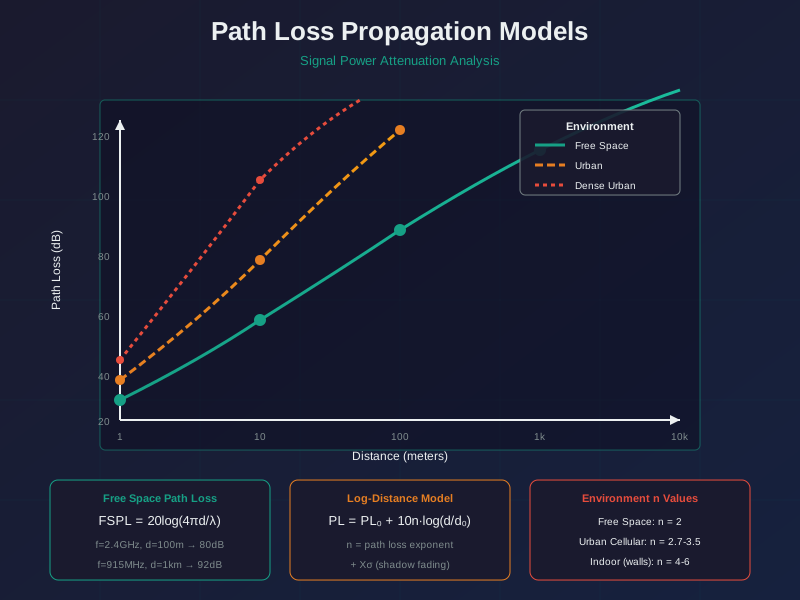
Path loss grows with distance, and the path-loss exponent rises indoors: walls and dense materials add loss well beyond the free-space prediction.
iotclass.org

Major section

Overview: Walls And RSSI Are Part Of The Link, Not Afterthoughts (continued)

Reflection Metal, reinforced concrete, machinery, and racks can bounce energy into multiple paths.

  • For IoT work, RSSI is useful when it is treated as a measurement record, not as a precise location oracle.
  • Absorption Some signal energy becomes heat inside material.
  • Reflections can help coverage or create fading.
iotclass.org

Major section

Overview: Walls And RSSI Are Part Of The Link, Not Afterthoughts (continued)

That turns signal strength from an anecdote into a coverage record that can be compared with later surveys.

  • It should not be used alone to promise centimeter or even reliable meter-level location in reflective indoor spaces.
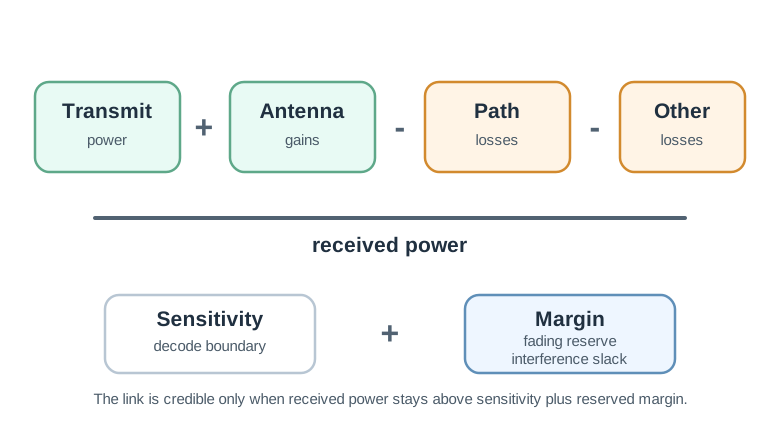
  • The important shift is to treat material loss as part of the link budget instead of a surprise discovered after installation.
  • Moisture, concrete, wood, bodies, and dense contents can increase this loss.
iotclass.org

Major section

Overview: Walls And RSSI Are Part Of The Link, Not Afterthoughts (continued)

A short path through a reinforced wall, freezer panel, water tank, metal rack, or crowded corridor can be worse than a longer open path.

  • Enclosures matter too: a radio that works on a bench may lose margin when the antenna is placed near a battery, metal bracket, wet housing, or grounded machine frame.
  • The coverage question is therefore not only "how far?" but "through what, at what height, with which antenna orientation?".
  • That labelled limit reconnects the visual to overview: walls and rssi are part of the link, not afterthoughts.
iotclass.org

Major section

Overview: Walls And RSSI Are Part Of The Link, Not Afterthoughts (continued)

Lower-frequency signals diffract around obstacles and penetrate materials such as walls, foliage, ground, and water more readily, which is one reason many sub-GHz LPWAN and cellular bands are chosen for exactly this penetration behavior.

  • RSSI RSSI is the receiver's signal-strength reading in dBm.
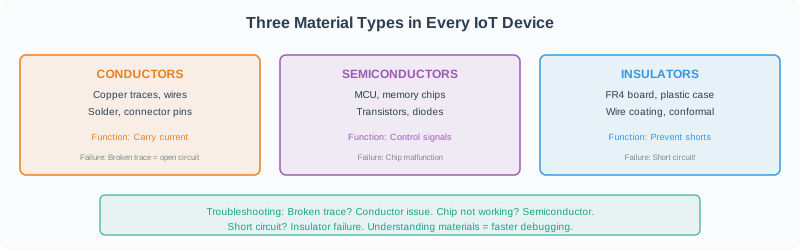
  • Locate Three Material Types in Every IoT Device on Figure: Materials inside and around a device can matter before checking: CONDUCTORS.
  • Carry: Three Material Types in Every IoT Device into overview: walls and rssi are part of the link, not afterthoughts; use: Copper traces, wires as its limiting condition.
iotclass.org

Major section

Practitioner: Turn Materials Into Survey Rows

Material attenuation values from tables are starting points.

  • That record is what lets another engineer explain a weak zone later.
  • A reading taken at high transmit power, a slow data rate, or a favorable antenna angle cannot be compared directly with a reading taken under a different mode.

Key terms

RSSI
RSSI is only meaningful when compared with the receiver's operating threshold.

Why it matters

That discipline prevents teams from making a permanent layout change based on a transient RSSI dip.

Indoor planning works best when distance loss, material loss, installation loss, and reserve margin are kept as separate rows.
iotclass.org

Major section

Practitioner: Turn Materials Into Survey Rows (continued)

The goal is not to collect many numbers; it is to collect enough comparable evidence to decide whether margin remains.

  • When the survey finds a weak zone, change one likely cause at a time when possible.
  • Rotate the antenna, raise the gateway, move the device out of a metal shadow, change the channel, or add a gateway, then measure again.
  • Each obstacle can add loss or reflection that changes the received signal.
iotclass.org

Major section

Practitioner: Turn Materials Into Survey Rows (continued)

The record should show the condition, the intervention, and the recheck result so later maintainers can understand why the final placement was chosen.

  • Layout change, new shelving, wet wall, closed door, or new enclosure.
  • Gateway move, antenna change, firmware radio-mode change, or device relocation.
  • Data rate, bandwidth, spreading, coding, protocol, or payload timing changes.
iotclass.org

Major section

Practitioner: Turn Materials Into Survey Rows (continued)

That discipline prevents teams from making a permanent layout change based on a transient RSSI dip.

  • RSSI is only meaningful when compared with the receiver's operating threshold.
  • The survey should drive an action, not just collect signal readings.
  • Wall composition, thickness, moisture, reinforcement, angle, and frequency can all change the actual loss.
iotclass.org

Major section

Under The Hood: RSSI Is A Noisy Proxy
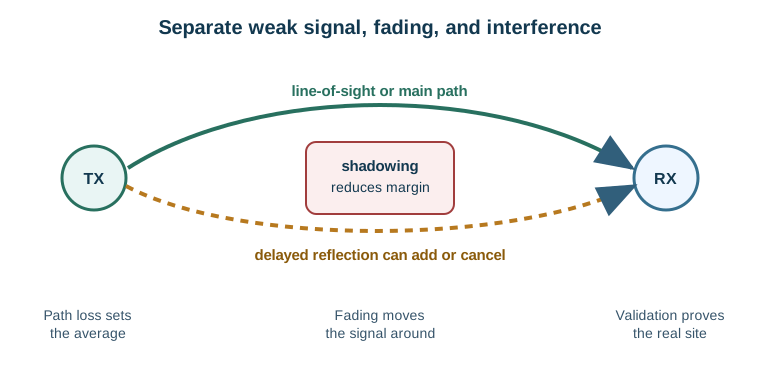
RSSI is usually a received-power indicator reported by the radio chipset.

  • Different receivers report it differently, antenna orientation changes it, channel fading changes it, and reflected paths can make the same location look strong one moment and weak the next.
  • Good engineering records keep that ambiguity visible.

Key terms

If the goal
If the goal is coverage acceptance, the question is whether enough margin remains across representative conditions.
RSSI alone
RSSI alone is usually a coarse proximity signal.
Multipath breaks simple distance assumptions because reflected signals can add, cancel, or fluctuate as people and equipment move.
iotclass.org

Major section

Under The Hood: RSSI Is A Noisy Proxy (continued)
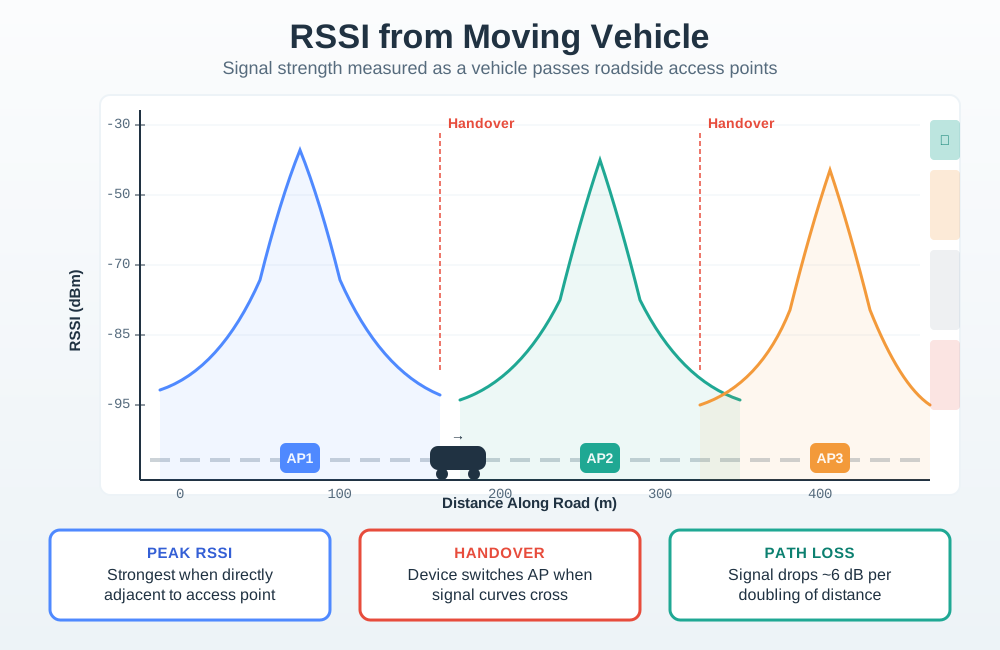
The log-distance model is still useful for rough reasoning: signal tends to fall as distance increases, and the path-loss exponent rises in cluttered environments.

  • But a model should be calibrated with site measurements before it is used for room detection, asset tracking, or coverage acceptance.
  • The under-the-hood problem is that several different physical causes can produce the same RSSI value.
  • The model should match the decision being made.
iotclass.org

Major section

Under The Hood: RSSI Is A Noisy Proxy (continued)
A weak reading may mean longer distance, a lossy wall, antenna polarization mismatch, destructive multipath, a detuned enclosure, interference, receiver automatic-gain behavior, or a temporary obstruction.

  • A strong reading may still be unstable if it comes from a reflected path that disappears when a door closes or a vehicle moves.
  • RSSI is therefore a proxy for received power under a particular receiver and environment, not a unique explanation of the path.
  • If the goal is coverage acceptance, the question is whether enough margin remains across representative conditions.
  • RSSI alone is usually a coarse proximity signal.
iotclass.org

Major section

Under The Hood: RSSI Is A Noisy Proxy (continued)
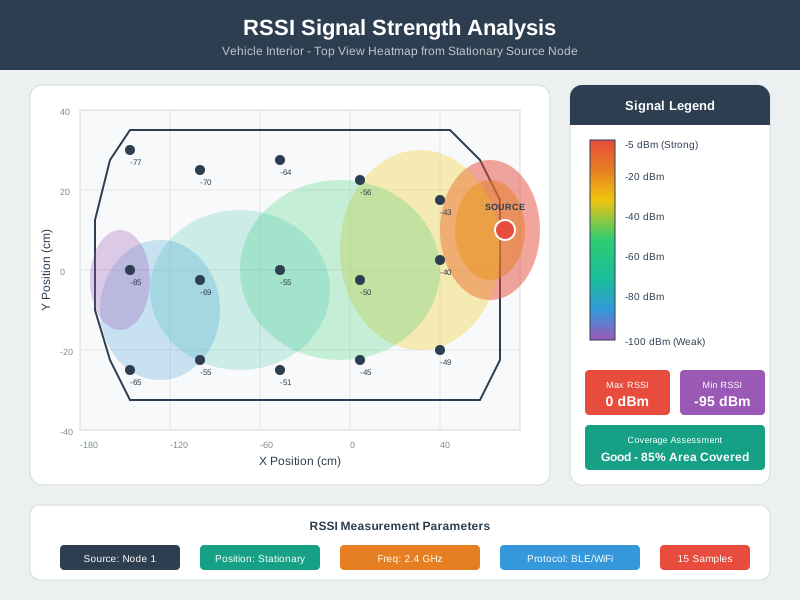
In under the hood: rssi is a noisy proxy, record: RX as the deciding distinction.

  • Trend RSSI trends can show that a device is moving farther from a gateway, entering a shielded zone, or losing margin after an installation change.
  • A threshold that works on one gateway model or band may not transfer cleanly to another.
  • For under the hood: rssi is a noisy proxy, retain: X Position (cm) as evidence for the resulting choice.
iotclass.org

Deck summary

Key takeaways

Distance did not change.

  • This runway does not turn one signal reading into a coverage claim.
  • Wireless propagation does not stop at distance.
  • Reflection Metal, reinforced concrete, machinery, and racks can bounce energy into multiple paths.
  • That turns signal strength from an anecdote into a coverage record that can be compared with later surveys.
iotclass.org

Retrieval practice

Recall check 1 of 3

Packet Pete says: answer from memory, then check your reasoning.

Q1Why should material attenuation and RSSI be recorded during indoor IoT coverage planning?

AThey replace the need to know receiver sensitivity.
BThey show how materials and placement change received power beyond distance.
CThey make all RSSI readings accurate distance measurements.
DThey prove that lower-frequency radios always work indoors without validation.
Show answer

Answer: B Materials, reflections, device placement, and receiver behavior explain why the installed RSSI can differ from a clean distance-only estimate.

iotclass.org

Retrieval practice

Recall check 2 of 3

Packet Pete says: answer from memory, then check your reasoning.

Q2A warehouse sensor reports unstable RSSI only when forklifts move through an aisle with metal racks. What is the best next step?

ATrial a different sensor model to improve receiver sensitivity in the aisle.
BUse the free-space path-loss formula alone because the distance has not changed.
CRecord aisle conditions and repeated RSSI before changing placement or gateways.
DUse the average delivery rate and set the fluctuating RSSI readings aside.
Show answer

Answer: C The instability is tied to a site condition, so the survey record should capture the path and repeated measurements before deciding on mitigation.

iotclass.org

Retrieval practice

Recall check 3 of 3

Packet Pete says: answer from memory, then check your reasoning.

Q3Why is a single RSSI reading a weak basis for precise indoor location?

ABecause RSSI is measured in volts rather than dBm.
BBecause material attenuation has no effect on radio signals.
CBecause path-loss models only work for wired networks.
DBecause reflections, orientation, and moving obstacles can alter RSSI.
Show answer

Answer: D RSSI is useful, but it is a noisy proxy for received power and does not map uniquely to distance indoors.

iotclass.org

Print reference

Answers

Answer key.

  1. B · Materials, reflections, device placement, and receiver behavior explain why the installed RSSI can differ from a clean distance-only estimate.
  2. C · The instability is tied to a site condition, so the survey record should capture the path and repeated measurements before deciding on mitigation.
  3. D · RSSI is useful, but it is a noisy proxy for received power and does not map uniquely to distance indoors.
iotclass.org