Core Networking · Study deck

Free-Space Path Loss

Picture a field sensor that works across an empty yard but fails after it is mounted behind a wet wall.

Packet Pete is your guide for this deck.

propfspl
Packet Pete, the module guide, in a scene from this chapter.
iotclass.org

After studying this chapter

Learning objectives

You will be able to:

  • Explain: A field RSSI reading from a clear doorway might validate the arithmetic for that moment, but it does not prove the link during inventory movement, seasonal leaf growth, rain, or a changed enclosure.
  • Explain: A 100 m path at 915 MHz is about 71.7 dB in free space, while the same 100 m path at 2.4 GHz is about 80.0 dB.
  • Explain: If the assumptions are visible, the team can decide whether to raise an antenna, move a gateway, change a band, accept a lower data rate, or schedule a field measurement.
iotclass.org

Major section

Start With Distance Taking Energy Away

The clean distance model is only the first line of the evidence.

  • A gateway means the boundary system that joins local devices to another network or service.
  • Free-space path loss is the clean baseline: what the path costs before walls, trees, antennas, fading, or interference make it harder.
  • Once you know the open-air loss, every real deployment adds evidence about materials, height, frequency, antennas, and margin.
iotclass.org

Major section

Overview: FSPL Is The Open-Air Baseline
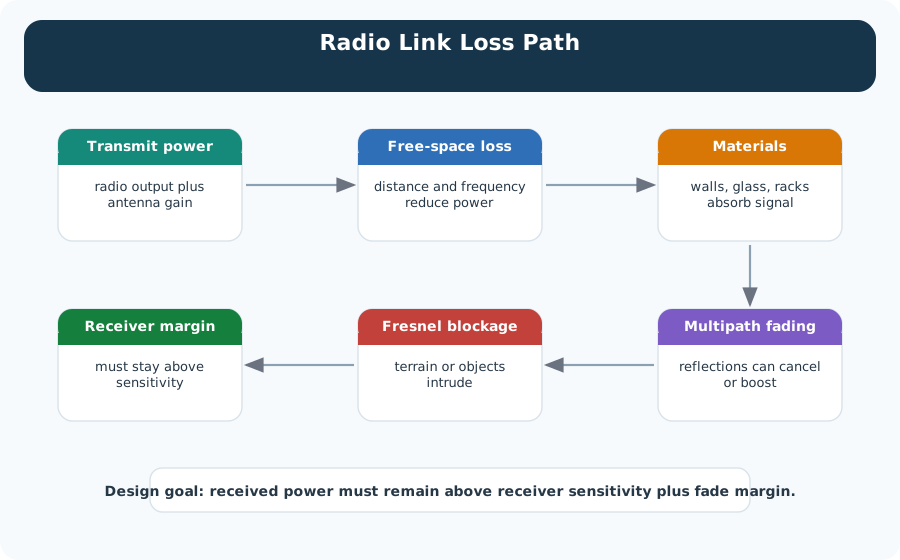
Free-space path loss estimates how much radio power is lost as a signal spreads through unobstructed space.

  • FSPL is not an indoor or city-range promise.
  • The practical value of FSPL is that it separates a radio design into two questions.
  • That separation keeps teams from arguing about range as a single number.

Numbers to remember

8.4 dBThe higher-frequency link starts with roughly 8.4 dB less headroom before walls

Why it matters

Frequency At equal distance, 2.4 GHz has about 8.4 dB more FSPL than 915 MHz because the frequency term is higher.

Path-loss estimates become useful only when they are connected to transmit power, antenna gains, receiver sensitivity, and required margin.
iotclass.org

Major section

Overview: FSPL Is The Open-Air Baseline (continued)

A 100 m path at 915 MHz is about 71.7 dB in free space, while the same 100 m path at 2.4 GHz is about 80.0 dB.

  • The higher-frequency link starts with roughly 8.4 dB less headroom before walls, antenna orientation, interference, and receiver mode are considered.
  • For an IoT gateway plan, the baseline should state the distance, frequency, formula convention, and receiver sensitivity before it states the conclusion.
  • If a designer cannot point to those assumptions, the range estimate cannot be reviewed or repaired when the site changes.
iotclass.org

Major section

Overview: FSPL Is The Open-Air Baseline (continued)

Carry: Radio Link Loss Path into overview: fspl is the open-air baseline; use radio output plus as its limiting condition.

  • If the assumptions are visible, the team can decide whether to raise an antenna, move a gateway, change a band, accept a lower data rate, or schedule a field measurement.
  • That visual pairing grounds path-loss estimates become useful only when they are connected to transmit power, antenna gains, receiver sensitivity, and required margin in named evidence.
  • Margin The deployment decision uses received power minus receiver sensitivity, with reserve for fading, walls, antenna mismatch, and aging.
iotclass.org

Major section

Practitioner: Turn FSPL Into A Link-Budget Record
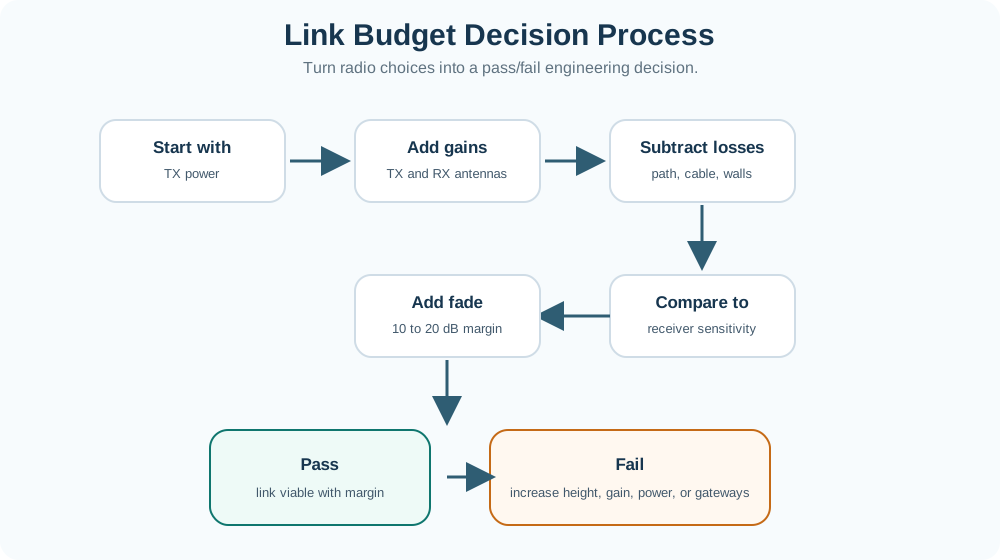
A field-ready link budget starts with transmit power, antenna gains, cable losses, FSPL, extra deployment losses, receiver sensitivity, and required margin.

  • The decision is not whether a theoretical signal exists.
  • The decision is whether enough margin remains after the site-specific losses are added.

Why it matters

This record also prevents overfitting to a single optimistic test.

A link-budget record turns the FSPL baseline into a go, redesign, or field-test decision.
iotclass.org

Major section

Practitioner: Turn FSPL Into A Link-Budget Record (continued)
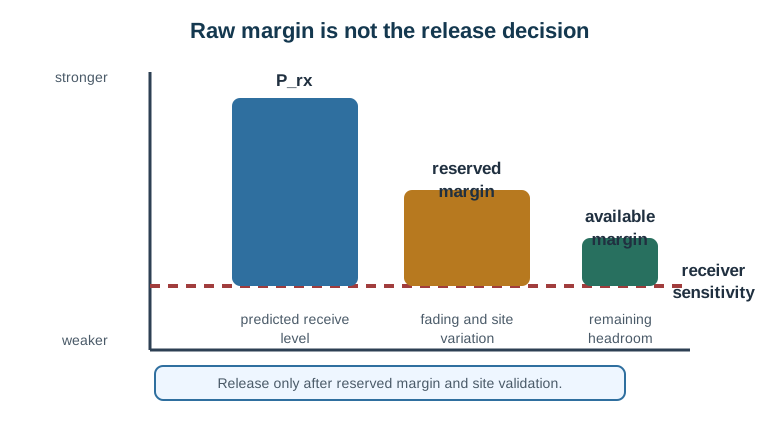
The path baseline should be followed by explicit allowances for walls, shelving, foliage, vehicle blockage, antenna mismatch, Fresnel clearance, weather exposure, and the fade margin required by the service.

  • A field RSSI reading from a clear doorway might validate the arithmetic for that moment, but it does not prove the link during inventory movement, seasonal leaf growth, rain, or a changed enclosure.
  • Accepting a link that has no reserve for fading, aging, or installation variance.
  • A smart-building estimate that passes in free space can still fail after wall loss, metal shelving, antenna orientation, and people moving through the path.
iotclass.org

Major section

Under The Hood: Model Boundaries Matter
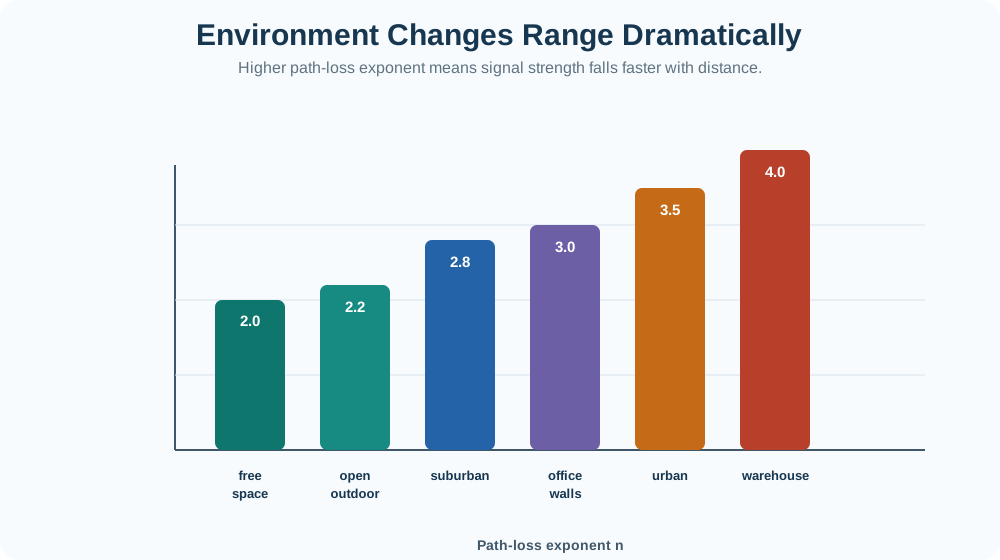
The logarithmic shape is the key engineering idea.

  • Doubling distance adds about 6 dB of free-space loss because the wavefront area grows with the square of distance.
  • Increasing frequency also raises the loss term in the usual link-budget form, so a radio comparison at the same range still needs the band written down.

Key terms

Free-space spreading
Free-space spreading is inside.

Why it matters

The formula is powerful because it gives a repeatable open-air baseline, but it stops being sufficient when obstacles, reflections, antenna placement, terrain, or fading dominate the received signal.

Path-loss exponent and site-loss assumptions change the distance term once the path is no longer free space.
iotclass.org

Major section

Under The Hood: Model Boundaries Matter (continued)

These terms are deterministic; the uncertainty enters when the path stops looking like the model.

  • A useful boundary note names which losses are inside the calculation and which are still external assumptions.
  • Free-space spreading is inside.
  • Free space uses about n = 2.
  • Unit Discipline The constant changes with units.
iotclass.org

Major section

Under The Hood: Model Boundaries Matter (continued)

Wall attenuation, enclosure detuning, polarization mismatch, partial Fresnel blockage, body shadowing, rain fade, interference, and receiver implementation margin are outside unless the record adds them explicitly.

  • That visual pairing grounds path-loss exponent and site-loss assumptions change the distance term once the path is no longer free space in named evidence.
  • That labelled check bounds path-loss exponent and site-loss assumptions change the distance term once the path is no longer free space.
  • Indoor and obstructed environments often need a larger exponent plus explicit wall, body, foliage, or fade-margin allowances.
iotclass.org

Major section

Under The Hood: Model Boundaries Matter (continued)

The exponent is not a decoration on the formula; it changes how quickly distance consumes margin.

  • Larger values describe environments where reflections, absorption, diffraction, and clutter make each distance increase more expensive.
  • The shadowing term X_sigma is the reminder that two paths with the same distance can still behave differently.
  • For IoT deployments, the under-the-hood review should therefore check model choice, unit consistency, and validation evidence together.
iotclass.org

Major section

Under The Hood: Model Boundaries Matter (continued)

Figure: Model choice is part of the evidence record makes under the hood: model boundaries matter inspectable through Raw margin is not the release decision and stronger.

  • Those diagram labels establish the scope of model choice is part of the evidence record: state the environment, exponent or loss allowances, and measurement plan.
  • Figure: Model choice is part of the evidence record places Raw margin is not the release decision alongside stronger.
  • Environment Drift Warehouses, hospitals, farms, and city streets do not share one path-loss exponent.
iotclass.org

Deck summary

Key takeaways

The clean distance model is only the first line of the evidence.

  • Free-space path loss estimates how much radio power is lost as a signal spreads through unobstructed space.
  • A 100 m path at 915 MHz is about 71.7 dB in free space, while the same 100 m path at 2.4 GHz is about 80.0 dB.
  • Carry: Radio Link Loss Path into overview: fspl is the open-air baseline; use radio output plus as its limiting condition.
  • A field-ready link budget starts with transmit power, antenna gains, cable losses, FSPL, extra deployment losses, receiver sensitivity, and required margin.
iotclass.org

Retrieval practice

Recall check 1 of 3

Packet Pete says: answer from memory, then check your reasoning.

Q1A 915 MHz LoRa link and a 2.4 GHz Wi-Fi link are both measured at 100 meters in clear line of sight. Which statement is correct for free-space path loss?

AThe 2.4 GHz link has more free-space path loss because the frequency term is higher.
BThe 915 MHz link has more free-space path loss because lower-frequency signals travel farther.
CBoth links have the same free-space path loss because only distance appears in the formula.
DThe Wi-Fi link has more path loss only because Wi-Fi uses more bandwidth.
Show answer

Answer: A FSPL rises with both distance and frequency, so comparing radios at the same distance still requires the frequency term.

iotclass.org

Retrieval practice

Recall check 2 of 3

Packet Pete says: answer from memory, then check your reasoning.

Q2A Wi-Fi sensor has a free-space link margin of 30 dB, but the route crosses concrete, shelving, and a crowded corridor. What should the deployment record do next?

AApprove the placement because free-space margin is positive.
BReuse the indoor loss allowance from another Wi-Fi band to preserve the existing 30 dB estimate.
CUse the longest range printed in the radio data sheet as the final gateway spacing.
DAdd site-loss allowances, recompute margin, then verify the path with field measurements.
Show answer

Answer: D A practical link budget starts with FSPL, then adds deployment losses and verifies that adequate margin remains.

iotclass.org

Retrieval practice

Recall check 3 of 3

Packet Pete says: answer from memory, then check your reasoning.

Q3Which review finding should stop a path-loss estimate from being used as deployment evidence?

AThe record states distance, frequency, formula units, receiver sensitivity, and required margin.
BThe record uses an indoor path-loss exponent and adds wall losses for a building deployment.
CThe record mixes meters with the km/MHz FSPL constant and then treats the result as a final indoor range.
DThe record requires field RSSI or packet-delivery checks after installation.
Show answer

Answer: C Path-loss estimates fail when units are inconsistent or when a free-space baseline is treated as proof for obstructed deployment conditions.

iotclass.org

Print reference

Answers

Answer key.

  1. A · FSPL rises with both distance and frequency, so comparing radios at the same distance still requires the frequency term.
  2. D · A practical link budget starts with FSPL, then adds deployment losses and verifies that adequate margin remains.
  3. C · Path-loss estimates fail when units are inconsistent or when a free-space baseline is treated as proof for obstructed deployment conditions.
iotclass.org