Core Networking · Study deck

Bandwidth and Channel Capacity

Firmware is the software stored on a device.

Packet Pete is your guide for this deck.

collisionbandwidth
Packet Pete, the module guide, in a scene from this chapter.
iotclass.org

After studying this chapter

Learning objectives

You will be able to:

  • Explain: A sensor that sends a small reading every few minutes may need little average bandwidth, while a shared wireless channel still needs enough airtime margin for bursts, retries, acknowledgements, and neighboring devices using the same medium.
  • Explain: If the same 300 devices reconnect after an outage and send that 100-byte exchange inside a 15-second recovery window, the offered load becomes 300 x 100 x 8 / 15 = 16,000 bps.
  • Explain: A link that looks safe on a daily average can still feel full during an alarm storm, power restoration, shift change, or gateway reconnect.
iotclass.org

Major section

Start With Capacity as a Shared Resource

Firmware is the software stored on a device.

  • Modulation is the way data changes a radio signal.
  • A payload is the useful data inside a message.
  • A protocol is a shared set of message rules.
  • A high stated rate can still deliver little useful data when devices wait or resend.

Key terms

Bandwidth
Bandwidth is the ceiling, not the useful delivered value.

Why it matters

Headers, retries, collisions, scheduling gaps, and weak links all reduce what applications actually receive.

iotclass.org

Major section

Start With Capacity as a Shared Resource (continued)

A lower rate may reach farther, but it keeps the channel busy for longer.

  • This meter story cannot prove useful delivery from a rate label.
  • Those need traffic traces and radio tests.
  • The deeper work qualifies the headline rate; it does not replace the busy-window check.
  • Spread routine sends.
iotclass.org

Major section

Overview: Capacity Is Not the Same as Useful Delivery
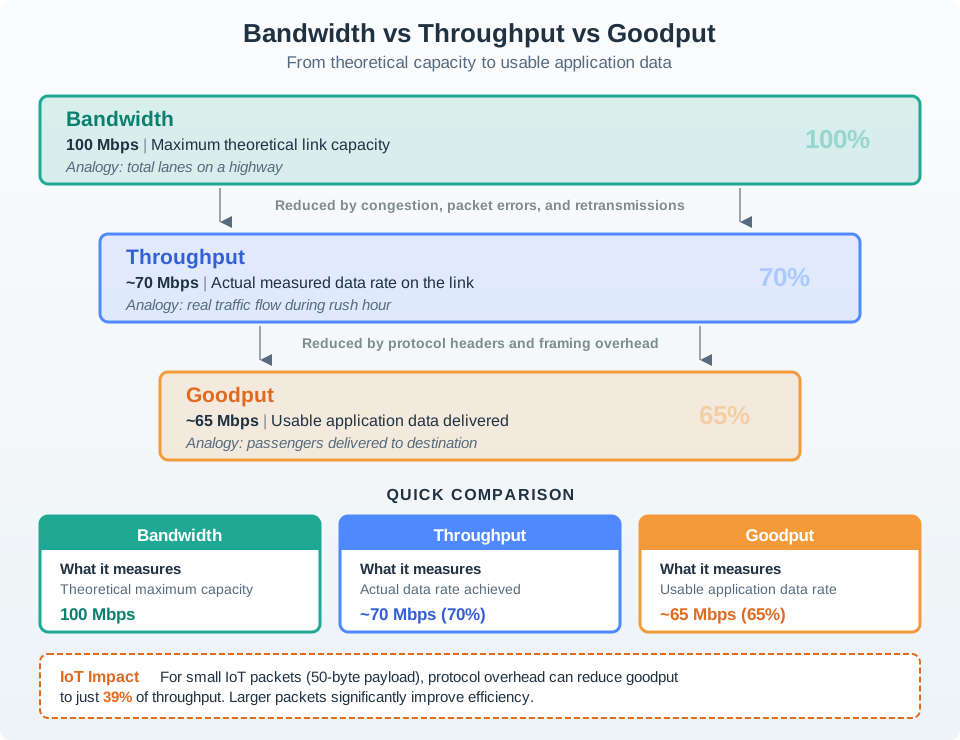
Bandwidth is the nominal amount of data a link can carry per second.

  • Channel capacity is the practical limit set by the medium, radio conditions, modulation, coding, channel access rules, and interference.
  • Throughput is what actually gets delivered after contention, loss, acknowledgements, and retries.
  • IoT design needs all four terms.

Why it matters

Core distinction: More bandwidth can carry more simultaneous data, but it does not automatically reduce propagation delay, wake-up delay, queueing delay, radio scheduling delay, or application response time.

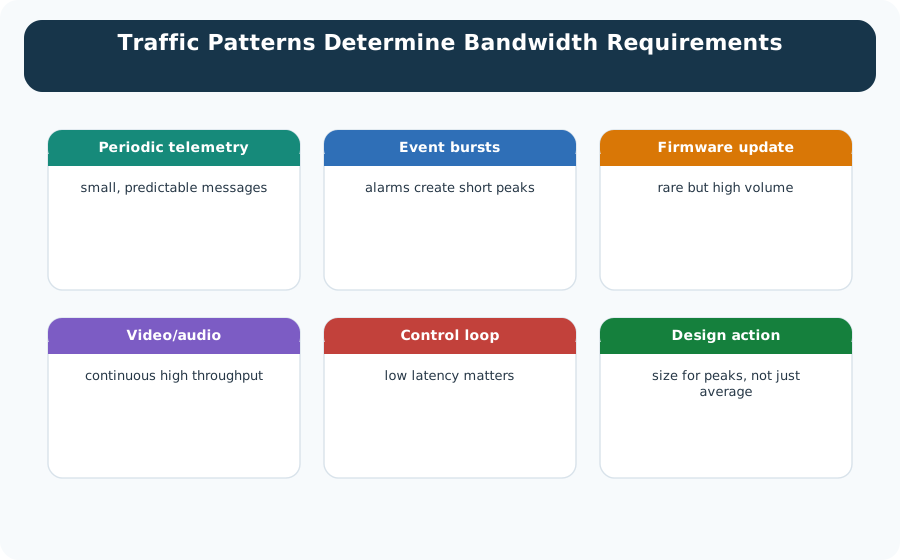
Capacity planning starts by classifying traffic shape, because peaks, latency-sensitive control, and rare bulk transfers stress different parts of the link.
iotclass.org

Major section

Overview: Capacity Is Not the Same as Useful Delivery (continued)
For overview: capacity is not the same as useful delivery, retain small, predictable messages as evidence for the resulting choice.

  • Goodput is the useful application payload left after protocol overhead.
  • The result is a delivery budget, not just a larger number on a datasheet.
  • Many devices send on a fixed interval.
iotclass.org

Major section

Overview: Capacity Is Not the Same as Useful Delivery (continued)

A sensor that sends a small reading every few minutes may need little average bandwidth, while a shared wireless channel still needs enough airtime margin for bursts, retries, acknowledgements, and neighboring devices using the same medium.

  • Periodic telemetry is predictable, event bursts are short and concentrated, firmware updates are rare but large, and control loops may care more about delay than volume.
  • A link that looks safe on a daily average can still feel full during an alarm storm, power restoration, shift change, or gateway reconnect.
  • Stagger reporting times and batch when latency allows.
iotclass.org

Major section

Overview: Capacity Is Not the Same as Useful Delivery (continued)

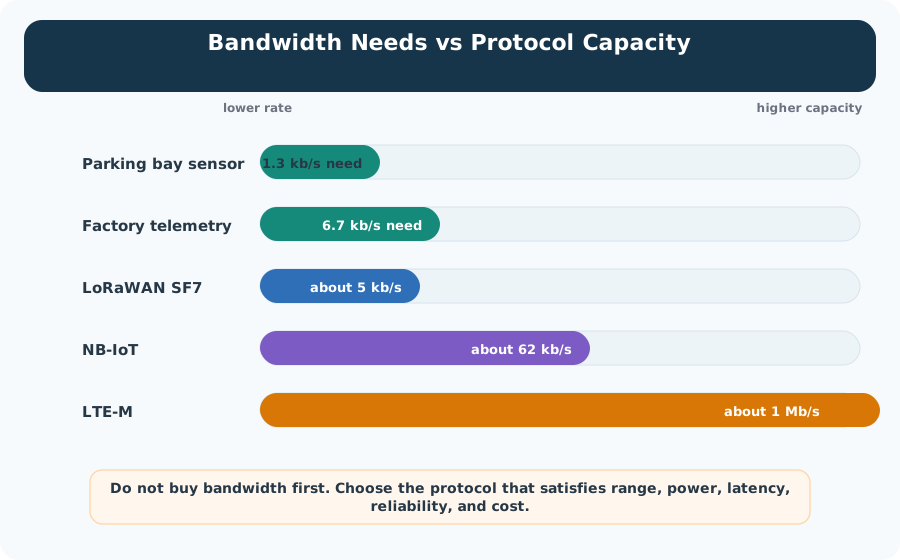
Its visual vocabulary joins Bandwidth Needs vs Protocol Capacity to lower rate, which frames nominal capacity should be checked against the traffic pattern, not selected as a substitute for the traffic calculation.

  • That labelled check bounds nominal capacity should be checked against the traffic pattern, not selected as a substitute for the traffic calculation.
  • For overview: capacity is not the same as useful delivery, retain higher capacity as evidence for the resulting choice.
  • The delivered rate after protocol behavior, channel access, retransmissions, and scheduling have taken their share of the link.
  • Alarms, occupancy changes, motion, or power restoration.
iotclass.org

Major section

Practitioner: Build a Capacity Record Before Selecting a Link
A useful capacity record starts from device behavior.

  • The formula is a starting point, not the whole answer.
  • If the real exchange is closer to 100 bytes after framing, addressing, security, acknowledgement, and supervision overhead, the average carried by the link is about 800 bps before retries.
  • Average payload demand is small.

Key terms

When a value
When a value is estimated rather than measured, mark it as an assumption and name the retest trigger.

Numbers to remember

100 bytesIf the real exchange is closer to 100 bytes after framing
Goodput is smaller than throughput, and throughput is smaller than nominal bandwidth whenever overhead, contention, or loss consumes capacity.
iotclass.org

Major section

Practitioner: Build a Capacity Record Before Selecting a Link (continued)

When a value is estimated rather than measured, mark it as an assumption and name the retest trigger.

  • That number is still small, but it is a better starting record than the payload-only estimate.
  • Goodput must be checked, not only payload bytes.
  • Some reports align after wake or outage.
iotclass.org

Major section

Practitioner: Build a Capacity Record Before Selecting a Link (continued)

If the same 300 devices reconnect after an outage and send that 100-byte exchange inside a 15-second recovery window, the offered load becomes 300 x 100 x 8 / 15 = 16,000 bps.

  • Payload size, firmware batch size, retry rate, and command frequency are common places where early records become stale.
  • Burst capacity may drive the design.
  • Deployment can fail if only averages are tested.
iotclass.org

Major section

Under the Hood: Airtime Turns Average Load into Collision Risk

The practical question is not just "How many bits per second?" It is "How much airtime is occupied when the medium is busiest?".

  • On a shared medium, a packet does not consume only its payload time.
  • Airtime math makes the risk visible.
  • Devices wait before trying again.

Numbers to remember

250 kbpsAt 250 kbps, a 100-byte frame contains 800 raw bits

Why it matters

Hidden nodes make this worse: two devices may both believe the channel is clear because they cannot hear each other, while the gateway receives overlapping signals.

iotclass.org

Major section

Under the Hood: Airtime Turns Average Load into Collision Risk (continued)

The under-the-hood evidence should explain which of those assumptions protects the busiest window.

  • It consumes preamble, headers, inter-frame spacing, acknowledgements, backoff, retransmission opportunities, and sometimes channel-scan time.
  • A good review therefore records both the physical rate and the access rule.
  • Stagger transmissions and reduce synchronized bursts.
iotclass.org

Major section

Under the Hood: Airtime Turns Average Load into Collision Risk (continued)

Latency rises even when payload size is small.

  • Collision risk rises when independent transmitters choose overlapping airtime on the same channel and cannot coordinate well enough to avoid each other.
  • Without both, teams can confuse a raw-data calculation with a channel-availability calculation.
  • Transmitters cannot sense each other.
iotclass.org

Major section

Under the Hood: Airtime Turns Average Load into Collision Risk (continued)

At 250 kbps, a 100-byte frame contains 800 raw bits, so the data portion takes about 3.2 ms before turnaround time, acknowledgement handling, contention windows, or retransmission.

  • They work well when devices can hear enough of each other and offered load is moderate.
  • Scheduling can reduce collisions, but it adds coordination state and timing discipline.
  • ALOHA-like access accepts some overlap and relies on sparse traffic, diversity, or retries.
iotclass.org

Major section

Summary

Bandwidth is nominal capacity; throughput and goodput are the delivered and useful portions after overhead, contention, and loss.

  • The baseline IoT sizing formula is devices x bytes per message x 8 / interval seconds, but release decisions also need burst timing, overhead, return-path traffic, and retry behavior.
  • Shared-medium capacity is governed by airtime during the busy window, not only by average payload volume.
  • Collision risk rises when devices contend for the same channel, cannot sense each other, or retry together after a busy period.
iotclass.org

Deck summary

Key takeaways

Firmware is the software stored on a device.

  • A lower rate may reach farther, but it keeps the channel busy for longer.
  • Bandwidth is the nominal amount of data a link can carry per second.
  • For overview: capacity is not the same as useful delivery, retain small, predictable messages as evidence for the resulting choice.
  • A sensor that sends a small reading every few minutes may need little average bandwidth, while a shared wireless channel still needs enough airtime margin for bursts, retries, acknowledgements, and neighboring devices using the same medium.
iotclass.org

Retrieval practice

Recall check 1 of 3

Packet Pete says: answer from memory, then check your reasoning.

Q1A sensor link has enough nominal bandwidth for the average payload calculation, but users still see delayed readings during shift changes. What should be checked next?

ABurst timing, shared-channel contention, and retries during the shift-change window
BOnly the advertised maximum link speed, because bandwidth and latency are the same design variable
COnly the payload size of one device, because collisions do not affect useful delivery
DOnly the monthly connectivity price, because cost proves whether the link is adequate
Show answer

Answer: A Average bandwidth can look safe while synchronized bursts, contention, and retransmissions create queues and radio delay.

iotclass.org

Retrieval practice

Recall check 2 of 3

Packet Pete says: answer from memory, then check your reasoning.

Q2A team calculates average offered load as devices x bytes x 8 / interval seconds. Which additional item must be added before treating the number as a release-ready capacity record?

ABurst timing, overhead, acknowledgements, retries, and usable medium capacity
BA larger headline bandwidth number, even when traffic measurements do not require it
CA fixed global price per device copied across all regions and operators
DA decision to ignore return-path messages because sensors only send small payloads
Show answer

Answer: A The average formula is only the baseline.

iotclass.org

Retrieval practice

Recall check 3 of 3

Packet Pete says: answer from memory, then check your reasoning.

Q3Why can a shared wireless IoT channel fail even when the average payload bandwidth is below the nominal link rate?

AAirtime can be consumed by overhead, synchronized bursts, retries, backoff, and hidden-node collisions
BAverage payload bandwidth always equals goodput, so the failure must be unrelated to the channel
CCollisions only happen on old wired Ethernet and cannot happen in wireless IoT channels
DIncreasing payload size always reduces airtime because fewer messages are sent
Show answer

Answer: A The nominal link rate does not capture when airtime is occupied or how much useful goodput remains after contention and recovery.

iotclass.org

Print reference

Answers

Answer key.

  1. A · Average bandwidth can look safe while synchronized bursts, contention, and retransmissions create queues and radio delay.
  2. A · The average formula is only the baseline.
  3. A · The nominal link rate does not capture when airtime is occupied or how much useful goodput remains after contention and recovery.
iotclass.org