Cellular IoT · Study deck

NB-IoT Technical Specifications

An NB-IoT radio module data sheet lists bands, power classes, deployment modes, rates, and sleep features, but a field device experiences one operator configuration through one antenna.

Radio Remi is your guide for this deck.

technicalspecifications
Radio Remi, the module guide, in a scene from this chapter.
iotclass.org

After studying this chapter

Learning objectives

You will be able to:

  • Explain: It connects to under the hood: the product transaction is the real spec test by requiring evidence at each boundary instead of accepting only the final success state.
  • Explain: A table may promise deep reach and long battery life, but the product still has to complete its whole send-and-sleep job at that exact site.
  • Explain: That order shows validation loop for NB-IoT technical specifications from required capability to standards reference, module support, operator profile, field measurement, and rollout decision.
  • Explain: Specifications and operator behavior change by radio module release, network, region, and radio conditions.
iotclass.org

Major section

Turn the Specifications Map Into Tests
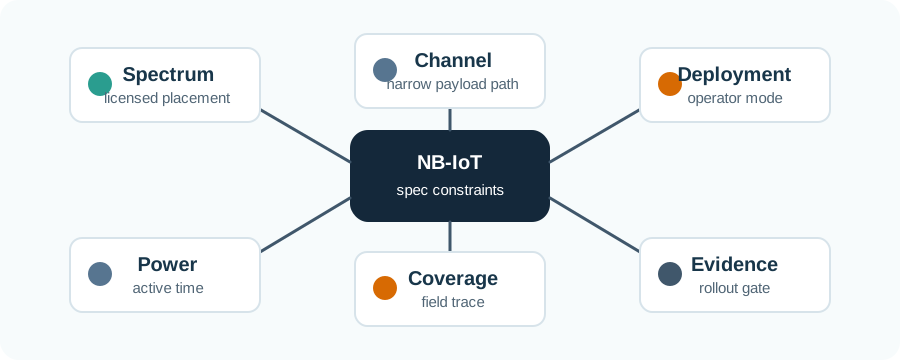
A feature must survive every layer.

  • If the standard defines a timer but the operator grants another value, the granted behavior controls reachability.
  • If the radio module supports a band but the antenna does not, the product does not have that band in practice.
NB-IoT technical specification map linking spectrum placement, narrowband channel, deployment mode, power behavior, coverage enhancement, payload profile, and validation evidence.
iotclass.org

Major section

Turn the Specifications Map Into Tests (continued)

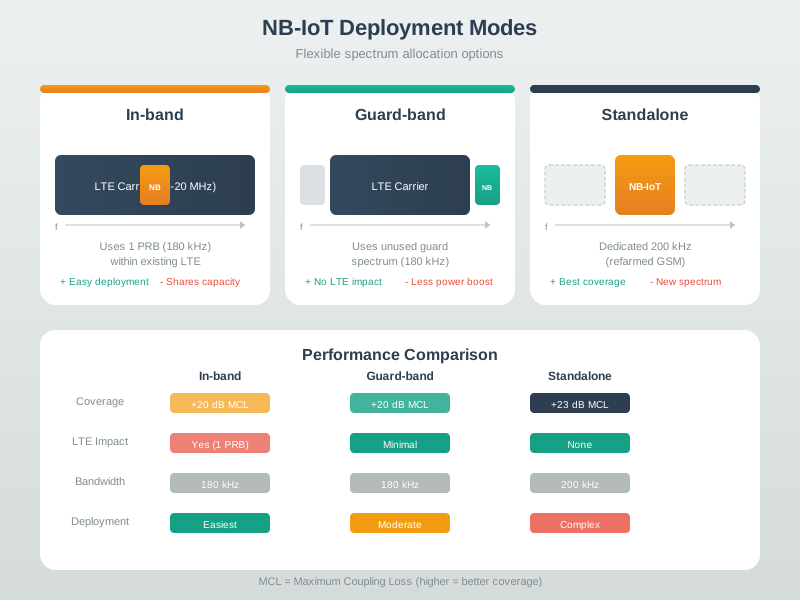
The modes explain how an operator can deploy NB-IoT; they are not settings an application can switch without network support.

  • Application throughput for the first transfer is (200\times8/4.0=400\ \mathrm{bps}); for the second it is about (88.9\ \mathrm{bps}).
  • Link each product promise—daily battery use, maximum report delay, indoor reach, or downlink window—to one or more observed fields.
  • Specifications and operator behavior change by radio module release, network, region, and radio conditions.
iotclass.org

Major section

Overview: A Specification Is a Constraint Stack

It sends a small reading each day and a rare fault alarm.

  • A table may promise deep reach and long battery life, but the product still has to complete its whole send-and-sleep job at that exact site.
  • Extra coverage attempts may improve reach while using more time and energy.

Key terms

Firmware
Firmware is the software that runs inside the device.
payload
payload is the useful data carried in a message.
NB-IoT technical specification map linking spectrum placement, narrowband channel, deployment mode, power behavior, coverage enhancement, payload profile, and validation evidence.
iotclass.org

Major section

Overview: A Specification Is a Constraint Stack (continued)

A maximum in a specification is not a promise for every operator, band, device, or building.

  • Long sleep life cannot be claimed from sleep current alone.
  • Firmware is the software that runs inside the device.
  • A payload is the useful data carried in a message.
iotclass.org

Major section

Under the Hood: The Product Transaction Is the Real Spec Test
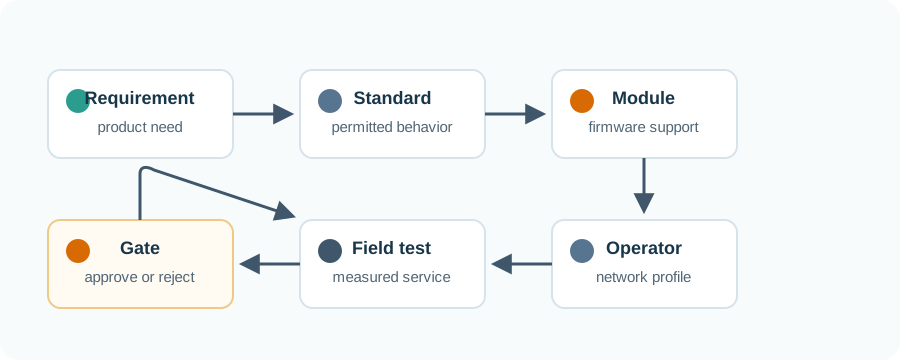
That order shows validation loop for NB-IoT technical specifications from required capability to standards reference, module support, operator profile, field measurement, and rollout decision.

  • It connects to under the hood: the product transaction is the real spec test by requiring evidence at each boundary instead of accepting only the final success state.
Validation loop for NB-IoT technical specifications from required capability to standards reference, module support, operator profile, field measurement, and rollout decision.
iotclass.org

Major section

Phoebe's Field Notes: Why the Network, Not the Device, Carries the Gain

The mathematical gist.: The Kraus beamwidth estimate for a 65° by 7° sector gives 41253/(65×7)=90.7 linear directivity, or 19.6 dBi.

  • Its 455 square-degree beam-area proxy is 1.10% of all directions.

Numbers to remember

1.10%Its 455 square-degree beam-area proxy is 1.10% of all directions.
iotclass.org

Deck summary

Key takeaways

A feature must survive every layer.

  • The modes explain how an operator can deploy NB-IoT; they are not settings an application can switch without network support.
  • It sends a small reading each day and a rare fault alarm.
  • A maximum in a specification is not a promise for every operator, band, device, or building.
  • That order shows validation loop for NB-IoT technical specifications from required capability to standards reference, module support, operator profile, field measurement, and rollout decision.
iotclass.org

Retrieval practice

Recall check 1 of 3

Radio Remi says: answer from memory, then check your reasoning.

Q1A product team sees Cat-NB2, PSM, and eDRX listed for NB-IoT. What evidence should they collect before claiming the field device can meet its service target?

AApprove the design because standardized features are available on every module and operator.
BVerify module, operator, SIM/eSIM, and field evidence for the target transaction.
CUse a peak table as proof that any payload size and delay target will work.
DSkip field testing if the modem attaches once in a lab.
Show answer

Answer: B NB-IoT technical review should connect the listed standard features to modem firmware, carrier enablement, profile behavior, and measured service evidence before approval.

iotclass.org

Retrieval practice

Recall check 2 of 3

Radio Remi says: answer from memory, then check your reasoning.

Q2A selected module advertises an NB-IoT feature and the product depends on it. What is the strongest validation record?

AA standards reference alone, because every release-era feature is enabled in every network.
BA coverage map alone, because deployment mode and operator service are the same everywhere.
CA record of firmware, operator, SIM/eSIM, field logs, current trace, and receipt.
DA single successful lab attach, because attach proves payload timing and battery life.
Show answer

Answer: C The validation record should prove the selected NB-IoT feature across module, operator, profile, field, and application layers.

iotclass.org

Retrieval practice

Recall check 3 of 3

Radio Remi says: answer from memory, then check your reasoning.

Q3Why is a product transaction log stronger evidence than a peak-rate table for NB-IoT design?

ABecause peak-rate tables are unrelated to cellular networks.
BBecause NB-IoT always sends large payloads at the same rate in every cell.
CBecause the application server does not need to acknowledge successful receipt.
DIt shows payload, coverage, retries, timing, power trace, receipt, and recovery.
Show answer

Answer: D NB-IoT technical validation should prove the full product transaction rather than relying on isolated nominal values.

iotclass.org

Print reference

Answers

Answer key.

  1. B · NB-IoT technical review should connect the listed standard features to modem firmware, carrier enablement, profile behavior, and measured service evidence before approval.
  2. C · The validation record should prove the selected NB-IoT feature across module, operator, profile, field, and application layers.
  3. D · NB-IoT technical validation should prove the full product transaction rather than relying on isolated nominal values.
iotclass.org