Cellular IoT · Study deck
NB-IoT Power Saving (PSM/eDRX)
A buried water meter may sleep for hours, wake to send a reading, and then become unreachable again.
Radio Remi is your guide for this deck.

After studying this chapter
Learning objectives
You will be able to:
- Explain: Request timer values, capture what the network grants, observe registration and paging behavior, measure current across the full cycle, and compare results with the reachability contract.
- Explain: The wider service can wait for a planned contact, but it should not promise an immediate command when the radio is unreachable.
- Explain: Under the Hood examines timer state, network grants, paging windows, retries, phase energy, firmware changes, and the evidence needed at representative sites.
- Explain: After an uplink, expect the modem to remain reachable for the granted active interval, then show the eDRX or PSM transition.
Major section
Read the Timer Gate From Wake to Sleep
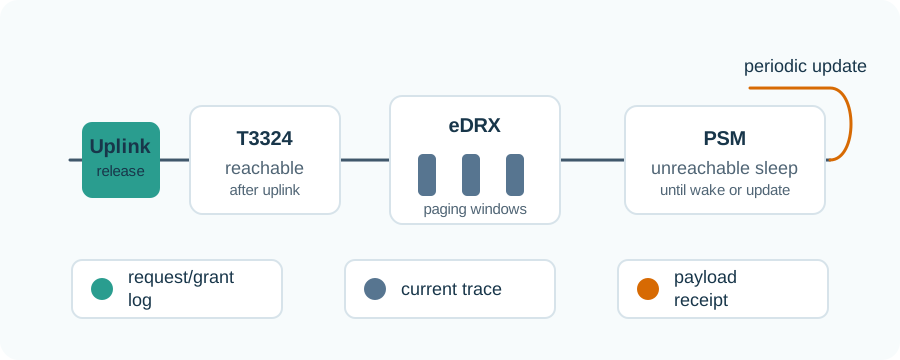
PSM turns the radio off more deeply; the network cannot page the device until it wakes for its own activity.
- Figure: Evidence loop for NB-IoT power saving from requirements adds the operational decision.
- A command arriving just after that window may wait almost six hours.
- Energy arithmetic needs the whole cycle.
Major section
Read the Timer Gate From Wake to Sleep (continued)
Request timer values, capture what the network grants, observe registration and paging behavior, measure current across the full cycle, and compare results with the reachability contract.
- Charge per cycle is ((120\times20+8\times100+0.02\times21{,}480)/3{,}600=1.01\ \mathrm{mAh}).
- Four cycles per day use about 4.04 mAh before battery ageing, retransmissions, temperature effects, and regulator losses.
- Networks and modem firmware can grant, round, or reject timers differently.
Major section
Read the Timer Gate From Wake to Sleep (continued)
Extra access attempts and longer radio-on time can dominate charge even when PSM current stays unchanged.
- After an uplink, expect the modem to remain reachable for the granted active interval, then show the eDRX or PSM transition.
- A configuration update may wait for the next wake, but an old open-valve command may no longer be valid then.
- When a command waits, those values distinguish normal PSM delay from a lost meter.
Major section
Overview: Power Saving Is a Reachability Contract
Firmware is the software stored on the meter.
- The service team may want to send a new setting, but the meter cannot save energy and listen all the time.
- The product promise must say when a reply can arrive and how long the team may wait.
Major section
Overview: Power Saving Is a Reachability Contract (continued)
A low sleep current or requested timer is not field proof.
- The wider service can wait for a planned contact, but it should not promise an immediate command when the radio is unreachable.
- This opening does not choose one timer or power mode.
- Under the Hood examines timer state, network grants, paging windows, retries, phase energy, firmware changes, and the evidence needed at representative sites.
Major section
Under the Hood: Timers Shape the State Machine
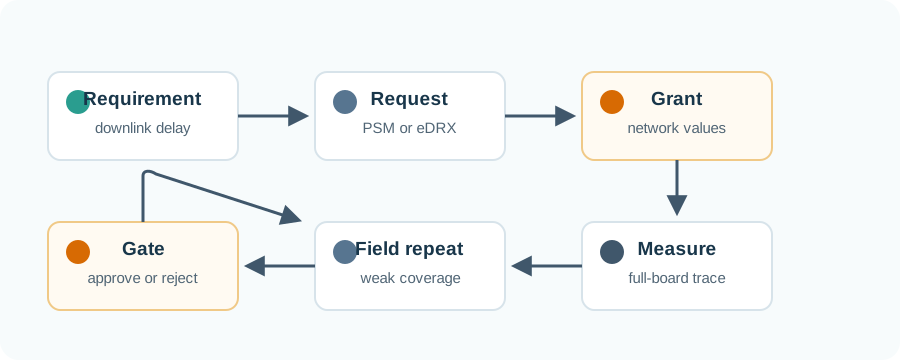
A requested timer is not a granted one, so the loop turns on the grant step.
- Under the hood, the granted timers are what shape the device's state machine.
Deck summary
Key takeaways
PSM turns the radio off more deeply; the network cannot page the device until it wakes for its own activity.
- Request timer values, capture what the network grants, observe registration and paging behavior, measure current across the full cycle, and compare results with the reachability contract.
- Extra access attempts and longer radio-on time can dominate charge even when PSM current stays unchanged.
- Firmware is the software stored on the meter.
- A low sleep current or requested timer is not field proof.
Retrieval practice
Recall check 1 of 3

Radio Remi says: answer from memory, then check your reasoning.
Q1A water meter sends one daily reading and can receive queued configuration changes immediately after that report. Which first design choice best matches the reachability requirement?
Show answer
Answer: A PSM and eDRX are selected from reachability needs, then approved only with granted timer and measured energy evidence.
Retrieval practice
Recall check 2 of 3

Radio Remi says: answer from memory, then check your reasoning.
Q2A prototype requests long PSM timers and the spreadsheet shows excellent battery life, but the test report only includes requested values and a modem-only sleep-current measurement. What should the reviewer do?
Show answer
Answer: C A defensible PSM/eDRX gate joins network grants, current traces, cloud evidence, and recovery behavior.
Retrieval practice
Recall check 3 of 3

Radio Remi says: answer from memory, then check your reasoning.
Q3A fleet uses PSM for normal daily reports and eDRX during a monthly maintenance window. Which evidence best proves the under-the-hood state machine is safe?
Show answer
Answer: D Hybrid PSM/eDRX designs need transition evidence, not only mode labels or requested timer constants.
Print reference
Answers
Answer key.
- A · PSM and eDRX are selected from reachability needs, then approved only with granted timer and measured energy evidence.
- C · A defensible PSM/eDRX gate joins network grants, current traces, cloud evidence, and recovery behavior.
- D · Hybrid PSM/eDRX designs need transition evidence, not only mode labels or requested timer constants.