Cellular IoT · Study deck
NB-IoT Fundamentals
Begin with a fixed meter.
Radio Remi is your guide for this deck.

After studying this chapter
Learning objectives
NB-IoT fit depends on a measured transaction at the intended installation.
- NB-IoT fits compact scheduled messages with delayed downlink tolerance.A mostly stationary basement meter sending a daily record is the chapter’s starting candidate, rather than a moving camera or urgent controller.
- Field approval needs operator, device, antenna, payload, and application evidence.The selected SIM profile, final enclosure, installation site, and delivery path must work together in the reviewed transaction.
- Requested power timers are different from network-granted values.The firmware can ask for PSM or eDRX settings, but the operator grants the values used by the device.
- The battery budget must include attach, retries, waiting, and recovery.Low sleep current cannot account for the active work that a weak link can add to each reporting cycle.
Major section
The daily meter record through the operator (1/2)
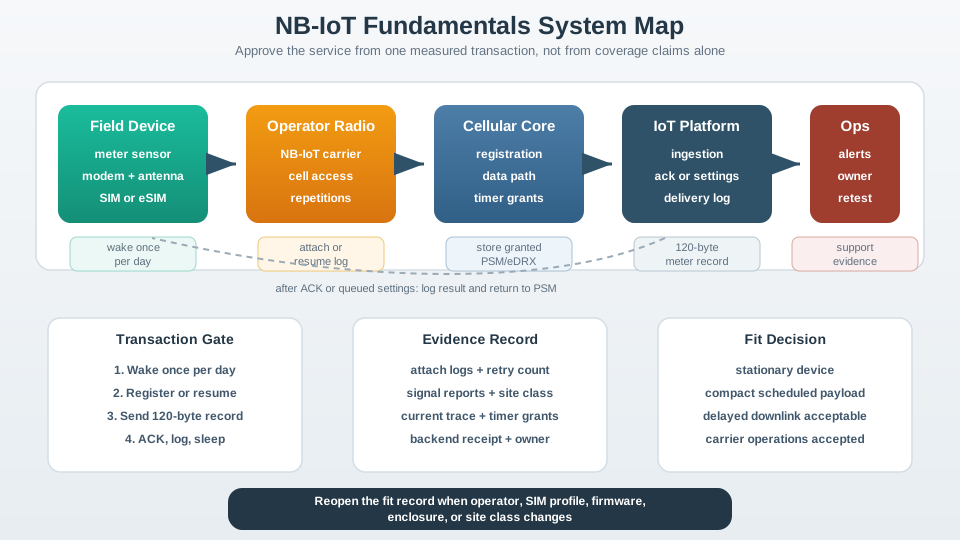
This system map follows the meter record; start at the sensor and trace delivery through the operator.
- The meter supplies the daily 120-byte record at the map’s start.The field transaction is defined by a specific payload and cadence rather than a general promise of deep coverage.
- The module and SIM connect the device to its operator service.That boundary needs the selected module, firmware, SIM or eSIM profile, and carrier path to support the intended installation.
Major section
The daily meter record through the operator (2/2)
- Radio, core, and platform are successive boundaries before application delivery.A successful attach cannot establish that the meter record reached the backend with useful acknowledgement and delivery evidence.
- Operations evidence records the result and return to PSM.The trace identifier, logged outcome, and measured cycle are needed to review the complete daily transaction.
Major section
The complete report cycle and absent service (1/2)
The approval concerns one complete report cycle rather than a general promise of long battery life.
- The daily cycle includes wake, attach, send, confirmation, and sleep.The device must deliver its 120-byte record, log the result, and return to PSM within the measured time and energy budget.
- Representative sites need both time and energy measurements.The weakest installation is part of the trial because thick walls or poor coverage can add retries and waiting.
Major section
The complete report cycle and absent service (2/2)
- Absent service needs a storage and retry policy.The meter must keep the reading’s age while following a clear retry rule instead of losing the observation’s original context.
- The application must distinguish delayed records from current measurements.An old reading that arrives after recovery cannot be presented as a fresh observation merely because the backend just received the message.
Activity 1 · Draw it
✎ Trace the daily meter report

I want you to account for the complete report before you trust the battery claim.
Draw wake, attach or resume, send the 120-byte record, confirm, log, and return to PSM. Mark where retries can cost time and energy. Add a branch for absent service that preserves the reading and its age.
4 minutes · Pen and paper · Answer: Activity 1
Major section
Overview: NB-IoT Is Narrowband Cellular for Small, Delayed Messages (continued)
It may also use more energy.
- Better reach is never free.
- This quick path is only a fit test.
- Practitioner work records the site trial and battery budget.
- Under the Hood explains the timers and repeated sends that can change both reach and service life.
Major section
Practitioner: Build the NB-IoT Fit Record
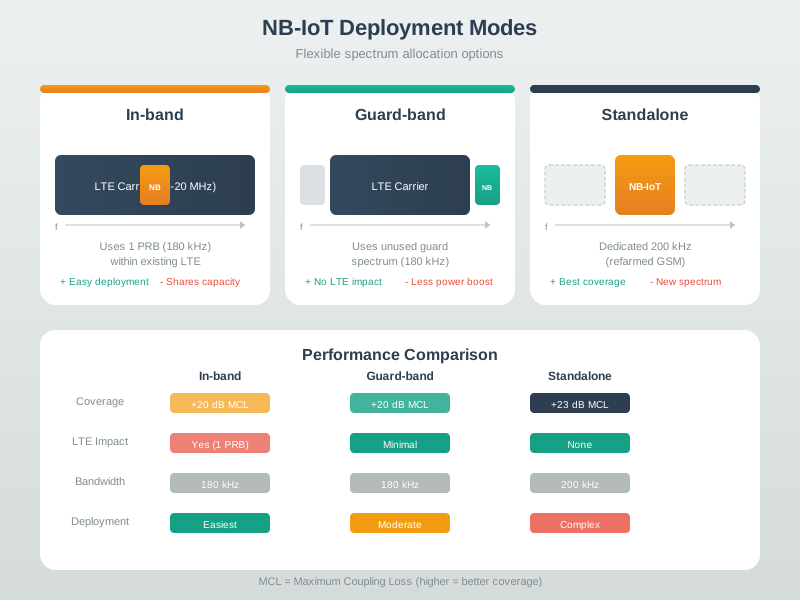
They show where an operator can host NB-IoT.
- They do not prove coverage or speed for a product.
- The test row starts with the target band and mode.
- The mode is useful context, but it is not the release proof.
- That proof must come from the final modem, network, antenna, case, and field sites.
Major section
Uplink, paging windows, and PSM (1/2)
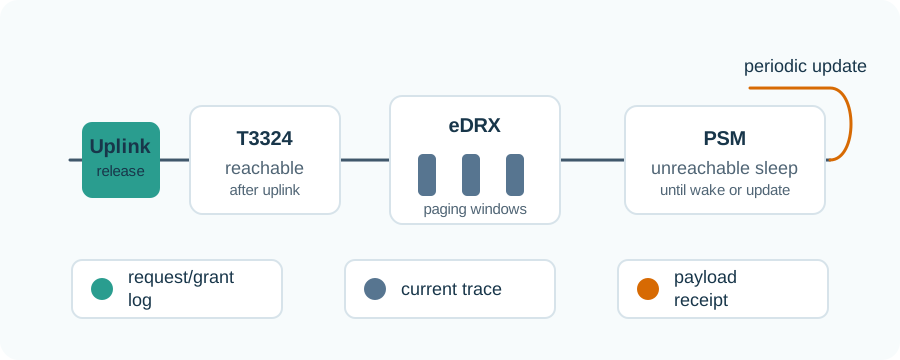
This timeline shows changing reachability; follow Uplink through T3324, paging windows, and PSM.
- The uplink is followed by the T3324 active-timer interval.The timeline begins with transmission and then shows the period after uplink, connecting timing with the device’s changing reachability.
- eDRX paging windows reduce listening while preserving some reachability.The application must tolerate the command delay created by those windows rather than assuming the device listens continuously.
Major section
Uplink, paging windows, and PSM (2/2)
- PSM preserves registration context but leaves the sleeping device unreachable.The network cannot reach the meter until it wakes, making scheduled reporting a better fit than an urgent command path.
- Granted timer values must fit command delay and measured energy limits.A network or SIM-profile update can change the grants and require the team to reopen earlier scheduling and battery assumptions.
Major section
Antenna gain and the ideal repetition bound (1/2)
The antenna example connects gain with an ideal bound that still needs field validation.
- At 900 MHz, the chapter’s wavelength is 0.333 m.That wavelength is the starting quantity for the illustrative antenna-aperture comparison, whose field result still needs measurement.
- A gain increase from 0 to 5 dBi multiplies ideal aperture by 3.16.The collecting-aperture increase is an ideal relationship, while orientation and installed loss still constrain the physical installation.
Major section
Antenna gain and the ideal repetition bound (2/2)
- The illustrative 23 dBm radio becomes 28 dBm EIRP.Adding the 5 dBi installed gain gives the chapter’s comparison, not a universal field-energy guarantee for every meter.
- The 5.06 ideal repeats are a physics bound, not a modem setting.The illustrative 16-repeat margin changes mathematically, but network scheduling and measured energy still determine the supported field result.
Major section
Under the Hood: Timers, Coverage, and Payload Shape Drive the Tradeoff (continued)
This ordering prevents a technology label from outranking the behaviour the product must prove.
- Stationary use, small messages, the full-cycle battery goal, delayed-downlink tolerance, and an evidenced operator path must all hold.
- A complete and observed transaction can become an NB-IoT candidate record; uncertainty calls for a pilot.
- High mobility, high throughput, low-latency control, or private-network ownership instead routes the workload elsewhere.
Major section
How Antenna Gain Buys Back Battery
The mathematical gist: At 900 MHz, wavelength is 0.333 m.
- The last value is a physics bound, not a supported modem setting; orientation, installed loss, network scheduling, and measured energy still decide the field result.
Major section
A non-cellular workload comparison
This Sigfox comparison shows workload limits; compare reach, small frames, and short bursts before the fit cards.
- The Sigfox reach region is paired with a constrained data envelope.This non-cellular baseline links long reach to workload limits before the chapter compares NB-IoT rather than assuming equivalent radio behaviour.
- Tiny, sparse frames limit message size and frequency.The baseline’s data envelope is suited to small telemetry, while video and frequent large transfers need a different fit assessment.
- Short transmit bursts connect the workload with the energy envelope.The illustration shows reach, sparse data, and short bursts as one trade rather than three independent performance promises.
- The fit cards separate telemetry from video and closed-loop control.Meters and alarms are the good-fit examples, while the poor-fit cards show why the interaction requirement must remain explicit.

Major section
The installed wake-to-sleep energy budget
The whole wake-to-sleep cycle determines whether the meter can meet its service-life goal.
- Joining the network consumes energy before the application receives a reading.The whole wake, connect, send, confirm, and sleep cycle must be counted when reviewing the basement meter’s service-life goal.
- Weak coverage can increase repeated access attempts and failed sends.Extra radio work can improve reach but also increase the transaction’s delay and energy cost.
- The final enclosure and antenna need site testing.A coverage-map label or lab evaluation-board attach cannot establish installed behaviour behind the basement’s thick walls.
- Large transfers, urgent control, and mobility need a different fit review.The quiet fixed meter is a starting candidate whose small-message assumptions cannot support every cellular IoT workload.
Major section
Standalone, guard-band, and in-band placement
Spectrum placement changes coexistence questions while leaving service evidence necessary.
- Standalone deployment uses a dedicated refarmed carrier.The spectrum placement is separate from service proof, so coverage, interference, capacity, and lifecycle still need evidence.
- Guard-band deployment uses LTE edge spectrum for the carrier.This arrangement changes coexistence questions, while the operator’s actual deployment and measured sites still define the supported service.
- In-band deployment shares an LTE carrier through scheduled resources.Scheduler behaviour is part of the evidence needed to explain how the narrowband service operates inside the LTE carrier.
- Every placement still needs coverage, interference, capacity, and lifecycle evidence.The common planning questions prevent a spectrum-mode label from becoming a universal claim about throughput or installed coverage.
Deck summary
Key takeaways
A defensible NB-IoT decision joins service fit, power evidence, delivery proof, and support ownership.
- Small scheduled records make a stationary meter a useful starting candidate.The daily 120-byte transaction needs delayed-command tolerance and an operator-managed path that works at the actual installation.
- The exact operator and installed device define the evidence boundary.Module firmware, antenna, enclosure, SIM profile, and representative site measurements must support the approved reporting behaviour.
- Granted timers and active transaction costs determine the power tradeoff.Attach, retry, waiting, and recovery can dominate a cycle even when the device has a very low nominal sleep current.
- Carrier, firmware, enclosure, and site changes can require another pilot.The fit record needs a retest trigger so a changed deployment cannot silently inherit stale coverage, timing, or battery assumptions.
Retrieval practice
Recall check 1 of 3
Radio Remi says: answer from memory, then check your reasoning.
Q1Which project is the strongest starting candidate for NB-IoT?
Show answer
Answer: B NB-IoT is strongest for mostly stationary, low-throughput devices that can tolerate delayed downlink and use operator-managed cellular service.
Retrieval practice
Recall check 2 of 3
Radio Remi says: answer from memory, then check your reasoning.
Q2A team wants to approve NB-IoT for meters in basements and outdoor cabinets. What should the fit record include before rollout?
Show answer
Answer: D The NB-IoT fit record should tie service, field, power, and application evidence to a decision.
Retrieval practice
Recall check 3 of 3
Radio Remi says: answer from memory, then check your reasoning.
Q3Why can an NB-IoT battery estimate fail even when the modem has a very low sleep current?
Show answer
Answer: C NB-IoT power evidence must include the whole report cycle, not only the low-current sleep state.
Print reference
Answers
Answer key.
- B · NB-IoT is strongest for mostly stationary, low-throughput devices that can tolerate delayed downlink and use operator-managed cellular service.
- D · The NB-IoT fit record should tie service, field, power, and application evidence to a decision.
- C · NB-IoT power evidence must include the whole report cycle, not only the low-current sleep state.
Print reference
Activity 1 answer
Model answer.
Draw it: The model follows wake, attach or resume, payload transfer, confirmation, logging, and PSM. Failed access or delivery can add retries and waiting. The absent-service branch stores the reading with its age and follows a defined retry rule, preventing stale data from appearing current.