Cellular IoT · Study deck
NB-IoT Coverage Enhancement
Picture a meter in a deep basement box.
Radio Remi is your guide for this deck.

After studying this chapter
Learning objectives
You will be able to:
- Explain: If every weak location uses heavy repetition at the same reporting time, the network, battery budget, and support process may all see load that the single-device pilot did not expose.
- Explain: The mathematical gist: At 900 MHz, a 0 dBi antenna installed at 70% efficiency has −1.55 dBi realized gain and 21.45 dBm EIRP from a 23 dBm transmitter.
- Explain: Repetition can improve decodability while lengthening the active window, so radio success, application receipt, latency, transaction energy, and return to sleep must agree before the site class is released.
Major section
Overview: Coverage Is Proven at the Installation Point
The message arrives late and the battery pays for each try.
- A single success is not enough.
- A payload is the useful data carried in a message: Latency means the time from sending work to receiving the needed result.
- Firmware is the software stored on the device.
- More repeats can help a weak link.
Major section
Overview: Coverage Is Proven at the Installation Point (continued)
They also use time, air space, and battery energy.
- Practitioner records site classes and repair order.
- Under the Hood explains coding, scheduling, repeats, and cell load.
- Those details can explain the trade.
- NB-IoT coverage enhancement helps weak radio links by combining narrowband operation, robust coding, scheduling, and repeated transmissions.
Major section
Overview: Coverage Is Proven at the Installation Point (continued)
The goal is not to make every hard location acceptable.
- The goal is to decide whether a real device, in its real enclosure and mounting position, can deliver the application payload without breaking battery, latency, or support expectations.
- A coverage map or a single successful attach can start the review, but it cannot approve a fleet.
- That prevents one convenient site from becoming evidence for every difficult location.
Major section
Overview: Coverage Is Proven at the Installation Point (continued)
Coverage enhancement is useful when it keeps the full product promise inside budget.
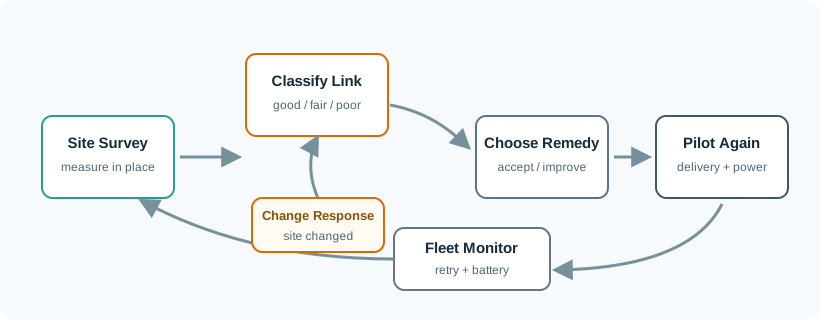
- The approval evidence is gathered at representative good, marginal, and weak sites with the production antenna, firmware, SIM profile, payload cadence, and sleep policy.
- A basement cabinet, an outdoor pit, a rooftop enclosure, and a street-level meter can have different approved actions even in the same city.
- Indoor and below-grade paths often differ from outdoor coverage assumptions.
Major section
Overview: Coverage Is Proven at the Installation Point (continued)
Each class should record delivery rate, retry pattern, measured transaction energy, application acknowledgement, and the remediation action that was accepted.
- The release decision should say whether the site is approved, approved with installation constraints, sent for remediation, or assigned to another network path.
- The purpose is to judge the whole transaction rather than celebrate one successful attach.
- Weak locations need a remediation rule before rollout.
Major section
Practitioner: Write the Coverage Review Record
A coverage review record keeps weak-link decisions from becoming anecdotal.
- The record is especially important for rooms, cabinets, pits, and enclosures where a small installation change can turn an acceptable link into a support problem.
- The device connects only through costly retry behavior that later drains the battery.
Major section
Under the Hood: Repetitions Trade Airtime for Decodability
Coverage enhancement works by making weak radio evidence more recoverable, but the mechanism has a cost.
- Repeated transmissions, robust coding, access retries, and longer grant waits can stretch a small payload into a much longer active window.
- Battery projections must include search, access, grant waits, repetitions, retries, acknowledgements, and return-to-sleep behavior.
Major section
Under the Hood: Repetitions Trade Airtime for Decodability (continued)
Measured active windows fit the battery model with margin.
- That active window drives battery impact and can also affect alarm timing, network load, and fleet support behavior.
- A link budget is useful for screening a design, but it is not a release gate by itself.
- Remediate placement, timing, coverage support, or network choice.
Major section
Under the Hood: Repetitions Trade Airtime for Decodability (continued)
Payload arrives consistently under the intended cadence and acknowledgement policy.
- The same received-power value can behave differently across operators, modules, firmware versions, antenna placements, and enclosure materials.
- If every weak location uses heavy repetition at the same reporting time, the network, battery budget, and support process may all see load that the single-device pilot did not expose.
- Fix application path, retry policy, or network fit before rollout.
Major section
Under the Hood: Repetitions Trade Airtime for Decodability (continued)
Under-the-hood coverage review should therefore include normal, marginal, and poor-site traces, plus a rule for batching, staggering, relocating, or rejecting weak classes.
- Repetition can improve decodability while lengthening the active window, so radio success, application receipt, latency, transaction energy, and return to sleep must agree before the site class is released.
- Signal values are useful diagnostics, but operator configuration, module firmware, deployment mode, antenna design, and site materials change the practical result.
- The payload must arrive at the application with the right meaning, duplicate policy, late-message handling, and owner response.
Major section
Phoebe's Field Notes: Why the Cabinet Steals Gain the Datasheet Never Warned About
The mathematical gist: At 900 MHz, a 0 dBi antenna installed at 70% efficiency has −1.55 dBi realized gain and 21.45 dBm EIRP from a 23 dBm transmitter.
- The 6.69 dB installation penalty is an ideal 4.67× repeated-energy equivalent, not a coverage guarantee.
Deck summary
Key takeaways
The message arrives late and the battery pays for each try.
- They also use time, air space, and battery energy.
- The goal is not to make every hard location acceptable.
- Coverage enhancement is useful when it keeps the full product promise inside budget.
- Each class should record delivery rate, retry pattern, measured transaction energy, application acknowledgement, and the remediation action that was accepted.
Retrieval practice
Recall check 1 of 3

Radio Remi says: answer from memory, then check your reasoning.
Q1A basement NB-IoT sensor sends one successful test message, but the team has not recorded access attempts, repetition behavior, current trace, or application acknowledgements. What should the coverage review conclude?
Show answer
Answer: B Coverage approval depends on installed-device evidence, not on a single message or a generic coverage promise.
Retrieval practice
Recall check 2 of 3
Radio Remi says: answer from memory, then check your reasoning.
Q2A facilities pilot shows that utility-room sensors work near the doorway, but fail or retry heavily inside metal cabinets. Which remediation step should come before fleet approval?
Show answer
Answer: C Practitioner coverage work records which installed conditions are approved, which need remediation, and which should move to another network path.
Retrieval practice
Recall check 3 of 3
Radio Remi says: answer from memory, then check your reasoning.
Q3A weak-location NB-IoT pilot meets payload delivery targets, but the current trace shows the active window is far longer than the battery model allowed. What is the correct under-the-hood decision?
Show answer
Answer: D Under-the-hood coverage review treats repeated weak-link behavior as a measured energy and operations cost.
Print reference
Answers
Answer key.
- B · Coverage approval depends on installed-device evidence, not on a single message or a generic coverage promise.
- C · Practitioner coverage work records which installed conditions are approved, which need remediation, and which should move to another network path.
- D · Under-the-hood coverage review treats repeated weak-link behavior as a measured energy and operations cost.