Cellular IoT · Study deck

NB-IoT Channel Access

An NB-IoT meter cannot transmit merely because it has a packet ready.

Radio Remi is your guide for this deck.

channelaccess
Radio Remi, the module guide, in a scene from this chapter.
iotclass.org

After studying this chapter

Learning objectives

You will be able to:

  • Explain: The mathematical gist.: A 4 dB installed antenna loss lowers a 23 dBm radio with a nominal 0 dBi antenna to 19 dBm EIRP and leaves 39.8% of the ideal receive aperture.
  • Explain: The visual is establishing NB-IoT uplink tone modes showing 15 kHz multi-tone allocations, 15 kHz single-tone operation, 3.75 kHz single-tone operation, and hopping across the narrowband carrier.
  • Explain: Closing 4 dB takes a 2.51× ideal repetition multiplier: an illustrative eight repeats become 20.1 ideally, or 32 only when a power-of-two step set is assumed.
iotclass.org

Major section

Follow One Scheduled Scheduled uplink
A registration icon alone cannot prove the final packet was accepted.

  • Figure: NB-IoT uplink tone modes showing 15 kHz multi-tone then shows how scheduled uplink resources can use single-tone or multi-tone arrangements.
  • The access network schedules the actual resource; the application does not select a throughput from a brochure.

Key terms

NB-IoT scheduling
NB-IoT scheduling is controlled by the deployed access network and modem implementation.

Why it matters

More assigned tones can shorten a transfer when coverage and channel-access device capability allow, while a narrow single-tone allocation supports robust operation at a different rate.

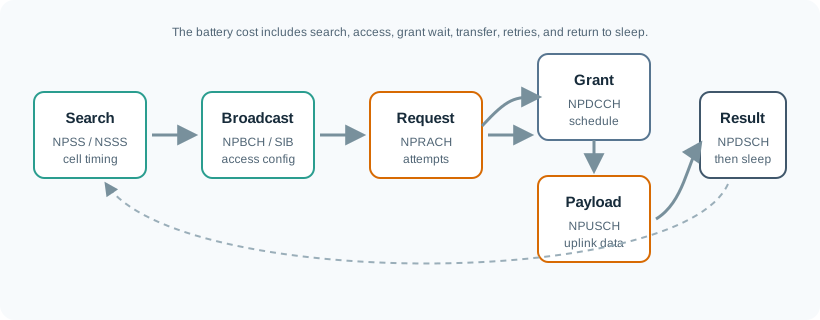
NB-IoT access flow from synchronization and broadcast information through NPRACH, NPDCCH scheduling, NPUSCH uplink, and NPDSCH response.
iotclass.org

Major section

Follow One Scheduled Scheduled uplink (continued)

The observed access-to-finish time is (1.420-0.400=1.020\ \mathrm{s}).

  • Two devices can choose the same random-access opportunity and collide.
  • In weak coverage, repetitions can improve decoding but occupy resources longer.
  • A speed claim without those conditions is not portable evidence.
  • Battery tests should include unsuccessful attempts.
iotclass.org

Major section

Follow One Scheduled Scheduled uplink (continued)

That comparison connects channel contention to channel-access device lifetime.

  • NB-IoT scheduling is controlled by the deployed access network and modem implementation.
  • A completed scheduled scheduled uplink can still be rejected by the service or wait behind a access network fault.
  • Changing both at once makes delay and charge evidence hard to attribute.
iotclass.org

Major section

Overview: Channel Access Makes NB-IoT Scheduled

The report itself is small, yet the device may spend most of its energy finding the cell, requesting a turn, waiting, repeating, and recovering from failure.

  • The access record must show that full awake period.
  • Modulation means changing a radio signal so it can carry information.
  • A payload means the useful content inside a message.
NB-IoT access flow from synchronization and broadcast information through NPRACH, NPDCCH scheduling, NPUSCH uplink, and NPDSCH response.
iotclass.org

Major section

Overview: Channel Access Makes NB-IoT Scheduled (continued)

A sent radio burst is not proof that the application received the report.

  • This trace does not predict every network or battery.
  • The deeper sections name the physical channels, grants, repetitions, coverage changes, and field records needed to defend the access and energy claim.
  • It turns overview: channel access makes nb-iot scheduled into a sequence of reviewable records rather than one end-to-end assumption.
iotclass.org

Major section

Practitioner: Approve the Grant You Measure
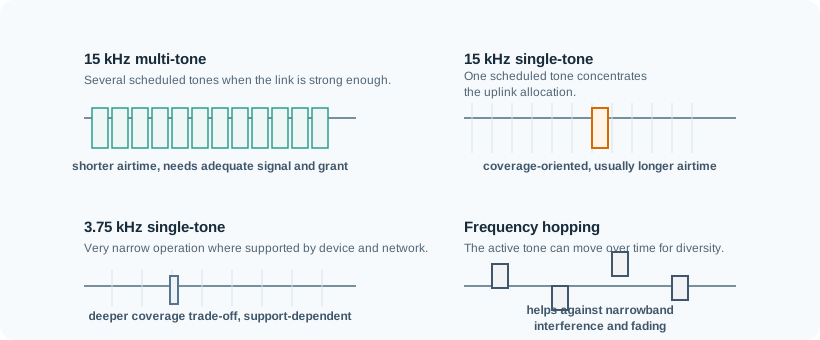
The visual is establishing NB-IoT uplink tone modes showing 15 kHz multi-tone allocations, 15 kHz single-tone operation, 3.75 kHz single-tone operation, and hopping across the narrowband carrier.

  • That test is the connection to uplink tone modes: evidence, limits, and retest triggers travel with the decision.
NB-IoT uplink tone modes showing 15 kHz multi-tone allocations, 15 kHz single-tone operation, 3.75 kHz single-tone operation, and hopping across the narrowband carrier.
iotclass.org

Major section

Phoebe's Field Notes: The Antenna Taxes Both Directions of the Handshake

The mathematical gist.: A 4 dB installed antenna loss lowers a 23 dBm radio with a nominal 0 dBi antenna to 19 dBm EIRP and leaves 39.8% of the ideal receive aperture.

  • Closing 4 dB takes a 2.51× ideal repetition multiplier: an illustrative eight repeats become 20.1 ideally, or 32 only when a power-of-two step set is assumed.

Numbers to remember

39.8%leaves 39.8% of the ideal receive aperture.
iotclass.org

Deck summary

Key takeaways

A registration icon alone cannot prove the final packet was accepted.

  • The observed access-to-finish time is (1.420-0.400=1.020\ \mathrm{s}).
  • That comparison connects channel contention to channel-access device lifetime.
  • The report itself is small, yet the device may spend most of its energy finding the cell, requesting a turn, waiting, repeating, and recovering from failure.
  • A sent radio burst is not proof that the application received the report.
iotclass.org

Retrieval practice

Recall check 1 of 3

Radio Remi says: answer from memory, then check your reasoning.

Q1Which statement best describes NB-IoT channel access?

ADiscover cell, request access, receive a grant, send uplink data, and confirm the result.
BThe application chooses any uplink tone and sends whenever it has data.
COnly payload size matters because NB-IoT packets are small.
DDownlink response behavior can be ignored once the device sends NPUSCH.
Show answer

Answer: A NB-IoT channel access is a scheduled sequence, not an application-controlled free transmission.

iotclass.org

Retrieval practice

Recall check 2 of 3

Radio Remi says: answer from memory, then check your reasoning.

Q2A battery-powered NB-IoT sensor has weak indoor coverage. Which approval rule is safest before rollout?

AConfirm field logs show grants, repetitions, retries, delivery, and current trace meet the gate.
BApprove the fleet because the module data sheet says NB-IoT supports deep coverage.
CUse one successful outdoor transfer as proof that every indoor enclosure will pass.
DCompare nominal uplink data rates and skip the current trace.
Show answer

Answer: A A channel plan is ready only when access, grant, payload, and current evidence pass in representative field conditions.

iotclass.org

Retrieval practice

Recall check 3 of 3

Radio Remi says: answer from memory, then check your reasoning.

Q3A pilot sends a small daily payload successfully, but the battery model is failing. Which channel-access evidence should the team inspect first?

AThe current trace for cell search, access attempts, grants, repetitions, retries, ACK, and return to sleep.
BOnly the application payload size, because the radio cost is always proportional to bytes sent.
CThe advertised peak uplink rate for NB-IoT under ideal conditions.
DA single successful delivery timestamp from the cloud platform.
Show answer

Answer: A The power cost of NB-IoT channel access is the complete active transaction, not just the bytes sent on NPUSCH.

iotclass.org

Print reference

Answers

Answer key.

  1. A · NB-IoT channel access is a scheduled sequence, not an application-controlled free transmission.
  2. A · A channel plan is ready only when access, grant, payload, and current evidence pass in representative field conditions.
  3. A · The power cost of NB-IoT channel access is the complete active transaction, not just the bytes sent on NPUSCH.
iotclass.org