Cellular IoT · Study deck
NB-IoT Architecture
A cellar meter reports successful network registration, but the billing service cannot find reading 42.
Radio Remi is your guide for this deck.

After studying this chapter
Learning objectives
You will be able to:
- Explain: The MME establishes and controls the bearer through S1-MME and S11, but application payload does not normally pass through the MME on this route.
- Explain: The core can deliver it through the SCEF using T6a for non-IP data delivery, with the external service reached through the exposure interface.
- Explain: It searches for NPSS/NSSS, decodes NPBCH, reads required system information on NPDSCH, and then uses the random-access procedure to request uplink resources.
- Explain: Keeping a stable reading identifier across them makes a lost measurement traceable without confusing successful attachment with a completed customer service.
Major section
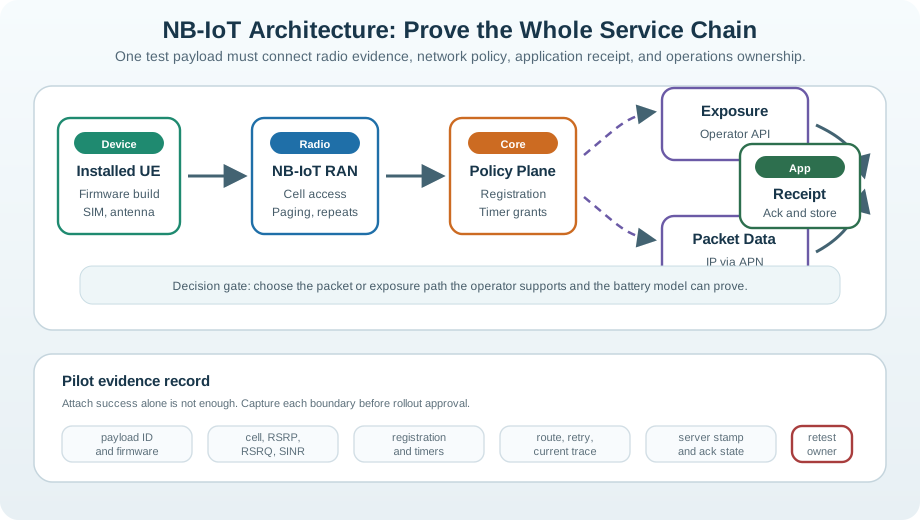
Overview: NB-IoT Architecture Is a Service Chain
Firmware is the software stored on a device.
- A payload is the useful data inside a message.
- Telemetry is data sent from a remote device for watching or review.
- A device may join the network but use the wrong data route.
- A cloud service may reject a good radio message.
Major section
Overview: NB-IoT Architecture Is a Service Chain (continued)
Long sleep saves power, yet it delays a reply and can make support harder.
- This cellar story cannot prove field cover, battery life, safe identity, or service quality.
- It also cannot show that every mobile operator grants the same settings.
- Those need an installed end-to-end test.
Major section
Under the Hood: Control, User, and Operations Boundaries
The UE carries data with signalling toward the MME over the radio and S1-MME control path.
- The user equipment (UE) first reaches an NB-IoT-capable eNodeB in the CIoT radio access network.
- From there, control and user data can take different routes.
- The UE cannot jump directly to application data.
Major section
Under the Hood: Control, User, and Operations Boundaries (continued)
A visible NPSS proves a cell can be detected.
- The MME establishes and controls the bearer through S1-MME and S11, but application payload does not normally pass through the MME on this route.
- NPRACH is the uplink random-access channel.
- A successful NPRACH proves an access preamble was detected.
Major section
Under the Hood: Control, User, and Operations Boundaries (continued)
The core can deliver it through the SCEF using T6a for non-IP data delivery, with the external service reached through the exposure interface.
- It searches for NPSS/NSSS, decodes NPBCH, reads required system information on NPDSCH, and then uses the random-access procedure to request uplink resources.
- Coverage repetitions can repeat these elements over time; the 180 kHz frequency footprint stays narrow while latency and energy grow.
- A preamble is sent as groups of single-tone symbols, and the tone index hops between symbol groups according to the configured pattern.
Major section
Locate Reading Forty-Two after Radio Access Succeeds
Repeating a transmission uses more time on that resource; it does not create a wider carrier.
- This helps explain why a visible cell and a completed access exchange do not establish a particular application response time.
- The installed subscription and software determine which route is in use.

Major section
Locate Reading Forty-Two after Radio Access Succeeds (continued)
The end-to-end delay is 8 s, assuming the two clocks are aligned well enough for that comparison.
- A radio event at 10:00:02 only establishes an intermediate point.
- The installed unit may still acquire the cell and register.
- Its uplink can still consume airtime while the application sees nothing.
Major section
Locate Reading Forty-Two after Radio Access Succeeds (continued)
The service should identify the repeated record and avoid billing the same usage twice, while preserving evidence that another delivery attempt occurred.
- This distinction gives the module's architecture practical value.
- Radio control, scheduled uplink and application receipt are separate observations that must be joined.
- Keeping a stable reading identifier across them makes a lost measurement traceable without confusing successful attachment with a completed customer service.
Deck summary
Key takeaways
Firmware is the software stored on a device.
- Long sleep saves power, yet it delays a reply and can make support harder.
- The UE carries data with signalling toward the MME over the radio and S1-MME control path.
- A visible NPSS proves a cell can be detected.
- The core can deliver it through the SCEF using T6a for non-IP data delivery, with the external service reached through the exposure interface.
Retrieval practice
Recall check 1 of 3

Radio Remi says: answer from memory, then check your reasoning.
Q1Which statement best describes a defensible NB-IoT architecture review?
Show answer
Answer: A NB-IoT architecture decisions should prove the device, radio, core, data path, application, and operations boundary together.
Retrieval practice
Recall check 2 of 3
Radio Remi says: answer from memory, then check your reasoning.
Q2A fixed sensor sends small daily reports, but the selected operator does not provide the exposure API the backend team expected. What is the best next architecture step?
Show answer
Answer: A NB-IoT data-path selection depends on operator support and measured behavior, not on the technology label alone.
Retrieval practice
Recall check 3 of 3
Radio Remi says: answer from memory, then check your reasoning.
Q3Why is one successful NB-IoT uplink not enough to approve the architecture?
Show answer
Answer: A Architecture approval needs evidence for every boundary that can fail in the field, not just one uplink demonstration.
Print reference
Answers
Answer key.
- A · NB-IoT architecture decisions should prove the device, radio, core, data path, application, and operations boundary together.
- A · NB-IoT data-path selection depends on operator support and measured behavior, not on the technology label alone.
- A · Architecture approval needs evidence for every boundary that can fail in the field, not just one uplink demonstration.