Cellular IoT · Study deck

NB-IoT Metering and Telemetry

A water meter, soil probe, and asset tracker may all use NB-IoT, yet they differ in payload timing, mobility, alarm urgency, and downlink need.

Radio Remi is your guide for this deck.

Radio Remi, the module guide, in a scene from this chapter.
iotclass.org

After studying this chapter

Learning objectives

You will be able to:

  • Explain: The new modem identity must map to the same approved asset only after installation evidence, and an old module should no longer deliver records for that asset.
  • Explain: The example cadence yields 12 × 24 = 288 records/day at five-minute intervals, and 100 bytes per record gives 28,800 payload bytes before overhead.
  • Explain: An asset tracker reporting every five minutes sends (12\times24=288) records; at 100 bytes each, that is 28,800 payload bytes.
  • Explain: That comparison is a test target; wet ground, lid material, pattern shape, mismatch, and serving-cell geometry still need measurement.
iotclass.org

Major section

Compare Metering, Agriculture, and Tracking Paths

A delayed batch can be acceptable if none of those records becomes ambiguous.

  • Soil moisture changes slowly, but a valve command has a physical effect.
  • One meter sends a 100-byte reading every hour, producing (24\times100=2{,}400) payload bytes per day before protocol overhead.

Why it matters

A silent meter, field probe, and moving tracker imply different urgency, so their alarm windows should not be copied merely because the radio technology matches.

Smart metering architecture with utility meter, MCU, NB-IoT module, cellular network, and utility backend.
iotclass.org

Major section

Compare Metering, Agriculture, and Tracking Paths (continued)

A soil station sends four 100-byte sensor records each hour, or 9,600 payload bytes daily.

  • An asset tracker reporting every five minutes sends (12\times24=288) records; at 100 bytes each, that is 28,800 payload bytes.
  • For the tracker, cross a coverage gap and verify queued locations keep their original times.
  • The new modem identity must map to the same approved asset only after installation evidence, and an old module should no longer deliver records for that asset.
iotclass.org

Major section

Overview: NB-IoT Fits Sparse, Patient Telemetry

It sends one small reading and then sleeps.

  • Telemetry means time-stamped reports about device state or events.
  • A payload is the useful data carried in one message.
  • Firmware is the software stored on the device.
  • NB-IoT can fit this patient pattern.

Key terms

payload
payload is the useful data carried in one message.
Smart metering architecture with utility meter, MCU, NB-IoT module, cellular network, and utility backend.
iotclass.org

Major section

Overview: NB-IoT Fits Sparse, Patient Telemetry (continued)

Practitioner builds the site and support record.

  • Under the Hood covers radio states, delayed downlink, energy cost, and operator limits.
  • Those details may rule out a site that the simple pattern seemed to fit.
  • Those labels make smart metering architecture with utility meter, MCU, NB-IoT module, cellular network, and utility backend concrete.
iotclass.org

Major section

Under the Hood: Fit Depends on State Boundaries
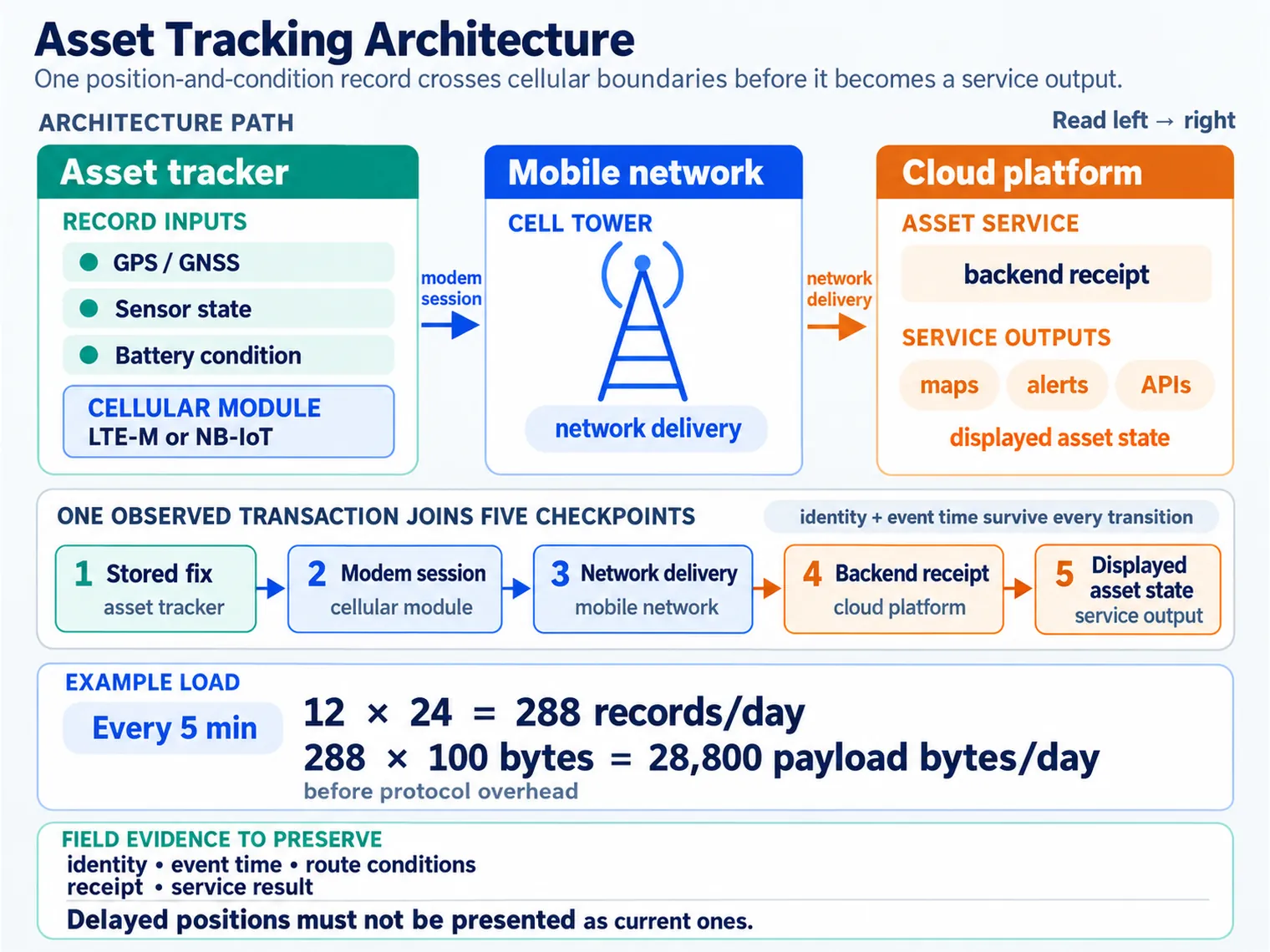
The service outputs—maps, alerts, and APIs—depend on the identity and event time surviving every transition.

  • The example cadence yields 12 × 24 = 288 records/day at five-minute intervals, and 100 bytes per record gives 28,800 payload bytes before overhead.
Asset tracker integrates GNSS, sensors, and power via LTE-M or NB-IoT, sending data to a cloud for services like maps, alerts, and APIs.
Asset tracking architecture with GPS, LTE-M cellular module, sensors, battery, cellular tower, and cloud platform.
iotclass.org

Major section

Phoebe's Field Notes: Why A Street-Level Sensor's Antenna Cheats Downward

A 3 dBi skyward patch reaches 26 dBm, a 9 dB or 7.94× on-axis power-density recovery.

  • That comparison is a test target; wet ground, lid material, pattern shape, mismatch, and serving-cell geometry still need measurement.

A 23 dBm transmitter with a nominal 0 dBi chip antenna falls to 17 dBm EIRP after an illustrative 6 dB installed ground loss.

iotclass.org

Deck summary

Key takeaways

A delayed batch can be acceptable if none of those records becomes ambiguous.

  • A soil station sends four 100-byte sensor records each hour, or 9,600 payload bytes daily.
  • It sends one small reading and then sleeps.
  • Practitioner builds the site and support record.
  • The service outputs—maps, alerts, and APIs—depend on the identity and event time surviving every transition.
iotclass.org

Retrieval practice

Recall check 1 of 4

Radio Remi says: answer from memory, then check your reasoning.

Q1Which application pattern is the strongest first-pass fit for NB-IoT?

AFixed meter with compact scheduled reads, buffering, and installed coverage.
BA vehicle tracker that needs live route updates and connected mobility throughout a trip.
CA camera node that uploads images and receives frequent firmware packages.
DA safety controller that requires immediate closed-loop commands from the network.
Show answer

Answer: A NB-IoT is strongest for sparse, fixed or mostly fixed telemetry with measured coverage and tolerant reachability requirements.

iotclass.org

Retrieval practice

Recall check 2 of 4

Radio Remi says: answer from memory, then check your reasoning.

Q2A basement leak-sensor pilot reports one clean uplink from a development board near a window. What should the practitioner request before approving rollout?

AFinal-hardware site tests, retry current, outage behavior, and ownership.
BApproval, because one clean uplink proves all basements and enclosures will work.
COnly a smaller payload, because payload size is the only rollout risk.
DOnly a lower subscription price, because operations evidence can wait until after deployment.
Show answer

Answer: A Practitioner review connects application behavior to installed coverage, power, reachability, lifecycle, and operations evidence.

iotclass.org

Retrieval practice

Recall check 3 of 4

Radio Remi says: answer from memory, then check your reasoning.

Q3Which evidence best supports the claim that an NB-IoT metering application is ready for fleet rollout?

AInstalled coverage, retry power, buffering, ownership, and retest results.
BOnly low sleep current from a data sheet without final-board retries.
CA phone coverage image from town rather than installed meter evidence.
DOne lab payload received once without fleet recovery evidence.
Show answer

Answer: A Under-the-hood review verifies the state boundaries that make the application claim durable.

iotclass.org

Retrieval practice

Recall check 4 of 4

Radio Remi says: answer from memory, then check your reasoning.

Q4An NB-IoT leak sensor changes its report rate and moves into a metal box. What should the team do?

AApprove from outdoor phone coverage because it predicts service inside the changed box at the new report rate.
BReopen fit with installed delivery and power tests for the changed sensor.
CKeep old pilot approval unchanged after moving the device into metal.
DCheck only report wording because the device's coverage and battery use follow from the stated schedule.
Show answer

Answer: B Both changes can alter coverage, retries, and battery use.

iotclass.org

Print reference

Answers

Answer key.

  1. A · NB-IoT is strongest for sparse, fixed or mostly fixed telemetry with measured coverage and tolerant reachability requirements.
  2. A · Practitioner review connects application behavior to installed coverage, power, reachability, lifecycle, and operations evidence.
  3. A · Under-the-hood review verifies the state boundaries that make the application claim durable.
  4. B · Both changes can alter coverage, retries, and battery use.
iotclass.org