AMQP · Study deck
MQTT and AMQP: Operational Tradeoffs
MQTT and AMQP serve different parts of the route.
Broker Bex is your guide for this deck.

After studying this chapter
Learning objectives
You will be able to:
- Compare AMQP and MQTT: Evaluate the strengths and weaknesses of each protocol for IoT scenarios
- Select Appropriate Protocols: Justify the choice between AMQP, MQTT, and CoAP based on quantified application requirements
- Design Hybrid Architectures: Construct systems that use MQTT for devices and AMQP for backend integration, specifying the protocol bridge configuration
- Evaluate Protocol Overhead: Calculate message size, bandwidth consumption, and cost trade-offs for competing protocol choices
Major section
In 60 Seconds
The reading may be replaced by a newer one.
- The repair order must be kept, routed to the right team, and marked when work is complete.
- The two services use different sets of message rules.
- The system designer should not choose from a feature list alone.
- A live room reading may favour a light path and the newest value.
Major section
In 60 Seconds (continued)
A work order may need a durable waiting place and a clear final result.
- They should know which message was sent, which receiver was stopped, what remained after restart, and which result counts as a pass.
- If they cannot reproduce it, the design claim is too broad.
- A status fact can become a work request.
Major section
In 60 Seconds (continued)
In practice, many IoT architectures use both: MQTT at the device edge for sensor telemetry and AMQP in the backend for reliable message routing between services.
- This order makes it clear which new need caused a more complex choice.
- A one-user test can become a shared service.
- This simple comparison leaves out many delivery and routing options.
Major section
Phoebe's Field Notes: 5000 mAh Is Not One Number of Watt-Hours
The mathematical gist: A 5000 mAh label states charge, not energy: multiply 5 Ah by voltage to obtain watt-hours.
- At 3.70 V the pack stores 18.5 Wh, while at 1.20 V it stores 6.00 Wh.
- The chapter's protocol comparison is different.
Major section
AMQP vs MQTT Showdown
"Which is better -- AMQP or MQTT?" asked Temperature Terry. The microcontroller shook his head. "Wrong question, Sammy!
- It's like asking whether a bicycle or a truck is better.
- It depends on what you need to carry!".
- Max summed it up: "Use MQTT for simple sensor-to-cloud communication where battery life matters.
Major section
AMQP vs MQTT Showdown (continued)
"MQTT is like a bicycle," explained the LED. "It's lightweight, simple, and perfect for quick trips.
- "AMQP is like a delivery truck," added the battery. "It's heavier and more complex, but it can route packages to dozens of different warehouses using exchange rules.
- If you need a message to go to exactly three specific systems based on complicated rules -- like 'all temperature alerts above 50 degrees on floor 2' -- AMQP handles that on the server side.".
- Many real IoT platforms actually use both -- MQTT at the edge, AMQP in the backend!".
Major section
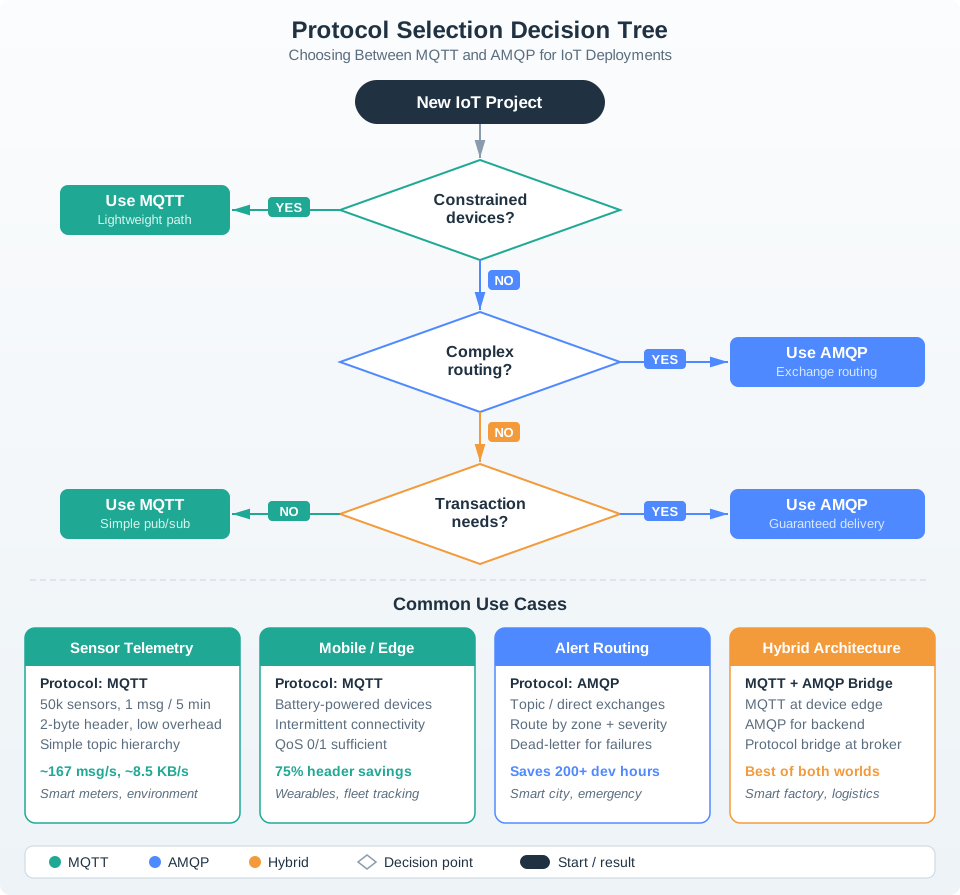
Protocol Selection Decision Tree
The chosen leaf should therefore be recorded with the constraint that caused it and revisited when that constraint changes.
- MQTT excels at scale and simplicity, while AMQP provides rich enterprise features like routing and transactions.
Deck summary
Key takeaways
The reading may be replaced by a newer one.
- A work order may need a durable waiting place and a clear final result.
- In practice, many IoT architectures use both: MQTT at the device edge for sensor telemetry and AMQP in the backend for reliable message routing between services.
- The mathematical gist: A 5000 mAh label states charge, not energy: multiply 5 Ah by voltage to obtain watt-hours.
- "Which is better -- AMQP or MQTT?" asked Temperature Terry. The microcontroller shook his head. "Wrong question, Sammy!
Retrieval practice
Recall check 1 of 3

Broker Bex says: answer from memory, then check your reasoning.
Q1A sensor fleet uses MQTT, while new backend services need richer routing. What is the safer transition?
Show answer
Answer: A A staged bridge preserves edge fit while backend routes are verified.
Retrieval practice
Recall check 2 of 3
Broker Bex says: answer from memory, then check your reasoning.
Q2Per this chapter's Common Misconception section, what is the key difference between MQTT QoS 2 and AMQP transactions?
Show answer
Answer: D MQTT QoS 2 prevents duplicate application-message delivery on its protocol hop.
Retrieval practice
Recall check 3 of 3
Broker Bex says: answer from memory, then check your reasoning.
Q3A fleet of 20,000 battery-constrained meters sends small periodic readings and needs no broker work queues at the device. A developer chooses AMQP 0-9-1 solely because it sounds like stronger QoS. Which listed concern should the design review raise?
Show answer
Answer: A The chapter's table gives a 2-byte MQTT minimum fixed header and an 8-byte AMQP 0-9-1 frame header.
Print reference
Answers
Answer key.
- A · A staged bridge preserves edge fit while backend routes are verified.
- D · MQTT QoS 2 prevents duplicate application-message delivery on its protocol hop.
- A · The chapter's table gives a 2-byte MQTT minimum fixed header and an 8-byte AMQP 0-9-1 frame header.