Analytics & ML · Study deck
IoT Machine Learning Pipeline
A bearing's vibration becomes useful to maintenance only after sampling, cleaning, machine-learning feature work, machine-learning model training, pipeline evaluation, and deployment all agree on what one record means.
Data Dora is your guide for this deck.

After studying this chapter
Learning objectives
You will be able to:
- Explain: The pipeline release record should include source population, label rule, split rule, machine-learning feature code version, machine-learning model artifact hash, pipeline evaluation metrics, deployment runtime, and monitoring thresholds.
- Explain: They allow a later library or firmware change to prove that collection, preparation, fusion, and deployed inference still agree before the full pipeline evaluation is repeated.
- Explain: The early path requires synchronized, versioned feature vectors before training; the late path requires calibrated per-sensor outputs and a versioned vote or weighted combiner.
- Explain: A two-second vibration window has 200 samples but only two temperature observations.
Major section
Carry One Bearing Event Through Seven Stages
Training fits only the training partition.
- Pipeline evaluation tests held-out bearings or time periods.
- A split by random window can place near-identical windows from one machine into both training and test sets.
- Instead, hold out two entire machines: eight machines give 800 training or validation windows, and two give 200 test windows.
Major section
Carry One Bearing Event Through Seven Stages (continued)
Figure: Early and late sensor-fusion pipelines differ in whether adds a branch in the evidence chain.
- Decision-level fusion joins explicit alarms or states.
- A two-second vibration window has 200 samples but only two temperature observations.
- A notebook screenshot leaves too many stages implicit.
Major section
Carry One Bearing Event Through Seven Stages (continued)
Attempt to fit scaling on the held-out machines and expect the leakage guard to fail.
- Early fusion needs a named alignment rule; repeating one temperature value 100 times does not create 100 independent measurements.
- A late-fusion design can preserve separate machine-learning feature clocks, then combine the vibration score with a temperature rule.
- It may limit false negatives on held-out machines, peak edge memory, inference time, or alert volume.
Major section
Carry One Bearing Event Through Seven Stages (continued)
The pipeline release record should include source population, label rule, split rule, machine-learning feature code version, machine-learning model artifact hash, pipeline evaluation metrics, deployment runtime, and monitoring thresholds.
- If maintenance happens after the sensor event, a time-aware join must not attach that outcome to windows recorded after the repair.
- They allow a later library or firmware change to prove that collection, preparation, fusion, and deployed inference still agree before the full pipeline evaluation is repeated.
- The pipeline can then report a failed requirement honestly instead of choosing the most flattering metric after pipeline evaluation.
Major section
Start With the Story
Machine learning means using examples to build a rule that can score new data.
- Firmware is the software stored on a device.
- A team wants a warning, but it must show why each warning deserves action.
- Missing readings, late repair notes, new firmware, or a changed mounting point can also alter the result.
- Train again only with cause.
Major section
Contracts, Leakage, and Drift
The early path requires synchronized, versioned feature vectors before training; the late path requires calibrated per-sensor outputs and a versioned vote or weighted combiner.
- The pipeline release record must test the chosen join point under sensor loss and drift.

Major section
Summary
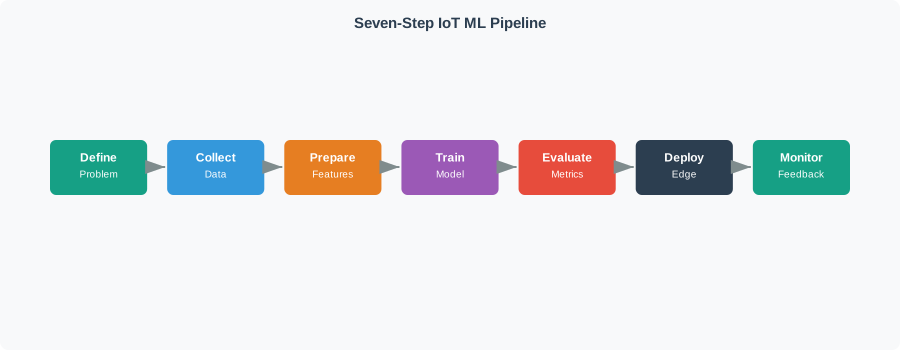
An IoT ML pipeline is an evidence chain from decision target through data, labels, features, training, evaluation, deployment, monitoring, and feedback.
- Data collection must record sensor meaning, context, label process, missingness, and out-of-scope conditions before training results are trusted.
- Feature engineering must be reproducible at inference time and must avoid future information, unit drift, inconsistent scaling, and hidden leakage.
- Deployment needs a versioned artifact bundle, fallback behavior, monitoring, feedback capture, rollback path, owner, and retraining gate.
Deck summary
Key takeaways
Training fits only the training partition.
- Figure: Early and late sensor-fusion pipelines differ in whether adds a branch in the evidence chain.
- Attempt to fit scaling on the held-out machines and expect the leakage guard to fail.
- The pipeline release record should include source population, label rule, split rule, machine-learning feature code version, machine-learning model artifact hash, pipeline evaluation metrics, deployment runtime, and monitoring thresholds.
- Machine learning means using examples to build a rule that can score new data.
Retrieval practice
Recall check 1 of 4

Data Dora says: answer from memory, then check your reasoning.
Q1A team says its IoT ML pipeline is ready because model training produced a high score on a random split. What should the review ask first?
Show answer
Answer: D A high score is useful only if the pipeline evidence supports the deployed decision boundary.
Retrieval practice
Recall check 2 of 4
Data Dora says: answer from memory, then check your reasoning.
Q2A leak-detection pipeline reports high overall accuracy, but leak examples are rare and labels arrive after inspection. What evidence is missing before release?
Show answer
Answer: C Overall accuracy can hide rare-event failures and delayed-label problems.
Retrieval practice
Recall check 3 of 4
Data Dora says: answer from memory, then check your reasoning.
Q3A model is deployed and its inputs begin to drift. What release record supports a safe response?
Show answer
Answer: A The record says when to act and how to recover.
Retrieval practice
Recall check 4 of 4
Data Dora says: answer from memory, then check your reasoning.
Q4A pipeline evaluates well because feature windows include readings from after an event, but deployed inference must decide before those readings exist. What is the main issue?
Show answer
Answer: D Training and inference must use information available at the same decision time.
Print reference
Answers
Answer key.
- D · A high score is useful only if the pipeline evidence supports the deployed decision boundary.
- C · Overall accuracy can hide rare-event failures and delayed-label problems.
- A · The record says when to act and how to recover.
- D · Training and inference must use information available at the same decision time.