Analytics & ML · Study deck
Mobile Sensing: Labels and Pipeline
A phone window is only useful for activity recognition when “walking,” “stairs,” or “vehicle” refers to a clear time interval and trustworthy observation.
Data Dora is your guide for this deck.

After studying this chapter
Learning objectives
You will be able to:
- Explain: Activity alone is not enough to explain a commute; Figure: A phone fuses inertial motion with speed shows why transportation mode needs motion and environmental context to agree.
- Explain: The confidence gate prevents the 0.78 winner from being presented as certainty, while the frame bounds preserve the evidence behind that decision.
- Explain: A model trained on one pocket may fail when the phone is held or left on a desk.
- Explain: Phone motion, location or speed cues, and a diary or confirmed journey can support a transport label.
Major section
Align the Label With the Motion Window
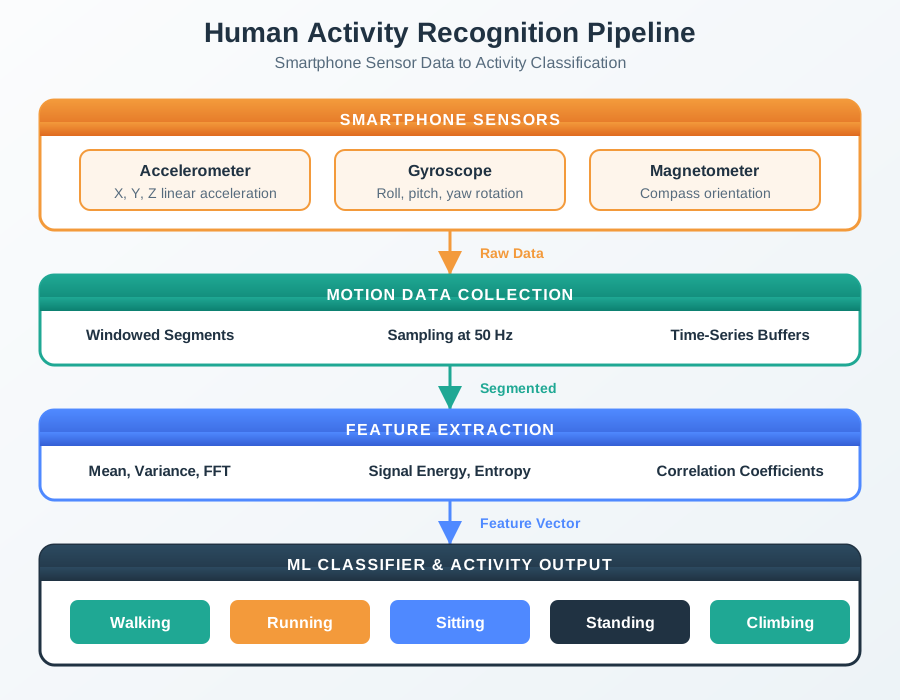
Every arrow carries a timing assumption.
- If the annotator presses “walking” after movement begins, the first window may span standing and walking.
- Phone motion, location or speed cues, and a diary or confirmed journey can support a transport label.
- Agreement strengthens the case; disagreement should remain visible rather than being overwritten by the preferred sensor.
Major section
Align the Label With the Motion Window (continued)
It contains (10\ \mathrm{s}\times50\ \mathrm{samples/s}=500) samples per axis.
- Five two-second non-overlapping windows fit that segment.
- Calling all five “vehicle” would attach the future state to earlier stillness.
- For self-reports, account for delay and mistakes.
- For scripted laboratory activities, record whether the phone position matches deployment.
Major section
Start With the Story
A sampling rate is the number of sensor readings taken in one second.
- A phone can take many motion readings while a person walks.
- Its accelerometer senses changes in motion.
- The label is a bounded guess, not a direct fact.
- A model trained on one pocket may fail when the phone is held or left on a desk.
Major section
Start With the Story (continued)
This plain path leaves out the exact feature maths and model setup.
- The Practitioner section shows how to build and test the windows.
- Under the Hood covers signal axes, feature values, class errors, memory, and power limits.
- Include “unknown” so the model is not forced to make a false choice.
- One quick tap can also be wrong.
Major section
Start With the Story (continued)
A pocket test does not prove a wrist, bag, or desk case.
- A test on one group does not prove all users.
- Recheck when the sensor, phone build, label set, or model changes.
- Each label needs a plain meaning and a good example.
- A very short window may miss the shape of a step.
Major section
Start With the Story (continued)
A long window may mix two acts and make the result late.
- If an alert follows, keep that time too.
- A high rate and constant model use can drain a phone or watch.
- A model that works only near a charger may not fit the job.
Major section
Activity Recognition Labels
The confidence gate prevents the 0.78 winner from being presented as certainty, while the frame bounds preserve the evidence behind that decision.
- Activity alone is not enough to explain a commute; Figure: A phone fuses inertial motion with speed shows why transportation mode needs motion and environmental context to agree.
Deck summary
Key takeaways
Every arrow carries a timing assumption.
- It contains (10\ \mathrm{s}\times50\ \mathrm{samples/s}=500) samples per axis.
- A sampling rate is the number of sensor readings taken in one second.
- This plain path leaves out the exact feature maths and model setup.
- A pocket test does not prove a wrist, bag, or desk case.
Retrieval practice
Recall check

Data Dora says: answer from memory, then check your reasoning.
Q1Why should a mobile activity recognition design record phone placement with each data collection session?
Show answer
Answer: C Phone placement is part of the evidence boundary for inertial activity recognition.
Print reference
Answers
Answer key.
- C · Phone placement is part of the evidence boundary for inertial activity recognition.