Analytics & ML · Study deck
IoT Machine Learning Fundamentals
Machine learning means using examples or patterns to make a useful estimate.
Data Dora is your guide for this deck.

After studying this chapter
Learning objectives
You will be able to:
- Explain: For example, changing a temperature feature from Celsius to Fahrenheit, dropping a calibration-age field, or moving from complete hourly windows to partial five-minute windows is not a harmless implementation detail.
- Explain: The review should be able to replay a held-out record through the exact production path and explain why the same feature vector, confidence value, and action would be produced.
- Explain: That chain includes the sensor, placement, timestamp, gateway, storage record, cleaning rule, label source, feature code, model artifact, deployment target, alert rule, and feedback loop.
- Review metrics, splits, and guardrails against operational costs
Major section
Begin With One Decision
Machine learning means using examples or patterns to make a useful estimate.
- Firmware is the code that runs on a device.
- A model could score its sound, heat, and flow.
- A rich model may catch a weak pattern, but it can be hard to explain and costly to run.
- A missing model is a normal fault case.
Major section
Begin With One Decision (continued)
A small model may fit on the device, but it may miss change.
- A good test score does not prove safe field use.
- The deeper routes bound the claim; they do not turn a score into a fact.
- A reviewer should be able to find the first point where the wrong act began.
Major section
Overview: What an IoT ML Claim Means
Machine learning in IoT means using data from devices, sensors, gateways, applications, and operations records to make a repeatable prediction or classification.
- Traditional firmware and application logic usually encode known cases directly: if a message, reading, or event matches this rule, take this action.
Major section
Overview: What an IoT ML Claim Means (continued)
That boundary matters because IoT data is rarely a clean spreadsheet.
- A machine-learning workflow keeps the decision explicit, but lets a fitted model learn the boundary from examples.
- Training data, labels, features, and observed errors change the model parameters; inference then reuses that fitted boundary on future readings.
- It also gives reviewers a concrete checklist to test before a model becomes a production dependency.
Major section
Reviewable ML Workflow
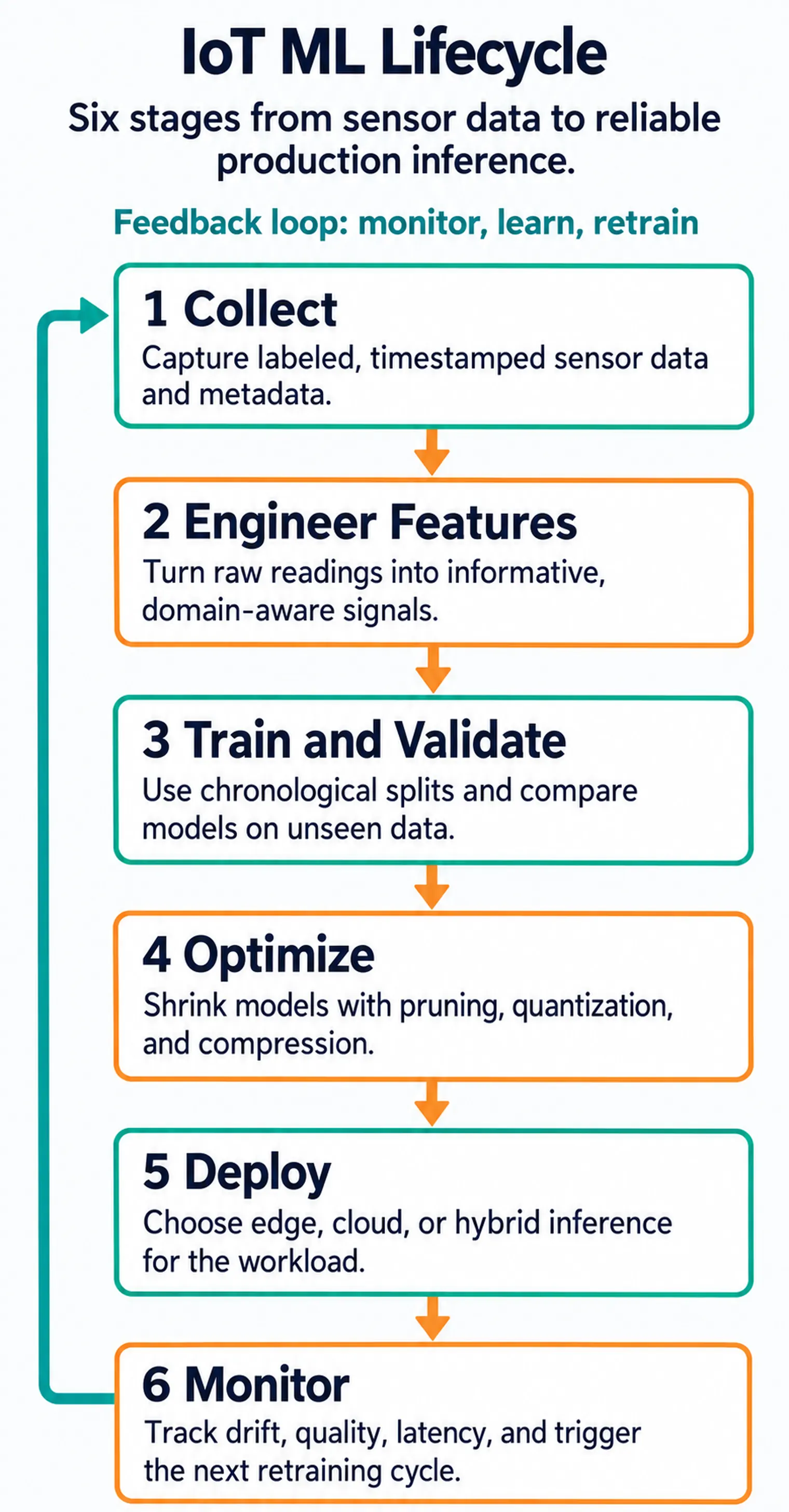
A practical IoT ML workflow starts before model training.
- It starts by writing the operational decision in plain language, then preserving the chain from physical observation to model output.
- That chain includes the sensor, placement, timestamp, gateway, storage record, cleaning rule, label source, feature code, model artifact, deployment target, alert rule, and feedback loop.
- The safest first model is often a baseline: a threshold, ruleset, statistical profile, or simple classifier that the team can explain.
Major section
ML Inference Contract
Under the hood, an IoT ML system is a chain of contracts.
- The data contract says what each reading means.
- The feature contract says how a repeatable input vector is built.
- The label contract says what the model is supposed to learn.
- The model contract says how predictions are produced.

Major section
ML Inference Contract (continued)
A gateway may batch data during training export, while edge inference receives partial windows.
- The most common deep failure is a mismatch between training and inference.
- A feature may be calculated with future data during training but only past data during deployment.
- It changes the input distribution and may make the validation result irrelevant.
Major section
ML Inference Contract (continued)
A label may be available from maintenance logs weeks after the event, while the deployed system needs an immediate warning.
- For example, changing a temperature feature from Celsius to Fahrenheit, dropping a calibration-age field, or moving from complete hourly windows to partial five-minute windows is not a harmless implementation detail.
- The review should be able to replay a held-out record through the exact production path and explain why the same feature vector, confidence value, and action would be produced.
- That replay evidence is often the fastest way to find hidden train-serve gaps.
Major section
Summary
Training, validation, inference, and monitoring are different jobs; the review must prove that their data and feature meanings stay aligned.
- IoT machine learning approval starts with a bounded decision, not with the words "AI" or "model.".
- Data, labels, features, evaluation splits, model artifacts, deployment targets, fallback rules, owners, and retest triggers need separate evidence.
- A deployed model needs a versioned artifact, reproducible feature pipeline, unsupported-input behavior, rollback path, and feedback loop.
Deck summary
Key takeaways
Machine learning means using examples or patterns to make a useful estimate.
- A small model may fit on the device, but it may miss change.
- Machine learning in IoT means using data from devices, sensors, gateways, applications, and operations records to make a repeatable prediction or classification.
- That boundary matters because IoT data is rarely a clean spreadsheet.
- A practical IoT ML workflow starts before model training.
Retrieval practice
Recall check 1 of 4

Data Dora says: answer from memory, then check your reasoning.
Q1A team says an IoT model is ready because it achieved a high validation score in a notebook. What should the review ask next?
Show answer
Answer: B A score is useful evidence only when the claim, data path, deployment boundary, and operating rules are defined.
Retrieval practice
Recall check 2 of 4
Data Dora says: answer from memory, then check your reasoning.
Q2A team has unlabeled device traces and wants to discover operating groups. Which learning setup fits?
Show answer
Answer: D Unsupervised methods seek structure without target labels.
Retrieval practice
Recall check 3 of 4
Data Dora says: answer from memory, then check your reasoning.
Q3A leak-detection model reports excellent overall accuracy because almost every training example is normal operation. Which evidence should the practitioner review before deployment?
Show answer
Answer: B Overall accuracy can hide rare-event failure, so the review must inspect metrics and operations evidence tied to the leak decision.
Retrieval practice
Recall check 4 of 4
Data Dora says: answer from memory, then check your reasoning.
Q4A model was trained with feature windows that include readings from after an event, but deployed inference only has readings available before the event. What is the main problem?
Show answer
Answer: B This is a training-inference mismatch and may also be data leakage if future information helped the validation result.
Print reference
Answers
Answer key.
- B · A score is useful evidence only when the claim, data path, deployment boundary, and operating rules are defined.
- D · Unsupervised methods seek structure without target labels.
- B · Overall accuracy can hide rare-event failure, so the review must inspect metrics and operations evidence tied to the leak decision.
- B · This is a training-inference mismatch and may also be data leakage if future information helped the validation result.