Analytics & ML · Study deck
Audio Feature Extraction for IoT
Picture a small device that must tell a knock from fan noise.
Data Dora is your guide for this deck.

After studying this chapter
Learning objectives
You will be able to:
- Explain: Window choice is a measurement trade, not decoration: a speech-envelope model often accepts the wider lobe, whereas a narrow machine-fault tone may require a longer frame or a different window.
- Explain: The filter therefore suppresses slow/common components relative to rapid changes, partly flattening the downward spectral tilt common in voiced speech and improving numeric use of the later spectrum.
- Explain: A device has produced messy evidence, an analytic step is about to change an alert or control decision, and someone has to explain why the result should be trusted.
Major section
Start With the Story
More sound can help a model, but it can also cost power and expose speech.
- Smaller records save space, yet they may lose a clue the task needs.
- The worked feature path later in the chapter provides that detail.
- A device has produced messy evidence, an analytic step is about to change an alert or control decision, and someone has to explain why the result should be trusted.
Major section
Short-Time Audio Features
That reduction can support minimisation, but it is not automatically anonymous.
- This advances the running narrative: retain raw clips only under an explicit need, consent, access, and deletion rule, and version the exact feature recipe used after deletion.
Major section
Phoebe's Field Notes: Why 16 kHz Audio Cannot Hear An 18-22 kHz Tone Honestly
The mathematical gist.: At 16 kHz, Nyquist limits honest input to 8 kHz.
- The chapter's 25 ms frame therefore holds 400 samples, its 10 ms hop holds 160, and the stated schedule produces 98 frames per second.
Major section
MFCC Feature Record
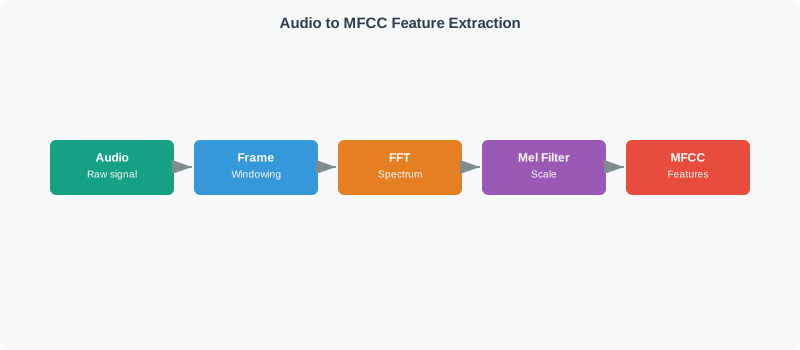
Pre-emphasis and window changes the shape of the frame without changing its size, which is why leakage and spectral tilt are corrected here and nowhere later.
- Those 13 are the model's entire view of 25 milliseconds of sound.
- And as the closing panel insists, that compression is minimisation, not anonymity.
Major section
MFCC Feature Record (continued)
Speech and many mechanical sounds are not stationary over a whole recording.
- At DC, the gain is $|1-\alpha|$; at the Nyquist frequency it is $|1+\alpha|$.
- With $\alpha=0.97$, those gains are 0.03 and 1.97 respectively.
- Libraries also use $1/N^2$, one-sided energy doubling, or window-energy normalization.
Major section
MFCC Feature Record (continued)
The filter therefore suppresses slow/common components relative to rapid changes, partly flattening the downward spectral tilt common in voiced speech and improving numeric use of the later spectrum.
- At 16 kHz, a 25 ms frame has $N=400$ samples and a 10 ms hop has $R=160$, so adjacent frames overlap by 240 samples, or 60%.
- That taper reduces sidelobes and therefore spectral leakage, at the cost of a wider main lobe and reduced ability to separate very close tones.
- Three formulas have now been introduced, and each of them does something to the signal that a plot makes obvious in a second.
Major section
MFCC Feature Record (continued)
Window choice is a measurement trade, not decoration: a speech-envelope model often accepts the wider lobe, whereas a narrow machine-fault tone may require a longer frame or a different window.
- Those conventions change feature magnitudes even when the waveform is identical, so record the FFT length, one- or two-sided spectrum, and normalization rule with the model.
- Retaining the lower-order $c_{i,r}$ coefficients gives the compact MFCC record; higher orders mostly describe finer variations across the filter-bank envelope.
- A model trained with 40 filters, one normalization rule, and 13 retained coefficients cannot safely consume features produced by an undocumented “equivalent” pipeline.
Major section
FFT And MFCC Parameter Explorer
An FFT size is an evidence choice, not a quality slider.
- At sample rate $f_s$, an $N$-sample frame spans $N/f_s$ seconds and its bin spacing is $f_s/N$.
- A window reduces edge discontinuities at the cost of widening the response around a tone.
- The final row is a small leakage probe, not a specification for a window: it evaluates the selected tone at the nearest bin and its two neighbors.
Deck summary
Key takeaways
More sound can help a model, but it can also cost power and expose speech.
- That reduction can support minimisation, but it is not automatically anonymous.
- The mathematical gist.: At 16 kHz, Nyquist limits honest input to 8 kHz.
- Pre-emphasis and window changes the shape of the frame without changing its size, which is why leakage and spectral tilt are corrected here and nowhere later.
- Speech and many mechanical sounds are not stationary over a whole recording.
Retrieval practice
Recall check 1 of 3

Data Dora says: answer from memory, then check your reasoning.
Q1Why should an IoT audio classifier record its frame size and hop size with the model evidence?
Show answer
Answer: A Frame and hop parameters are part of the evidence boundary for audio feature extraction.
Retrieval practice
Recall check 2 of 3

Data Dora says: answer from memory, then check your reasoning.
Q2A 16 kHz audio pipeline uses 25 ms frames and a 10 ms hop. How many samples are in each frame, and how many samples does the window advance each hop?
Show answer
Answer: A Feature records should preserve the arithmetic that maps raw samples to model inputs.
Retrieval practice
Recall check 3 of 3

Data Dora says: answer from memory, then check your reasoning.
Q3An MFCC extractor places filter centers at equal intervals on the mel scale between 0 and 8 kHz. Which account of the resulting filterbank and MFCC handoff is correct?
Show answer
Answer: A MFCC reasoning follows the full sequence: unequal hertz spacing from equal mel points, triangular power sums, logarithm, then the cosine transform.
Print reference
Answers
Answer key.
- A · Frame and hop parameters are part of the evidence boundary for audio feature extraction.
- A · Feature records should preserve the arithmetic that maps raw samples to model inputs.
- A · MFCC reasoning follows the full sequence: unequal hertz spacing from equal mel points, triangular power sums, logarithm, then the cosine transform.