Wi-Fi & 802.11 · Study deck
Choosing a Wireless Technology
A tap card, a battery sensor, and a moving tracker need different wireless evidence.
Radio Remi is your guide for this deck.

After studying this chapter
The device job determines the wireless evidence
Wireless selection is a bounded decision about a device, installed path, network owner, and tested workflow.
- A wireless shortlist needs the device’s range, traffic, and power requirements.The card needs a nearby tap, the room sensor needs long battery life, and the vehicle tracker must report across a wide area.
- The installed radio path needs evidence beyond a successful bench test.Walls, bodies, metal, interference, antenna position, and the final case can change loss, delay, power use, and recovery behaviour.
- The fit record assigns ownership and limits to the proposed path.Gateways, access points, credentials, subscriptions, backhaul, replacement, and support still need responsible operators after the radio is selected.
- Approval needs a tested scope and explicit retest triggers.A change in firmware, enclosure, traffic, route, owner, or recovery workflow can invalidate evidence from the earlier device class.
Major section
A tap, a sensor, and a tracker have different jobs (1/2)
The application’s required behaviour comes before the name of the radio family.
- The tap card needs intentional close interaction with a reader.NFC and many RFID designs can fit nearby badge or reader workflows when placement and the data being exchanged are clear.
- The room sensor needs evidence for its intended battery behaviour.Small payloads alone do not establish years of operation without the actual update interval, sleepy behaviour, and installed-link power observations.
Major section
A tap, a sensor, and a tracker have different jobs (2/2)
- The vehicle tracker needs a path that supports movement and wide reach.Route coverage, reconnect behaviour, service ownership, and downlink expectations can matter beyond a successful message from a stationary bench.
- A useful shortlist includes failure and operating constraints.Wait time, power source, antenna placement, radio noise, fees, and local rules can make an apparently suitable family unacceptable for the job.
Major section
A mixed product can assign different jobs to different links (1/2)
Each wireless segment needs a purpose and an owner within the complete product path.
- A setup link can differ from the daily reporting link.The chapter’s tag may use NFC for commissioning and another radio for ongoing data, with separate expectations for each exchange.
- A gateway can connect a local wireless path to the internet.That bridge creates responsibilities for availability, backhaul, credentials, and recovery that the local radio label cannot settle.
Major section
A mixed product can assign different jobs to different links (2/2)
- Device classes can share governance while using different wireless families.Badges, environmental sensors, trackers, video gateways, and maintenance tablets can need different traffic and mobility support within one campus.
- Each link needs evidence for its actual installed job.The final case, realistic placement, real message rate, and measured loss, delay, power, and recovery make the mixed path reviewable.

Activity 1 · Match
✎ Match the job to its evidence

I want the wireless requirement beside the device that depends on it.
Match five jobs to their first evidence needs: tap card; room sensor; vehicle tracker; Wi-Fi device; gateway. Use reader placement, sleep and battery behaviour, route and reconnect coverage, installed LAN coverage and credentials, and local-to-internet ownership.
3 minutes · Pen and paper · Answer: Activity 1
Major section
Antenna gain trades coverage angle for range (1/2)
The ideal antenna example connects wavelength, gain, and directional range.
- The 900 MHz example has a wavelength of 0.333 m.Its quarter-wave antenna is 8.33 cm, connecting the radio frequency with the physical antenna scale used in the chapter.
- A gain change from 0 to 8 dBi can concentrate the same power.The example’s 6.31 times concentration can raise EIRP from 20 to 28 dBm rather than creating uniform extra coverage around the antenna.
Major section
Antenna gain trades coverage angle for range (2/2)
- The ideal solid angle can fall from 12.57 to 1.99 sr.That narrower coverage explains why a directional gain benefit cannot be treated as equal reach in every possible installation direction.
- Free-space range can grow by 2.51 times only in the favoured direction.The field review still needs enclosure, obstacle, mounting, and antenna evidence before extending the ideal example to the installed device.
Major section
Wireless families suggest different proof requirements
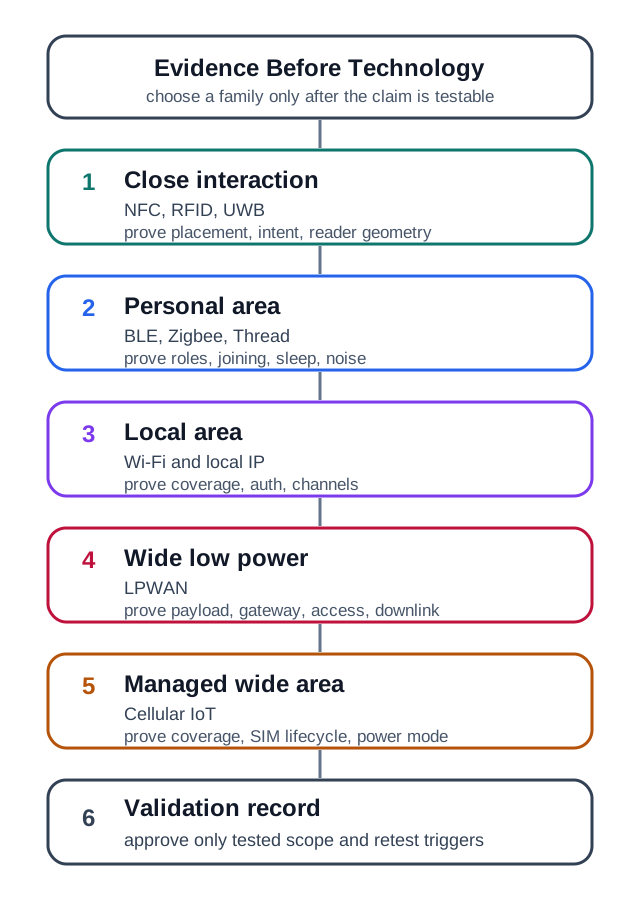
The family map moves from close interaction to personal, local, and wide-area paths; follow each family to its validation requirement.
- Close interaction needs evidence for the reader and intended placement.A tap workflow depends on the actual near-reader position and data scope rather than on a broad claim about wireless coverage.
- Nearby sensor families need joining, sleep, and receiver support evidence.Bluetooth LE, ANT/ANT+ profiles, and IEEE 802.15.4-based choices require the ecosystem and maintenance assumptions to fit the device job.
- Local-area paths need installed coverage, credentials, power, and support.Wi-Fi can support IP services, richer traffic, diagnostics, and updates when the intended network and operating conditions are validated.
- Wide-area choices need service and lifecycle evidence alongside reachability.LPWAN and cellular reviews include coverage, gateway or operator ownership, downlink behaviour, subscriptions, SIM lifecycle, and the support path.
Major section
A family label leaves ecosystem and lifecycle questions open
The shortlist is useful only when it states the evidence needed before accepting each candidate family.
- A BLE recommendation needs a known receiver and deployment arrangement.Range, body placement, phone or gateway availability, bonding or provisioning, and battery budget must support the sensor’s actual workflow.
- An ANT or ANT+ choice needs verified profile and receiver support.Sport, fitness, or equipment telemetry requires hub or phone compatibility, pairing, coexistence, and battery evidence within that narrower ecosystem.
- A cellular recommendation needs operator and profile-lifecycle evidence.The antenna, enclosure, traffic pattern, downlink timing, and support owner remain part of the managed wide-area service decision.
- A bounded shortlist states which observation could reject the candidate.If the receiver ecosystem or bridge path remains uncertain, the record needs more evidence before approving the proposed family.
Major section
Mobility changes the operating model
Moving from a local handset to cellular service changes which coverage and ownership claims need proof.
- A cordless handset can move while its base still anchors the service.The local review needs interference, handset range, battery, and the base station’s connection to the wired telephone line.
- Cellular service needs coverage and handoff across many base stations.Planning cells and frequency reuse describe a different mobility problem from a single transmitter supporting one home or room.
- Standards evolution is part of the hardware’s service-lifecycle choice.Operators migrated toward LTE and 5G NR while CDMA2000 remained a distinct standard; NB-IoT and LTE-M are LTE-based options.
- A cellular site still needs measured signal, capacity, and mobility evidence.A tower, rooftop, or camouflaged pole and its service owner must support the approved route rather than inherit an idealized cell diagram’s promise.
Major section
The wireless fit record turns assumptions into evidence
The record ties application, placement, ownership, validation, and the exact approval boundary together.
- The application record needs the actual device role and traffic requirements.Payload, latency, command need, update interval, power source, and expected lifetime distinguish a sensor from a gateway, actuator, tag, or handheld.
- Placement evidence must describe the case and path actually tested.Cabinets, bodies, vehicles, underground positions, mounting height, and antenna location can change the result obtained on an open bench.
- Network ownership includes the work needed after launch.Access points, gateways, subscriptions, keys, credentials, monitoring, backhaul, replacement stock, and escalation require responsible teams even with existing infrastructure.
- Validation needs observations of normal operation and fault recovery.Representative coverage, join, reconnect, publish, acknowledge, commands, updates, coexistence, and battery behaviour define what the family has actually demonstrated.
Major section
The retrofit and moving asset need separate validation
A shared small payload does not make unlike installations or mobility patterns equivalent.
- The building retrofit needs separate reviews for its device classes.Installed coverage and network policy must fit powered and battery devices rather than treating the existing laptop network as automatic approval.
- Metal rooms and riser cabinets need representative installed tests.Commissioning, segmentation, power, replacement, and fault response can change when the radio moves from the bench into the real building.
- The moving maintenance tool needs route and workflow evidence.Small messages do not settle reconnect, charging, command reachability, storage state, or ownership along depots, streets, and service vehicles.
- Approval remains limited to the validated installation and operating profile.Locations, firmware, enclosure, traffic, owner model, service class, exclusions, and retest triggers keep a local success from becoming an organization-wide claim.
Activity 2 · Predict
✎ A good bench result enters a metal cabinet
I have a sensor that now misses reports and drains faster after retries.
Predict which boundary needs evidence first after a working bench sensor enters a metal cabinet. Name the observations to keep before changing the wireless family. Explain why the bench result cannot approve this placement.
3 minutes · Pen and paper · Answer: Activity 2
Major section
A failed message needs a named evidence boundary
Separating physical path, link behaviour, service, and workflow helps locate the first unsupported claim.
- Physical-path evidence can cover the tested antenna, enclosure, placement, and environment.It leaves application freshness, credential handling, fleet scale, and support readiness open for other parts of the review.
- Link evidence can cover the joining, sleep, and recovery behaviour actually observed.A successful access point or firmware combination does not establish that another gateway, channel plan, policy, or traffic burst behaves identically.
- Service evidence can cover the approved infrastructure and operator path.Gateways, access points, subscriptions, backhaul, routing, and monitoring still leave application authorization, update safety, and maintenance workflows to be validated.
- Workflow evidence can cover setup, replacement, updates, faults, and escalation.Future firmware, new installers, different owners, credential rotation, or fleet expansion can require another review instead of inheriting the earlier approval.
Deck summary
Approval belongs to tested conditions
A wireless recommendation is strongest when its device class, installed path, owner, and retest limits remain explicit.
- The device’s job is the starting point for choosing a wireless family.Range, data size, delay tolerance, power, mobility, and network ownership can establish the shortlist before popularity or a successful demonstration influences the choice.
- Installed measurements are necessary for a defensible deployment claim.A cabinet, changed antenna, body placement, new obstacle, or vehicle route can alter coverage, reconnect behaviour, retries, and battery use.
- Different wireless paths can share security, monitoring, and maintenance governance.A campus can support unlike badges, sensors, trackers, gateways, and tablets without pretending their radio requirements are identical.
- The final approval needs exclusions, ownership, and explicit retest triggers.Firmware, location, enclosure, traffic, service plan, credential rotation, or support changes can reopen the bounded result that the record currently supports.
Retrieval practice
Recall check 1 of 4
Radio Remi says: answer from memory, then check your reasoning.
Q1A battery sensor works on the bench but, inside a metal cabinet in production, misses reports and drains faster after retries. Which boundary should the review inspect first?
Show answer
Answer: A A field-only failure inside a metal cabinet points to the installed physical path: antenna, enclosure effects, reconnect, and retries.
Retrieval practice
Recall check 2 of 4
Radio Remi says: answer from memory, then check your reasoning.
Q2A campus wants one wireless network for badges, environmental sensors, equipment trackers, video gateways, and maintenance tablets. What is the strongest review position?
Show answer
Answer: B Different device classes can need different wireless paths while sharing evidence, security, and operations governance.
Retrieval practice
Recall check 3 of 4
Radio Remi says: answer from memory, then check your reasoning.
Q3A sensor stays associated with its access point and link retries remain low, but reports stop after the site backhaul fails. Which boundary should be inspected first?
Show answer
Answer: B The observed change is beyond a working local link, at the service path that carries reports onward.
Retrieval practice
Recall check 4 of 4
Radio Remi says: answer from memory, then check your reasoning.
Q4A device has good radio signal and joins the network, but the user task still fails. What must the review separate?
Show answer
Answer: D Join evidence does not prove the service or task.
Print reference
Answers
Answer key.
- A · A field-only failure inside a metal cabinet points to the installed physical path: antenna, enclosure effects, reconnect, and retries.
- B · Different device classes can need different wireless paths while sharing evidence, security, and operations governance.
- B · The observed change is beyond a working local link, at the service path that carries reports onward.
- D · Join evidence does not prove the service or task.
Print reference
Activity 1 answer
Model answer.
Match: Tap card: reader placement. Room sensor: sleep and battery behaviour. Vehicle tracker: route and reconnect coverage. Wi-Fi device: installed LAN coverage and credentials. Gateway: local-to-internet ownership. Each match begins a fit review rather than approving a family everywhere.
Print reference
Activity 2 answer
Model answer.
Predict: The installed physical path and link behaviour need evidence first: antenna position, enclosure effects, join, reconnect, retries, and sleep recovery. Preserve location, firmware, traffic, and power state. The bench result did not exercise the production cabinet or its retry cost.