Wi-Fi & 802.11 · Study deck
Reviewing a Wireless Design
Imagine a field sensor works on a desk but loses contact after it is sealed in its case.
Radio Remi is your guide for this deck.

After studying this chapter
Learning objectives
You will be able to:
- Explain: The strongest overview review is therefore short but explicit: what behavior is being approved, where it was tested, which device state was used, which service owner is responsible, and what change forces retest.
- Explain: Under a 20 dBm EIRP cap it needs about 10.02 dBm conducted power rather than 20 dBm; that is an ideal 9.95-fold RF-power reduction, not proof of corridor coverage.
- Explain: A battery complaint starts at the energy sequence, then checks retry count, reconnect behavior, command windows, sleep timing, and the physical causes that might be forcing extra airtime.
Major section
Test the Sealed Field Sensor
The team must decide whether the installed radio path can support the promised service.
- The desk test says little about the field sensor once its aerial is inside the sealed case and the site has walls, distance, and motion.
- A successful bench transfer should remain labelled as a bench result.
- Antenna gain and laboratory signal measurements support an early assessment, but cannot establish coverage for the installed device.
Major section
Phoebe's Field Notes: What A Gateway's Sector Antenna Actually Buys The Site
The mathematical gist: A 15 cm square panel at 2.4 GHz and 55% aperture efficiency has 0.01238 m² effective area, 9.95 linear gain (9.98 dBi), and 1.26 sr ideal solid angle.
- Under a 20 dBm EIRP cap it needs about 10.02 dBm conducted power rather than 20 dBm; that is an ideal 9.95-fold RF-power reduction, not proof of corridor coverage.
Major section
Design Approval Is An Evidence Contract
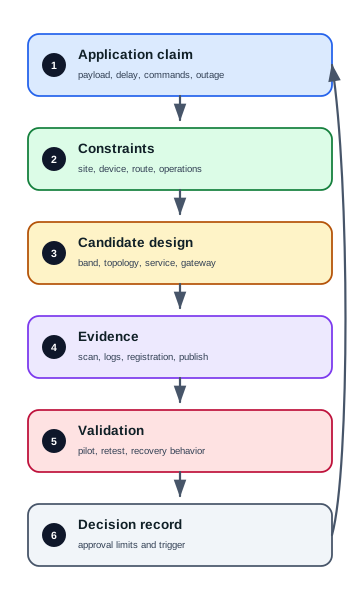
A mobile wireless design is approved only for the claim and conditions that were actually tested.
- This loop is the chapter's scope-control mechanism.
- A changed traffic deadline, enclosure, route, operator, gateway position, or duty cycle changes an earlier box and therefore triggers a new pass through the evidence contract.
Major section
Design Approval Is An Evidence Contract (continued)
The strongest overview review is therefore short but explicit: what behavior is being approved, where it was tested, which device state was used, which service owner is responsible, and what change forces retest.
- Wi-Fi, BLE, 802.15.4, LoRaWAN, or cellular may all be defensible in the right claim; none is defensible without the matching evidence boundary.
- Payload pattern, delay tolerance, command need, outage behavior, mobility, and the end-to-end success state.
- Credentials, updates, monitoring, ownership, support records, acceptance limits, and retest triggers.
- That prevents the common mistake of treating a wireless family name as the approval.
Major section
Build The Design Review Record
Long firmware listings are less useful than repeatable evidence tied to the installed points and routes.
- A practical review record turns a wireless recommendation into something another engineer can audit.
- It should separate measured behavior from assumptions, name the first unproven layer, and state whether the decision is accepted, accepted with limits, retest required, redesigned, or escalated.
- Some sensors are battery powered, some are mains powered, and several are mounted inside equipment rooms or cabinets.
Major section
Build The Design Review Record (continued)
It should still cover application need, site and movement context, device state, spectrum fit, topology, service path, power sequence, security, updates, operations, and validation evidence.
- The review should split device classes, test representative floors and cabinets, record AP or gateway ownership, capture application publish evidence, and define what changes require retest.
- The decision might be: "Accept with limits for tested floors, enclosures, gateway locations, firmware, and reporting interval.
- Retest after gateway move, enclosure change, channel-plan change, firmware update, credential rotation, or occupancy change that affects channel pressure.".
Major section
Under The Hood: Wireless Failures Cross Boundaries
The implementation review should keep those boundaries separate.
- A successful association is not the same as an application acknowledgement.
- A signal measurement is not the same as battery-life evidence.
- A service plan is not the same as an operations process.
- The boundary order should follow the symptom.
Major section
Under The Hood: Wireless Failures Cross Boundaries (continued)
Moving-route gap: a stationary test passes, but a vehicle, handheld, or asset route loses service at expected operating points.
- A missing measurement starts at product evidence, then walks backward through application acknowledgement, service route, link access, and physical radio evidence until the first unsupported claim appears.
- A support incident starts at ownership, credentials, update, rollback, monitoring, and escalation records before blaming the radio layer.
- Good under-the-hood evidence is comparative.
Major section
Under The Hood: Wireless Failures Cross Boundaries (continued)
A battery complaint starts at the energy sequence, then checks retry count, reconnect behavior, command windows, sleep timing, and the physical causes that might be forcing extra airtime.
- Without that one-variable discipline, a later failure cannot tell whether the fix came from RF margin, service routing, retry policy, or operations repair.
- Antenna, enclosure, mounting, body loss, cabinet loss, floor plan, route, and interference determine whether the radio path is usable.
- Application acknowledgement, freshness state, command execution, updates, credential recovery, and support workflow determine whether users can trust the result.
Major section
Under The Hood: Wireless Failures Cross Boundaries (continued)
Installed enclosure loss: the bench radio works, but the production enclosure or cabinet changes antenna behavior.
- Command reachability mismatch: aggressive sleep saves power but prevents timely downlink or configuration updates.
- Operations drift: AP profiles, gateway placement, subscriptions, credentials, firmware, or owner responsibilities change without retest.
- Acceptance should include normal, weak, busy, moving, retry, reconnect, service-loss, command, update, and recovery cases where they matter to the claim.
Deck summary
Key takeaways
The team must decide whether the installed radio path can support the promised service.
- The mathematical gist: A 15 cm square panel at 2.4 GHz and 55% aperture efficiency has 0.01238 m² effective area, 9.95 linear gain (9.98 dBi), and 1.26 sr ideal solid angle.
- A mobile wireless design is approved only for the claim and conditions that were actually tested.
- The strongest overview review is therefore short but explicit: what behavior is being approved, where it was tested, which device state was used, which service owner is responsible, and what change forces retest.
- The implementation review should keep those boundaries separate.
Retrieval practice
Recall check 1 of 3

Radio Remi says: answer from memory, then check your reasoning.
Q1What is the strongest first move in a mobile wireless design review?
Show answer
Answer: C Design approval should be bounded by the actual claim, conditions, evidence, and retest trigger.
Retrieval practice
Recall check 2 of 3
Radio Remi says: answer from memory, then check your reasoning.
Q2A design review shows good signal at all fixed sensor points, but a firmware update changes the reporting interval and command behavior. What should the reviewer do?
Show answer
Answer: D A review record should define retest triggers for changes that alter communication or reachability assumptions.
Retrieval practice
Recall check 3 of 3
Radio Remi says: answer from memory, then check your reasoning.
Q3A battery sensor saves energy by sleeping for ten minutes, but maintenance commands must reach it within thirty seconds. Which design boundary needs review?
Show answer
Answer: B A design must prove command reachability within the required deadline alongside its battery budget.
Print reference
Answers
Answer key.
- C · Design approval should be bounded by the actual claim, conditions, evidence, and retest trigger.
- D · A review record should define retest triggers for changes that alter communication or reachability assumptions.
- B · A design must prove command reachability within the required deadline alongside its battery budget.