Wi-Fi & 802.11 · Study deck
Cellular Architecture for IoT
Imagine a moving tracker sends a small alarm through a mobile network and waits for a reply.
Radio Remi is your guide for this deck.

After studying this chapter
Learning objectives
You will be able to:
- trace IoT traffic from device through radio access, cellular core, and application services
- separate radio coverage, subscription, core registration, packet service, and application failures
- explain why power-saving and reachability decisions are architecture decisions
- evaluate cellular technology fit using evidence rather than fixed marketing claims
Major section
A Clear First Route · Start With the Wireless Story · In 60 Seconds
The team must trace the alarm across each owner and system boundary.
- Firmware means software stored in a device.
- Latency means the wait from an event to a useful result.
- A payload is the useful data carried by a message.
- This page starts with one job.
Major section
Phoebe's Field Notes: Why a Sector Antenna's Gain Is a Coverage Trade, Not Free Power · Architecture Scope
The mathematical gist.: A 17 dBi sector has 50.1 times the favoured-direction power density of an isotropic reference.
- Gain redirects power; good RSRP does not prove that identity, subscription, core, or application layers are healthy.
Major section
Cellular Traffic Path · Device And Radio Access Evidence
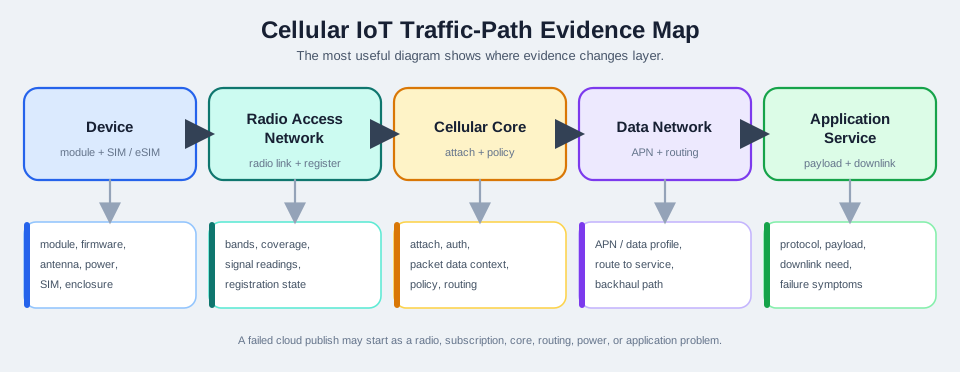
At each boundary, the next proof changes: modem and antenna state, registration and bearer state, addressing and route, then protocol and service response.
- That ordered walk connects the architecture to the chapter's diagnostic rule: identify the first failing transition before changing hardware, service profiles, or cloud credentials.
Major section
Technology-Fit Review · Decision Options
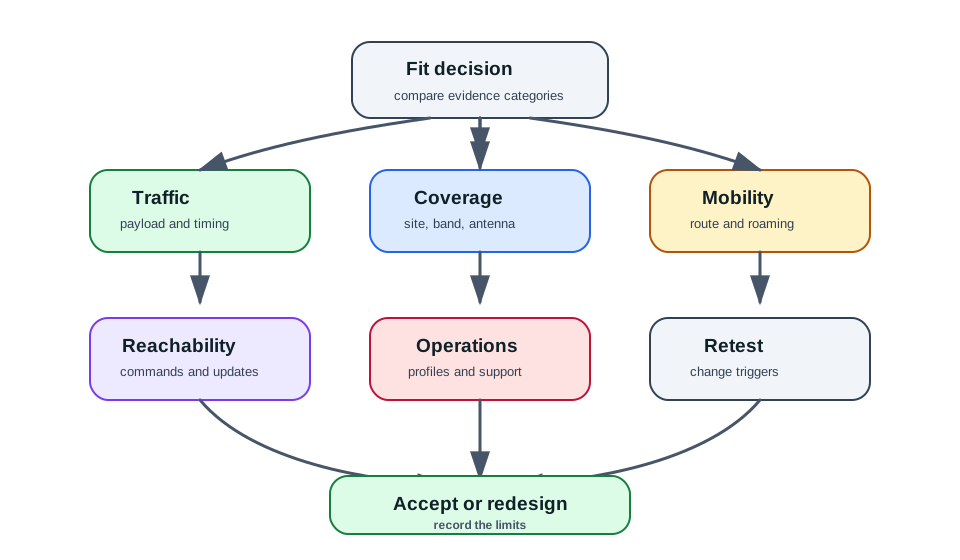
Cellular options should be compared through evidence categories, not fixed universal rankings.
- The route connects architectural labels to deployment proof, so no technology is selected from headline range or data rate alone.
- Spec sheets are where technology-fit reviews usually start — and where weak ones stop.
Major section
Worked Review: Moving Asset Tracker · Common Mistakes
Scenario: a tracker moves through several regions and must report events while in motion.
- Accepted answer: "Mobility and regional service evidence are part of architecture fit.
- A stationary-device assumption cannot be reused for a moving asset without retest.".
- treating signal quality alone as proof that the cellular architecture is ready.
Major section
Review Checklist · Base Station Plus Core, Split Into Two Planes
The core does the work a device never sees: authenticating the SIM, tracking which cell the device is in, and routing its data to the internet.
- The core separates a control plane (signalling: who you are, where you are, setting up connections) from a user plane (the actual data packets).
- In LTE the core is the EPC; in 5G it is the service-based 5G Core (5GC).
- That split also gives the review a clean failure order.
- For IoT, this split is the key to efficiency, because tiny messages should not pay the full price of user-plane setup.
Major section
EPC Elements, 5GC Equivalents, and RRC States · CIoT Optimizations for Small Data
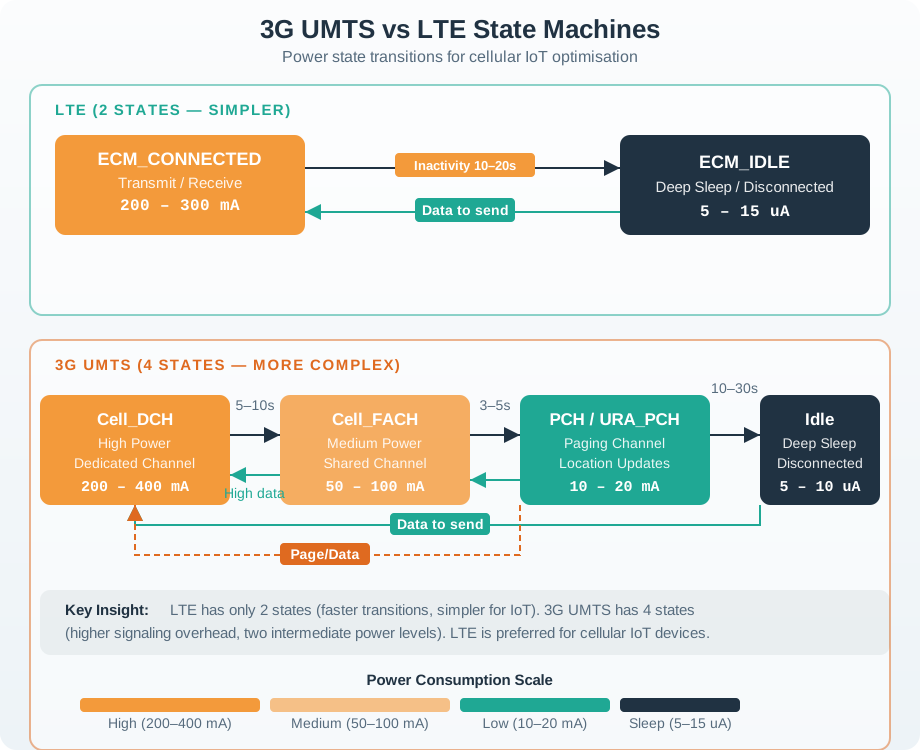
Older GSM and UMTS diagrams use different names, but the review habit is the same.
- A BSC or RNC controls radio resources at the base-station edge.
- An SMSC stores and forwards text messages.
- The source-era SMS example makes the store-and-forward boundary concrete.
Major section
Summary · Key Takeaway · Concept Relationships
Cellular spectrum explains why operator support, region, and supported bands shape architecture fit.
- Cellular architecture review connects device evidence, radio evidence, identity evidence, core network evidence, and application evidence.
- The design is ready only when the whole path supports the deployment claim.
- Propagation design explains why antenna, enclosure, and location change cellular results.
Deck summary
Key takeaways
The team must trace the alarm across each owner and system boundary.
- The mathematical gist.: A 17 dBi sector has 50.1 times the favoured-direction power density of an isotropic reference.
- At each boundary, the next proof changes: modem and antenna state, registration and bearer state, addressing and route, then protocol and service response.
- Cellular options should be compared through evidence categories, not fixed universal rankings.
- Scenario: a tracker moves through several regions and must report events while in motion.
Retrieval practice
Recall check 1 of 6

Radio Remi says: answer from memory, then check your reasoning.
Q1Cellular IoT architecture is described as a chain of evidence. For a device with good signal that still cannot publish, what does that framing imply?
Show answer
Answer: A Cellular architecture is a chain: signal proves only the radio link, so registration, profile, and routing must each be checked.
Retrieval practice
Recall check 2 of 6

Radio Remi says: answer from memory, then check your reasoning.
Q2A cellular IoT device reports usable signal strength, but it cannot publish telemetry to the cloud. Which review step best separates the architecture evidence?
Show answer
Answer: A Cellular architecture review should separate radio access evidence from core-network, routing, and application evidence.
Retrieval practice
Recall check 3 of 6

Radio Remi says: answer from memory, then check your reasoning.
Q3A cellular device reports usable signal, but registration is denied and no packet data context can be created. What is the best architecture review decision?
Show answer
Answer: C Registration denial points to subscription, profile, operator, service, or policy evidence before the cloud application can be meaningfully tested.
Retrieval practice
Recall check 4 of 6

Radio Remi says: answer from memory, then check your reasoning.
Q4What is the difference between the control plane and the user plane in a cellular core?
Show answer
Answer: B Separating signalling from data is what lets IoT optimizations route small data efficiently.
Retrieval practice
Recall check 5 of 6

Radio Remi says: answer from memory, then check your reasoning.
Q5Which LTE EPC element handles control-plane signalling such as authentication and mobility (and maps to the 5G AMF)?
Show answer
Answer: A The MME is the LTE control-plane brain; its 5G counterpart is the AMF.
Retrieval practice
Recall check 6 of 6

Radio Remi says: answer from memory, then check your reasoning.
Q6How does the Control-Plane CIoT optimization make tiny NB-IoT messages efficient?
Show answer
Answer: B The payload rides control-plane signalling to the MME, avoiding user-plane bearer establishment for rare, tiny data.
Print reference
Answers 1 of 2
Answer key.
- A · Cellular architecture is a chain: signal proves only the radio link, so registration, profile, and routing must each be checked.
- A · Cellular architecture review should separate radio access evidence from core-network, routing, and application evidence.
- C · Registration denial points to subscription, profile, operator, service, or policy evidence before the cloud application can be meaningfully tested.
- B · Separating signalling from data is what lets IoT optimizations route small data efficiently.
Print reference
Answers 2 of 2
Answer key.
- A · The MME is the LTE control-plane brain; its 5G counterpart is the AMF.
- B · The payload rides control-plane signalling to the MME, avoiding user-plane bearer establishment for rare, tiny data.