Privacy & Compliance · Study deck
Mobile Wi-Fi and Sensing Privacy
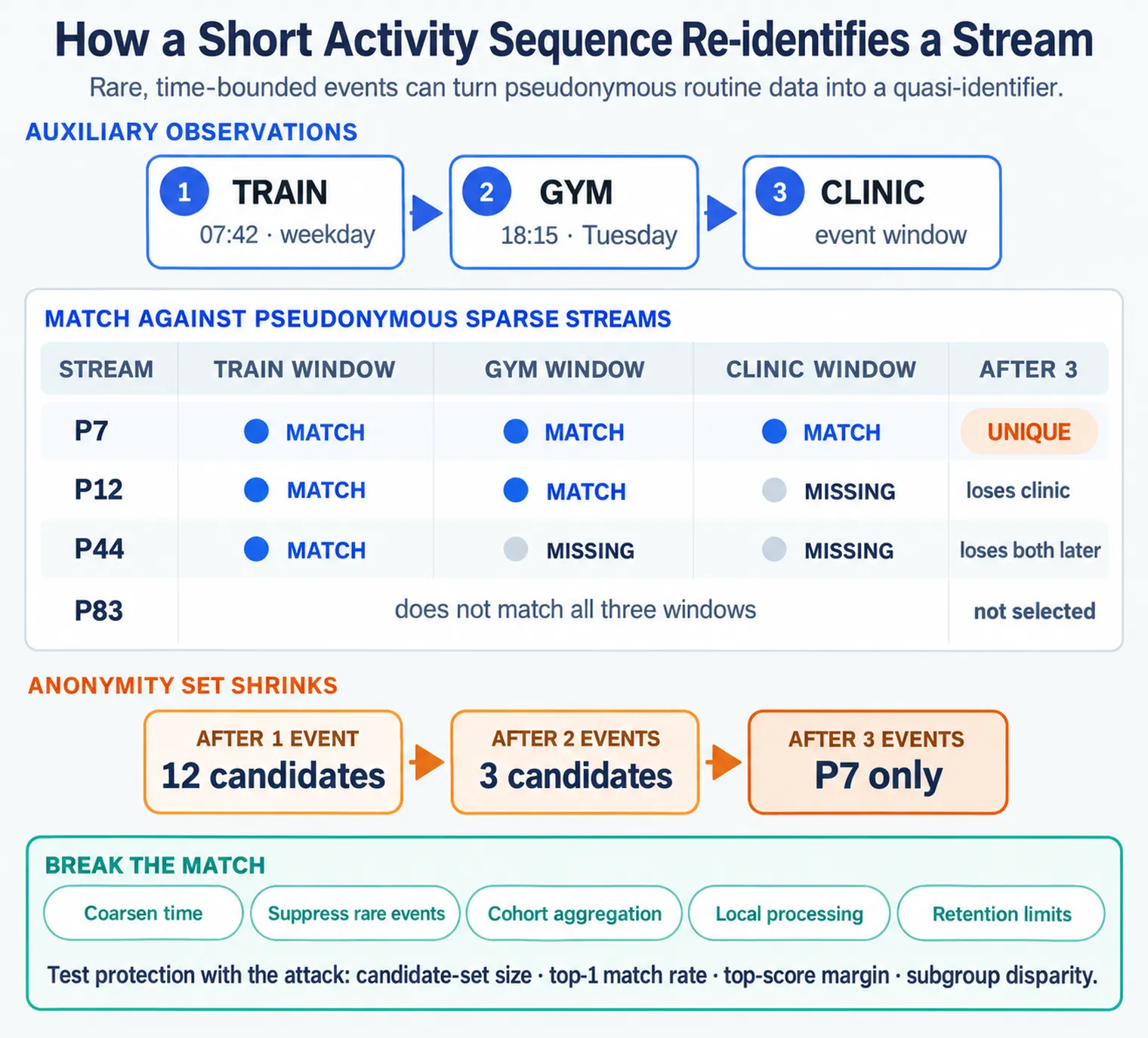
Pseudonyms offer little protection when a short auxiliary sequence is rare enough to correlate. @fig-privacy-auxiliary-stream-match matches train, gym, and clinic windows against four representative sparse streams and shows the anonymity set collapsing.
Privacy Priya is your guide for this deck.

After studying this chapter
Learning objectives
You will be able to:
- Explain: Mobile activity streams are often high-dimensional and sparse: one person produces events across transport, location, motion, app, touch, and time dimensions, yet only a few events occur in each narrow combination.
- Explain: A 10 Hz privacy limit instead folds that motion to about 3.33 Hz, while the chapter's stated breathing example produces only 0.628 Hz.
- Explain: For each auxiliary event $a_i$, define a match to stream $S_k$ when event type/location agrees and time is within tolerance $\Delta_i$.
- explain how Wi-Fi and sensing signals can identify a person without message content
Major section
Sensor Inference Through Activity-Stream Re-identification
Removing names from a sensing dataset does not remove routines.
- Mobile activity streams are often high-dimensional and sparse: one person produces events across transport, location, motion, app, touch, and time dimensions, yet only a few events occur in each narrow combination.
- That rarity makes a short correlated sequence behave like a quasi-identifier.
Major section
Sensor Inference Through Activity-Stream Re-identification (continued)
The adversary now has auxiliary sequence.
- The anonymous release contains streams $S_1,\ldots,S_n$ keyed only by pseudonyms.
- For each auxiliary event $a_i$, define a match to stream $S_k$ when event type/location agrees and time is within tolerance $\Delta_i$.
- $$ score(S_k,A)=\sum_i w_i\,\mathbf{1}[match(a_i,S_k,\Delta_i)]. $$.
Major section
Sensor Inference Through Activity-Stream Re-identification (continued)
Weights should be larger for rarer events; an information-based choice is $w_i=-\log P(a_i)$.
- The target is singled out when one stream remains plausible and the gap to the next candidate is large enough.
- A single train event may match hundreds of people; train then a particular gym schedule can reduce the anonymity set to one.
- The safe question is not “did we delete the name?” but “how much outside knowledge is needed to single someone out?”.
Major section
Phoebe's Field Notes: Why "Limit Sampling Rate" Is Not Just A Policy Knob
The mathematical gist.: A 5 GHz wave is 0.0600 m long.
- A 10 Hz privacy limit instead folds that motion to about 3.33 Hz, while the chapter's stated breathing example produces only 0.628 Hz.
Deck summary
Key takeaways
Removing names from a sensing dataset does not remove routines.
- The adversary now has auxiliary sequence.
- Weights should be larger for rarer events; an information-based choice is $w_i=-\log P(a_i)$.
- The mathematical gist.: A 5 GHz wave is 0.0600 m long.
Retrieval practice
Recall check 1 of 3

Privacy Priya says: answer from memory, then check your reasoning.
Q1Why is a phone that always uses the same Wi-Fi hardware (MAC) address when scanning a privacy risk, and how do modern platforms reduce it?
Show answer
Answer: B A persistent scan or hardware address lets sites recognize the same device over time and across places; randomized addresses break that linkage.
Retrieval practice
Recall check 2 of 3

Privacy Priya says: answer from memory, then check your reasoning.
Q2An IoT companion app needs to scan for a nearby Bluetooth accessory during pairing. On a platform that offers a dedicated nearby-devices permission, which choice best fits least privilege?
Show answer
Answer: A Using the dedicated nearby-devices scanning permission, and declaring the scan is not used to derive location, scopes access to the actual need.
Retrieval practice
Recall check 3 of 3

Privacy Priya says: answer from memory, then check your reasoning.
Q3A building automation vendor wants to detect room occupancy from Wi-Fi. Which approach best limits privacy exposure while still detecting presence?
Show answer
Answer: D Deriving the minimal result on device from signal data and discarding raw channel measurements keeps sensitive measurements from leaving the space.
Print reference
Answers
Answer key.
- B · A persistent scan or hardware address lets sites recognize the same device over time and across places; randomized addresses break that linkage.
- A · Using the dedicated nearby-devices scanning permission, and declaring the scan is not used to derive location, scopes access to the actual need.
- D · Deriving the minimal result on device from signal data and discarding raw channel measurements keeps sensitive measurements from leaving the space.