Sensor Applications · Study deck
Participatory Sensing
Picture residents using their phones to map street noise.
Physics Phoebe is your guide for this deck.

After studying this chapter
Learning objectives
You will be able to:
- Explain: The mathematical gist.: Decibels turn power ratios into additions: $L=10\log_{10}(P/P_{ref})$, so a 4 dB phone-family gap means $10^{4/10}=2.51\times$ acoustic power.
- Explain: A repeated +3 dB bias is nearly a doubling, not a rounding error; preserve device provenance and correct against a reference meter rather than blaming ADC bit depth.
- Explain: Each contributor brings a phone, a prompt, an access state, a place, a time, and a context note that must be reviewed before records are combined.
- Design a contribution prompt that produces reviewable sensor evidence.
Major section
Start With the Crowd Story
Each contributor brings a phone, a prompt, an access state, a place, a time, and a context note that must be reviewed before records are combined.
- This check cannot remove every phone difference or participation bias.
- People and devices change.
- The deeper sections show how contribution records, calibration, privacy, coverage, and feedback support an honest crowd result.
Major section
Phoebe's Field Notes: What a "+3 dB" Phone Bias Really Costs
The mathematical gist.: Decibels turn power ratios into additions: $L=10\log_{10}(P/P_{ref})$, so a 4 dB phone-family gap means $10^{4/10}=2.51\times$ acoustic power.
- A repeated +3 dB bias is nearly a doubling, not a rounding error; preserve device provenance and correct against a reference meter rather than blaming ADC bit depth.
Major section
In 60 Seconds
Participatory sensing uses phones carried by contributors to collect observations for a shared sensing task.
- The value comes from many scoped contribution records, not from assuming that every phone reading is automatically comparable.
- This chapter keeps the workflow bounded.
- It teaches how to review contribution evidence before combining phone-based observations.
Major section
Participatory Sensing Workflow
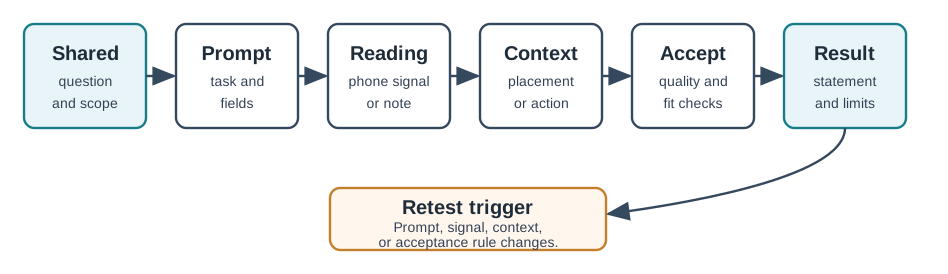
A participatory workflow starts with a shared question and a clear prompt.
- The prompt tells contributors what to observe, when to collect, which phone signal or note is needed, and what context must be recorded.
- Without that shared structure, the combined data set is difficult to review.
Major section
Contribution Record
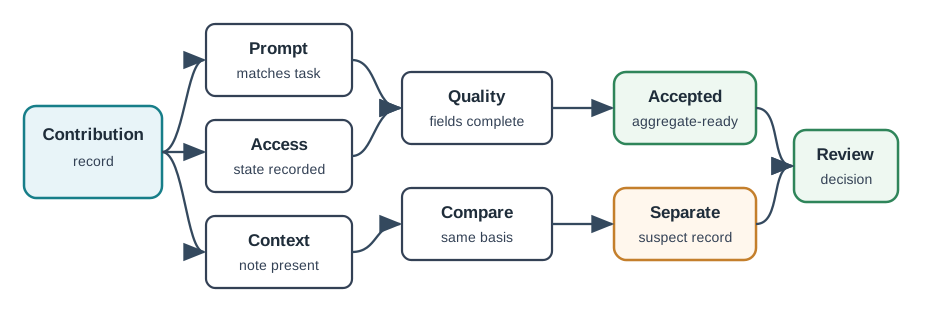
A single contribution should be readable without asking the contributor to explain it later.
- The timestamp and context note capture when and under what placement, surroundings, or collection posture the record was created.
- The same fields should be used for every contributor in the exercise.
- Mixed records can still be useful, but the review should identify which fields changed.
Major section
Acceptance Gates
Contributed readings should pass basic gates before they are aggregated.
- The goal is not to discard every imperfect record; it is to keep accepted and suspect evidence visibly separate.
Major section
Contribution Modes
The contributor intentionally starts a reading or writes an observation.
- It works well for short exercises where each record needs a context note.
- The app asks for a contribution when a learning activity reaches a defined point.
- It should state the expected phone placement or user action and request only the fields needed for the shared question.
Major section
Contribution Modes (continued)
During review, separate incomplete records from accepted ones rather than filling gaps by assumption.
- The app may guide collection using a defined trigger or collection window, but automation still needs a visible review record.
- The app must keep stale data separate from current contributions so an old observation cannot satisfy a new prompt.
- If the trigger or collection window changes, the review should name that change as a retest condition.
Major section
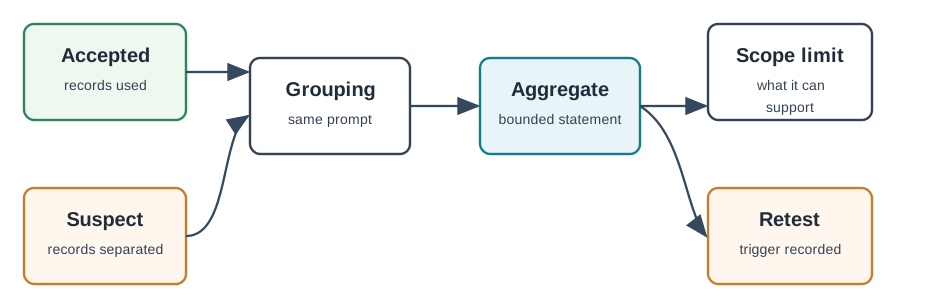
Aggregation Review
Accepted records supply the aggregate, while suspect or rejected records remain visible beside it rather than disappearing.
- The grouping rule—such as a shared prompt, location label, sample window, or context category—states why the selected records are comparable.
- That sequence connects the shared result back to the individual contribution evidence.
Major section
A Crowd of Phones Is a Crowd of Different Instruments
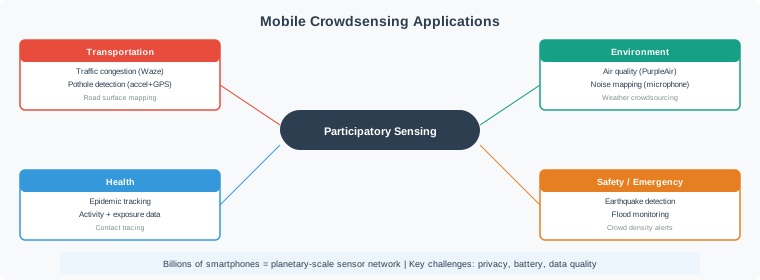
The application branches explain the attraction; the cross-cutting challenges explain why collection alone is not the engineering result.
- This connects the scale promised by crowdsensing to the acceptance and aggregation records developed later in the chapter.
Major section
Concept Relationships
The shared question defines the contribution prompt, and that prompt selects the phone signal and context fields each record needs.
- Access state and data quality then determine whether a contribution is accepted, suspect, or rejected.
- Aggregation can combine only comparable accepted records under an explicit rule; it does not repair missing context or incompatible prompts.
- Scope limits keep the resulting statement bounded, while retest triggers reopen the workflow when the question, collection window, access path, or acceptance rule changes.
Deck summary
Key takeaways
Each contributor brings a phone, a prompt, an access state, a place, a time, and a context note that must be reviewed before records are combined.
- The mathematical gist.: Decibels turn power ratios into additions: $L=10\log_{10}(P/P_{ref})$, so a 4 dB phone-family gap means $10^{4/10}=2.51\times$ acoustic power.
- Participatory sensing uses phones carried by contributors to collect observations for a shared sensing task.
- A participatory workflow starts with a shared question and a clear prompt.
- A single contribution should be readable without asking the contributor to explain it later.
Retrieval practice
Recall check 1 of 5

Physics Phoebe says: answer from memory, then check your reasoning.
Q1A participatory noise survey receives phone readings with no location context or permission state. How should the dataset treat them?
Show answer
Answer: A Participatory sensing relies on scoped, comparable contribution records rather than assuming all phone readings are equal.
Retrieval practice
Recall check 2 of 5

Physics Phoebe says: answer from memory, then check your reasoning.
Q2What is the central data-quality challenge that distinguishes participatory (crowd) sensing from a fixed, professionally calibrated sensor network?
Show answer
Answer: A Device heterogeneity and lack of calibration are the defining quality challenge of crowdsensing.
Retrieval practice
Recall check 3 of 5

Physics Phoebe says: answer from memory, then check your reasoning.
Q3A crowdsensing map averages thousands of contributions but stays biased because a common phone model reads systematically high. Why doesn't adding more contributors fix it?
Show answer
Answer: C Correlated, shared bias does not average away; only per-device calibration or normalization removes it.
Retrieval practice
Recall check 4 of 5

Physics Phoebe says: answer from memory, then check your reasoning.
Q4A city air-quality map built from volunteer phones shows clean air citywide, but contributions came almost entirely from a few affluent daytime neighbourhoods. What limitation is this, and how should it be handled?
Show answer
Answer: D Uneven contributor coverage biases the aggregate; the fix is to characterize and account for coverage, not to claim citywide validity.
Retrieval practice
Recall check 5 of 5

Physics Phoebe says: answer from memory, then check your reasoning.
Q5A class collects phone-based sound observations, but some records lack timestamp, access state, and phone placement notes. What is the strongest review feedback before comparing the submissions?
Show answer
Answer: A Participatory sensing records should pass prompt, access, context, and data-quality checks before they are aggregated.
Print reference
Answers 1 of 2
Answer key.
- A · Participatory sensing relies on scoped, comparable contribution records rather than assuming all phone readings are equal.
- A · Device heterogeneity and lack of calibration are the defining quality challenge of crowdsensing.
- C · Correlated, shared bias does not average away; only per-device calibration or normalization removes it.
- D · Uneven contributor coverage biases the aggregate; the fix is to characterize and account for coverage, not to claim citywide validity.
Print reference
Answers 2 of 2
Answer key.
- A · Participatory sensing records should pass prompt, access, context, and data-quality checks before they are aggregated.