Sensor Applications · Study deck
Mobile Phone as a Sensor
Imagine using a phone to measure noise during a walk.
Physics Phoebe is your guide for this deck.

After studying this chapter
Learning objectives
You will be able to:
- name which role a phone plays in a measurement (sensor, recorder, user prompt, or gateway) before treating a reading as evidence
- record access state (granted, denied, unavailable, unsupported, stale, revoked) and its fallback behavior for a phone signal
- write a phone sensing evidence record that preserves collection window, placement, and interpretation limits
- state what a phone record can and cannot prove without additional sensors, calibration, or field validation
Major section
Start With the Phone Story
The phone may sense sound, save the record, ask the user a question, or send the result onward.
- A gateway is a bridge that passes local data to another system.
- A different result may reveal hardware or setup effects.
- This simple walk does not prove that every phone measures the same way.
Major section
A Phone Is a Bounded Sensing Platform
Those strengths are useful only when the sensing question is bounded.
- A phone reading supports a specific claim collected under specific access, placement, timing, and context conditions.
- The important historical shift was not one sensor appearing in isolation.
- The safe habit is to start with the question, not the feature list.
Major section
A Phone Is a Bounded Sensing Platform (continued)
Early mobile phones became IoT-relevant as GPS, cameras, accelerometers, app stores, and packet data converged in the same pocket device.
- Motion, orientation, location, media, light, proximity, user input, and external sensor gateway signals all need different evidence.
- A phone may be the sensor, the recorder, the user prompt, or the gateway, but the record must say which role it played.
- For example, a phone in a backpack can show movement, but it does not automatically prove the user's activity, posture, speed, or location history.
Major section
A Phone Is a Bounded Sensing Platform (continued)
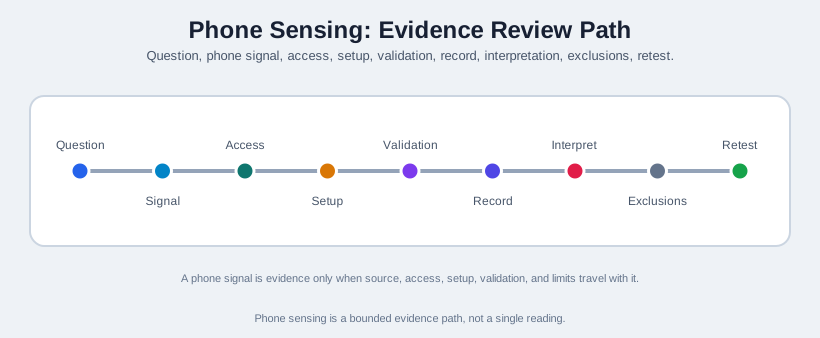
The record needs to state the collection window, phone placement, access state, sampled signal, quality check, and interpretation limit.
- A phone placed on a desk during a vibration exercise has a different evidence boundary from the same phone carried by a participant during a field survey.
- If you only need the intuition, use this rule: a phone signal is evidence only when the record preserves source, unit or format, timestamp, access state, setup context, validity state, interpretation limit, and retest trigger.
- AccessRecord whether access was granted, denied, unavailable, unsupported, stale, or revoked, and define the fallback behavior for each state.
Major section
Build the Phone Sensing Evidence Record
Retest: Reopen review when phone model, OS/browser path, permission flow, placement, prompt, signal, or interpretation rule changes.
- A phone sensing plan should make the data path reviewable before collection begins.
- User action, collection window, stored sample or derived field, consent boundary, and interpretation limit.
- Receiving nearby sensor data, attaching user context, and forwarding records.
Major section
Phone Sensing Fails at Boundaries
The same app can collect different evidence when the phone is carried differently, access is denied, sampling is paused, a signal is unavailable, or an external sensor disconnects.
- Access BoundaryPermissions, unsupported APIs, unavailable hardware, stale readings, and revoked access must produce visible states instead of silent defaults.
- Context BoundaryPlacement, orientation, user action, foreground/background state, collection window, and environment determine what a phone signal can mean.
- New data use, audience, sharing rule, or retention requirement.
Major section
Phone Sensing Fails at Boundaries (continued)
Data BoundaryUnits, timestamps, identity, uncertainty, validity state, and rejected data rules keep later analysis from treating every value as equally trustworthy.
- Interpretation BoundaryA phone reading can support a scoped observation or learning exercise without proving exact field conditions, continuous presence, or a calibrated instrument result.
- Granted, denied, revoked, unsupported, stale, unavailable, and user-cancelled states.
- The record stores the access state and the app uses an explicit fallback or rejection rule.
Major section
Phone Sensing Fails at Boundaries (continued)
The interpretation changes only when validation shows the setup still supports the same question.
- Connection loss, duplicate records, delayed upload, unknown sensor identity, and changed units.
- Phone metadata and external sensor metadata remain distinct and reconnect behavior is recorded.
- The record keeps only the evidence needed for the stated question and documents what was excluded.
Major section
Decide What the Phone Can Sense During a Cycle
A rough-road vibration may be real while its size still depends on mount angle and pocket movement.
- The phone may show cached state or an error unless the sensor access path is checked.
Deck summary
Key takeaways
The phone may sense sound, save the record, ask the user a question, or send the result onward.
- Those strengths are useful only when the sensing question is bounded.
- Early mobile phones became IoT-relevant as GPS, cameras, accelerometers, app stores, and packet data converged in the same pocket device.
- The record needs to state the collection window, phone placement, access state, sampled signal, quality check, and interpretation limit.
- Retest: Reopen review when phone model, OS/browser path, permission flow, placement, prompt, signal, or interpretation rule changes.
Retrieval practice
Recall check 1 of 3

Physics Phoebe says: answer from memory, then check your reasoning.
Q1A phone records movement while carried in a backpack. What makes that record usable as IoT sensing evidence?
Show answer
Answer: D A phone is a useful sensing platform only when the record ties signal, access, context, validation, and limits to a specific question.
Retrieval practice
Recall check 2 of 3
Physics Phoebe says: answer from memory, then check your reasoning.
Q2A phone-based inspection note stores a location estimate. Which record best avoids overclaiming?
Show answer
Answer: B Phone sensing records should preserve access, source, context, uncertainty, validation, and interpretation boundaries.
Retrieval practice
Recall check 3 of 3
Physics Phoebe says: answer from memory, then check your reasoning.
Q3Why should a phone sensing design preserve denied, stale, unavailable, and unsupported states?
Show answer
Answer: C Phone sensing designs should make invalid, stale, or unavailable states visible so downstream claims remain bounded.
Print reference
Answers
Answer key.
- D · A phone is a useful sensing platform only when the record ties signal, access, context, validation, and limits to a specific question.
- B · Phone sensing records should preserve access, source, context, uncertainty, validation, and interpretation boundaries.
- C · Phone sensing designs should make invalid, stale, or unavailable states visible so downstream claims remain bounded.