Wi-Fi & 802.11 · Study deck
Practice: Wi-Fi Spectrum Analysis
Picture a sensor that works beside the desk but drops out in the store room.
Radio Remi is your guide for this deck.
After studying this chapter
Learning objectives
You will be able to:
- create a Wi-Fi survey record that separates observation from recommendation
- classify channel crowding, overlap, weak signal, and non-spectrum failures
- connect scan points to real IoT device locations, enclosure states, and access point placement
- explain why channel choice differs between 2.4 GHz, 5 GHz, and 6 GHz deployments
Major section
Start With the Wireless Story
Several nearby networks may still be talking over one another.
- A spectrum view shows how radio energy is spread across a band.
- A network scan shows the named Wi-Fi networks a device can hear.
- Separate weak reach from crowding, a wrong password, failure to get an address, loss beyond the local network, or poor device power.
Major section
Survey Evidence Flow
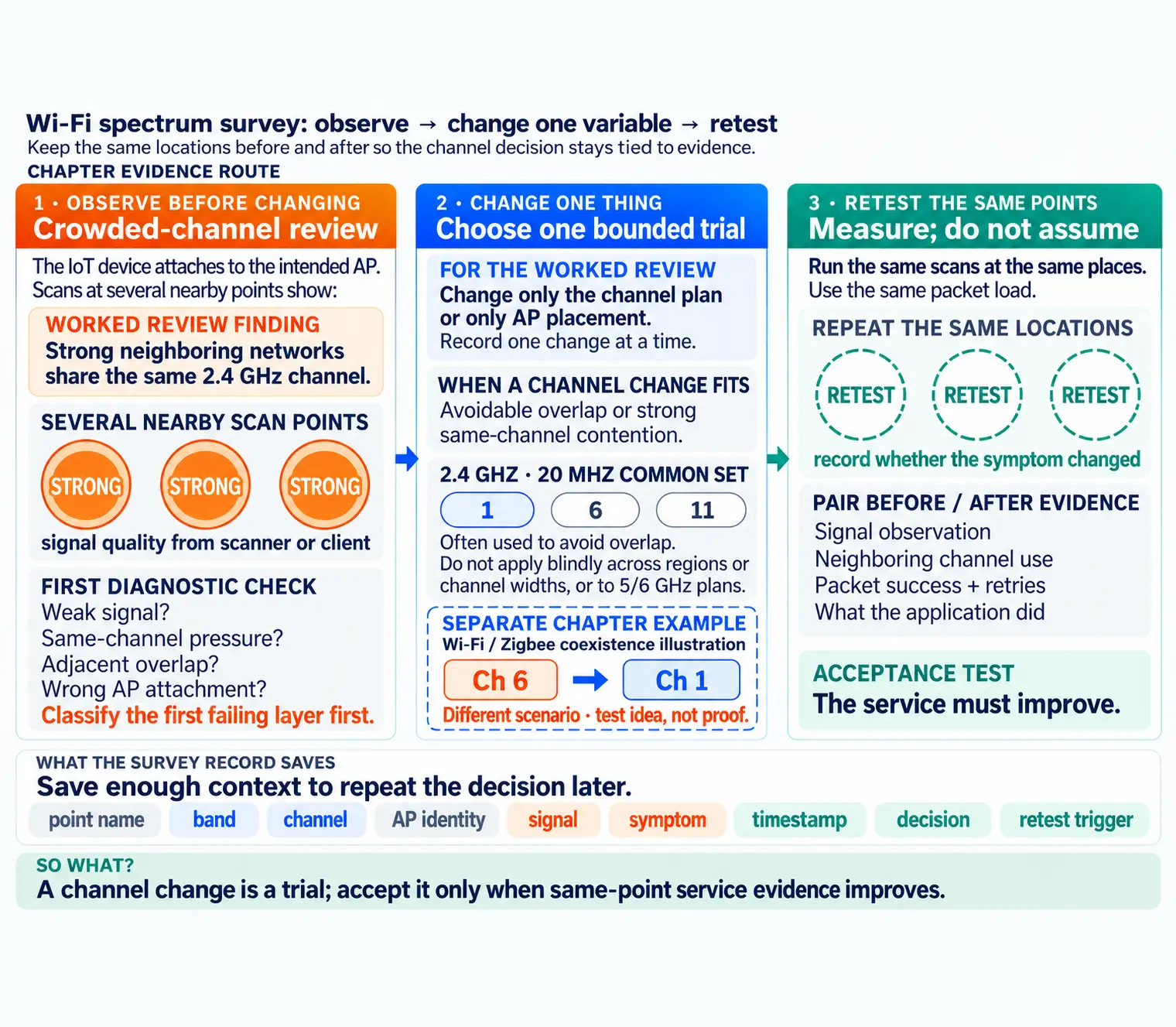
Wi-Fi spectrum review should move from claim to scan evidence before changing the channel plan.
- The final retest is part of the route, not an optional appendix: it shows whether the changed channel, width, band, or placement improved the same client locations.
- That disciplined order connects the survey to an auditable planning decision rather than a collection of screenshots.
Major section
Classify The First Symptom
Weak signal: the intended AP is visible but the client has low or unstable signal evidence at the installed point.
- Crowded channel: many strong neighboring APs share the same channel or tool evidence shows airtime pressure.
- Adjacent overlap: nearby channels overlap a 2.4 GHz plan and can cause avoidable contention.
- Authentication or addressing: the radio can see the AP, but security, DHCP, VLAN, or policy setup fails.
Major section
Decision Options
If several changes are made together, mark the result as exploratory rather than accepted evidence.
- On a point list or floor plan, name the IoT clients and service area that need a Wi-Fi decision.
- The expected output is a bounded claim that can be tested again after one channel or placement change.
- Include a point near the AP and one at the edge so channel pressure can be compared spatially.
Major section
Decision Options (continued)
The expected point record is repeatable by another technician using the same scanner and client.
- A real site scan was not run here; the local channel fixture in Step 4 is instructional only.
- In the browser run, the default plan diagnosed partial overlap between AP A and AP B; Optimize changed its plan label from Usable to Strong.
- At each real scan point, use your own scanner or controller to record AP identity, signal, neighbors, and retries.
Major section
Decision Options (continued)
If the tool exposes only AP counts, do not infer airtime pressure without utilization or retry evidence.
- This synthetic comparison illustrates a review method; it is not a scan of the learner's building.
- Strong signal beside poor delivery requires attachment and backhaul checks as well as spectrum review.
- If several changes occurred, record the trial as exploratory until a single-variable retest is done.
Major section
See Who Is on Each Channel, and How Busy It Is
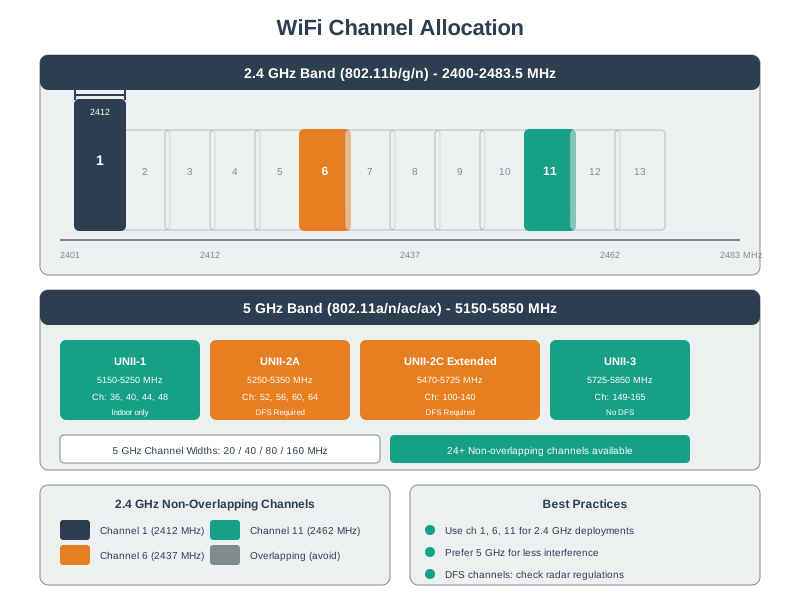
Its centres are 5 MHz apart, so channels 1 and 6 are 5 steps × 5 MHz = 25 MHz apart; that clears their 20 MHz footprints.
- The scan now becomes band-and-width proof rather than a list of channel numbers.
- The evidence record should therefore list more than SSID and signal strength.
- A clean-looking scan from a laptop at desk height can still be weak evidence for a low-power sensor inside a metal enclosure.
Major section
Read a Scan and Judge Interference
That distinction changes the repair.
- Co-channel crowding may be acceptable if the airtime is low, or it may require AP power changes, client steering, narrower channels, or a 5/6 GHz move.
- Deployment heuristics are only starting points.
- Worked example: A 2.4 GHz scan shows APs on channels 1, 3, 6, 8, and 11.
Major section
Read a Scan and Judge Interference (continued)
A shared SSID can make roaming possible across APs, and modest cell overlap helps a moving client see the next AP before the old one disappears, but too much overlap creates co-channel pressure.
- If channel 6 then shows 80% utilization, that is a capacity problem to solve by spacing APs or moving clients to 5 GHz, not by inventing a fourth channel.
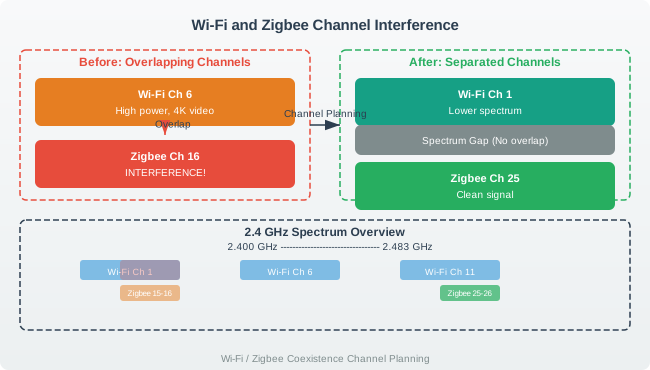
- For a defensible lab result, make the next test one-variable.
- If the record changes channel, AP placement, transmit power, and client band preference together, the retest may prove that something improved but not why.
Major section
5 GHz Channels, Width, and DFS
Channel width can bond channels to 40/80/160 MHz for more throughput — at the cost of consuming more of the band and leaving fewer non-overlapping choices for reuse.
- An 80 MHz channel is four times the spectrum of a 20 MHz one, so in dense areas wider is not better.
- DFS (Dynamic Frequency Selection) governs the applicable UNII-2 channels, which are shared with radar.
- Spectrum analysis tests whether width was the bottleneck.
Major section
5 GHz Channels, Width, and DFS (continued)
Enabling vetted DFS channels may add more choices, accepting radar-driven moves.
- DFS channels add reuse options but carry the risk of a radar-triggered channel change mid-service.
- Worked example: In an office's available channel set, only two 80 MHz slots fit without overlap.
- For IoT, the hidden constraint is often reliability rather than peak throughput.
- The lab decision should match the device's traffic, not a generic maximum-rate target.
Deck summary
Key takeaways
Several nearby networks may still be talking over one another.
- Wi-Fi spectrum review should move from claim to scan evidence before changing the channel plan.
- Weak signal: the intended AP is visible but the client has low or unstable signal evidence at the installed point.
- If several changes are made together, mark the result as exploratory rather than accepted evidence.
- The expected point record is repeatable by another technician using the same scanner and client.
Retrieval practice
Recall check 1 of 6
Radio Remi says: answer from memory, then check your reasoning.
Q1What is the useful output of a Wi-Fi spectrum survey lab?
Show answer
Answer: A A Wi-Fi spectrum survey produces a record of scan points, crowded channels, and installed-form attachment for a channel decision.
Retrieval practice
Recall check 2 of 6
Radio Remi says: answer from memory, then check your reasoning.
Q2A device has good signal but poor delivery beside crowded neighboring radios. What should the lab classify first?
Show answer
Answer: A Strong signal can coexist with airtime pressure and overlap.
Retrieval practice
Recall check 3 of 6
Radio Remi says: answer from memory, then check your reasoning.
Q3A scanner shows strong signal from the intended access point, but the IoT device still cannot send application data. What should the survey record do next?
Show answer
Answer: B Strong signal with failed data is ambiguous until the first failing layer is identified.
Retrieval practice
Recall check 4 of 6
Radio Remi says: answer from memory, then check your reasoning.
Q4In a common 2.4 GHz Wi-Fi plan using channels 1–11 at 20 MHz width, which three non-overlapping channels are used?
Show answer
Answer: B In this channels-1–11 plan, 1/6/11 provide the standard three-channel reuse set at 20 MHz width.
Retrieval practice
Recall check 5 of 6
Radio Remi says: answer from memory, then check your reasoning.
Q5Why is an AP on channel 3 often worse for the band than a second AP on channel 6?
Show answer
Answer: A Channel 3 overlaps both 1 and 6.
Retrieval practice
Recall check 6 of 6
Radio Remi says: answer from memory, then check your reasoning.
Q6In a dense deployment, why can narrowing 5 GHz channels from 80 MHz to 40 MHz increase total capacity?
Show answer
Answer: D Narrower width can create more independent channels; when contention falls enough, aggregate capacity can rise.
Print reference
Answers 1 of 2
Answer key.
- A · A Wi-Fi spectrum survey produces a record of scan points, crowded channels, and installed-form attachment for a channel decision.
- A · Strong signal can coexist with airtime pressure and overlap.
- B · Strong signal with failed data is ambiguous until the first failing layer is identified.
- B · In this channels-1–11 plan, 1/6/11 provide the standard three-channel reuse set at 20 MHz width.
- A · Channel 3 overlaps both 1 and 6.
Print reference
Answers 2 of 2
Answer key.
- D · Narrower width can create more independent channels; when contention falls enough, aggregate capacity can rise.