Wi-Fi & 802.11 · Study deck
Practice: Coverage Planning
Picture a door sensor in the far corner of a school.
Radio Remi is your guide for this deck.
After studying this chapter
Learning objectives
You will be able to:
- Explain: A useful lab record therefore stores the raw reading, the tool or AT command used, the cell or service identity when available, and the decision rule applied for that deployment.
- Explain: That order preserves causality: the chapter's planning record can link an improvement to the chosen antenna, placement, band, or gateway change instead of to a different measurement route.
- Explain: A CE 0 device might complete a report in a fraction of a second; a CE 2 device repeating 64–128 times can hold the channel for many seconds.
- interpret weak-signal evidence without overclaiming precision
Major section
Start With the Wireless Story
A mark on a sales map says it should work.
- The lab must test the real job in the real place.
- A radio reading is only one clue.
- Also send the same kind of data the product will send.
- A new wall, case, channel, antenna, software build, or network plan can reopen the test.
Major section
Start With the Wireless Story (continued)
The final wall, case, and mounting point may say otherwise.
- Under the Hood explains link budget, radio bands, weak-signal modes, and capacity.
- Coverage planning begins with a floor plan and a promise: every device location needs enough signal for its job.
- The lab story is how assumptions, measurements, obstacles, gaps, and retest decisions become a coverage record.
Major section
Coverage Evidence Flow
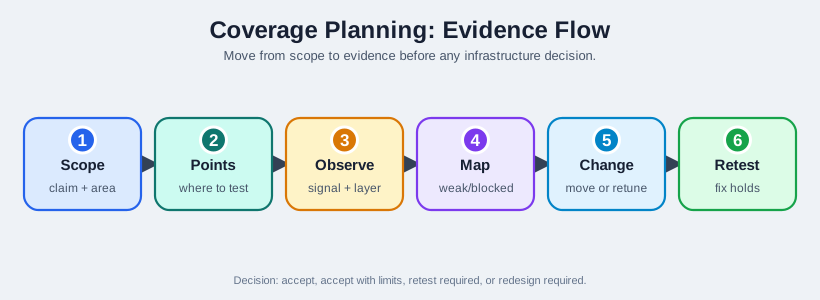
The coverage planning workflow should move from scope to evidence before making an infrastructure decision.
- The route fixes the claim and locations before measurement so the later retest can be compared fairly.
- That order preserves causality: the chapter's planning record can link an improvement to the chosen antenna, placement, band, or gateway change instead of to a different measurement route.
Major section
Troubleshooting Map
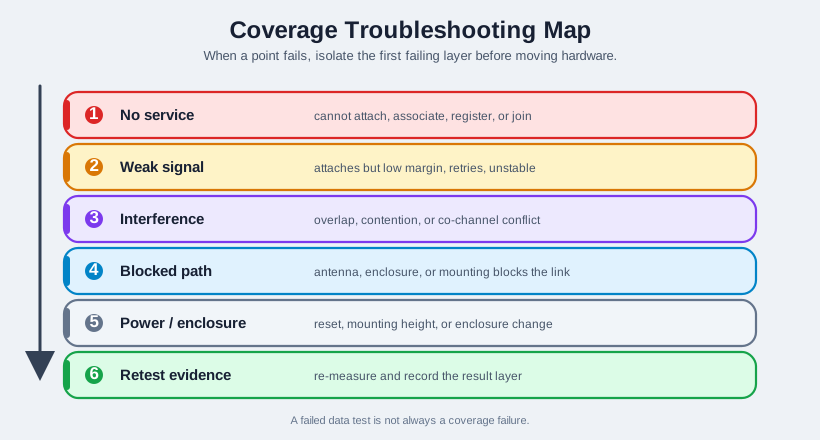
When a coverage point fails, isolate the first failing layer before moving hardware.
- It separates absence of service from weak signal, interference, obstruction, and device-state changes so one symptom does not trigger several uncontrolled fixes.
- When a test point fails, consult the Coverage troubleshooting map: isolate the first failing layer before moving hardware diagram before moving hardware.
Major section
Decision Options
Multiple simultaneous changes make it hard to know what actually fixed the issue.
- On the site map or named-point list, mark only the device positions and routes the deployment must support.
- The expected output is a testable set of points, not a broad statement that the whole site has coverage.
- The expected record lets another technician stand at the same point and repeat the observation.
Major section
Decision Options (continued)
This physical walk was not run here; a local three-point fixture is used below to practice classification.
- No site radio was measured here, so the fixture values in Step 4 must not be used as deployment evidence.
- Its input was A -54 dBm/1 retry/attached, B -70 dBm/4 retries/attached, C -74 dBm/11 retries/not attached.
- These thresholds are an exercise rule, not acceptance limits for Wi-Fi, cellular, or another radio.
Major section
Decision Options (continued)
On the map, flag points with good signal but failed data as ambiguous until service and power are checked.
- On your own site, repeat the same points at the same height and orientation after that change.
- If several changes were made together, label the trial exploratory and do another controlled retest.
- End with accepted, accepted with limits, retest required, or redesign required and name the owner.
Major section
Plan Where Every Device Has Enough Signal
The route makes service conditional: a street-level meter may be comfortable, while the same design in a basement pit may require deeper enhancement, longer radio-on time, and a different battery or placement decision.
- The depth issue is that each band changes the operating cost of the fleet.
- A comfortable point can send a short report, release the radio, and return to sleep.
- A marginal point may still report, but needs extra repetitions, longer receiver windows, and more retries after small site changes.
- Point names, enclosure state, antenna orientation, and gateway or cell identity make later retests comparable.
Major section
RSRP Bands and NB-IoT Coverage-Enhancement Levels
Higher levels generally permit more repetitions to reach devices in worse signal.
- Operators configure exact thresholds, modules expose different field names, and firmware may report RSRP, RSRQ, SINR, registration state, and packet-service state through different commands.
- A useful lab record therefore stores the raw reading, the tool or AT command used, the cell or service identity when available, and the decision rule applied for that deployment.
- Under an ideal independent-combining model, repetition can buy up to ~10 log₁₀(N) dB, so 32 repeats have a theoretical ~15 dB gain.
Major section
Capacity Is the Hidden Coverage Cost
Worked example: Two identical basements each hold 50 sensors.
- A cell has a fixed amount of airtime.
- A CE 0 device might complete a report in a fraction of a second; a CE 2 device repeating 64–128 times can hold the channel for many seconds.
- Coverage planning is capacity planning.
Major section
Capacity Is the Hidden Coverage Cost (continued)
Adding “just enough” RSRP is not only about closing the link — it is about keeping devices in low CE levels so each consumes little airtime, which is what lets a single cell support thousands of them.
- The link-budget lever (antenna, siting, band choice) and the capacity lever are the same lever.
- The arithmetic does not need a proprietary network model to be useful.
- For that reason, deep coverage records should preserve uncertainty.
Major section
Concept Relationships
Propagation design explains why obstacles, antennas, enclosure materials, mounting, and multipath change coverage evidence.
- Frequency bands explains why band and channel choice affect range, interference, and service availability.
- Cellular modem labs show how registration and packet-service evidence can separate coverage problems from modem setup problems.
- Wi-Fi spectrum labs provide shared-spectrum measurement practice that can feed a coverage record.
Deck summary
Key takeaways
A mark on a sales map says it should work.
- The final wall, case, and mounting point may say otherwise.
- The coverage planning workflow should move from scope to evidence before making an infrastructure decision.
- When a coverage point fails, isolate the first failing layer before moving hardware.
- Multiple simultaneous changes make it hard to know what actually fixed the issue.
Retrieval practice
Recall check 1 of 5

Radio Remi says: answer from memory, then check your reasoning.
Q1What is the first step in a wireless coverage-planning lab?
Show answer
Answer: A Coverage planning begins by defining the coverage claim and service area before collecting measurements.
Retrieval practice
Recall check 2 of 5
Radio Remi says: answer from memory, then check your reasoning.
Q2A device shows weak and inconsistent readings only after it is placed in the final enclosure. What is the best coverage-planning decision?
Show answer
Answer: B Installed-form evidence controls the acceptance decision, and one-variable retest keeps the diagnosis clear.
Retrieval practice
Recall check 3 of 5
Radio Remi says: answer from memory, then check your reasoning.
Q3What is the goal of cellular IoT coverage planning?
Show answer
Answer: D Planning maps signal across the site and budgets for the worst locations rather than assuming uniform coverage.
Retrieval practice
Recall check 4 of 5
Radio Remi says: answer from memory, then check your reasoning.
Q4Why can a handful of deep-coverage (CE 2) NB-IoT devices consume disproportionate airtime and battery energy?
Show answer
Answer: B Repetition trades airtime and power for coverage, so CE 2 devices are disproportionately expensive to serve: each message can occupy far more airtime and energy than a CE 0 device's.
Retrieval practice
Recall check 5 of 5
Radio Remi says: answer from memory, then check your reasoning.
Q5Why is improving a device's RSRP (e.g., via a better antenna) also a capacity win for the cell?
Show answer
Answer: C If better RSRP changes the configured coverage level and repetition count, each report uses less airtime and energy.
Print reference
Answers 1 of 2
Answer key.
- A · Coverage planning begins by defining the coverage claim and service area before collecting measurements.
- B · Installed-form evidence controls the acceptance decision, and one-variable retest keeps the diagnosis clear.
- D · Planning maps signal across the site and budgets for the worst locations rather than assuming uniform coverage.
- B · Repetition trades airtime and power for coverage, so CE 2 devices are disproportionately expensive to serve: each message can occupy far more airtime and energy than a CE 0 device's.
Print reference
Answers 2 of 2
Answer key.
- C · If better RSRP changes the configured coverage level and repetition count, each report uses less airtime and energy.