Wi-Fi & 802.11 · Study deck
Practice: Cellular Modem Bring-Up
Picture a field device that must send a small status report where no local network is available.
Radio Remi is your guide for this deck.
After studying this chapter
Learning objectives
You will be able to:
- run a cellular modem bring-up sequence without skipping dependency checks
- read AT-command responses as evidence for serial, SIM, signal, registration, and data readiness
- separate UART, SIM, antenna, coverage, power, registration, and data-session failures
- capture a compact lab record that another reviewer can repeat
Major section
Required Equipment And Service — Gather This First
Weather, walls, load, plan limits, and antenna placement can change the result.
- A cellular modem gives the device a path through a mobile network.
- The lab is successful only when you can prove the whole path, not when one light turns green.
- That review is not a completed hands-on bring-up.
Major section
Start With the Wireless Story
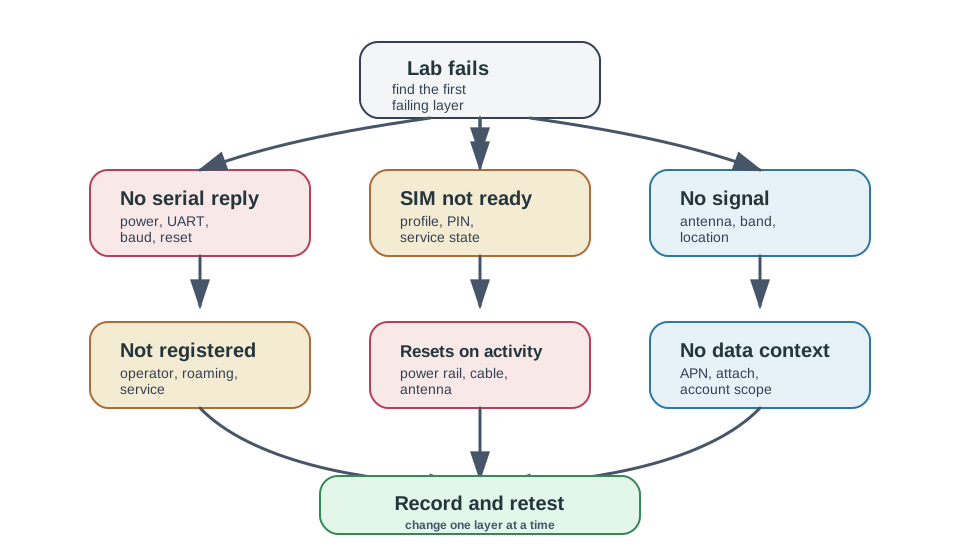
The fault may sit in power, the SIM, the radio link, or the network.
- A quick success can hide weak signal or a supply dip.
- A long log can also hide the one step that failed, so keep each claim tied to clear proof.
- The lab flow later in the chapter sets those bounds.
Major section
Phoebe's Field Notes: What "Correctly Matched" Costs in Decibels
The mathematical gist.: VSWR 2:1 means a reflection coefficient of 0.333, 11.1% reflected power, and 0.512 dB mismatch loss.
- At 5:1, the coefficient is 0.667, 44.4% reflects, and loss reaches 2.55 dB.
Major section
Record The Equipment And Setup
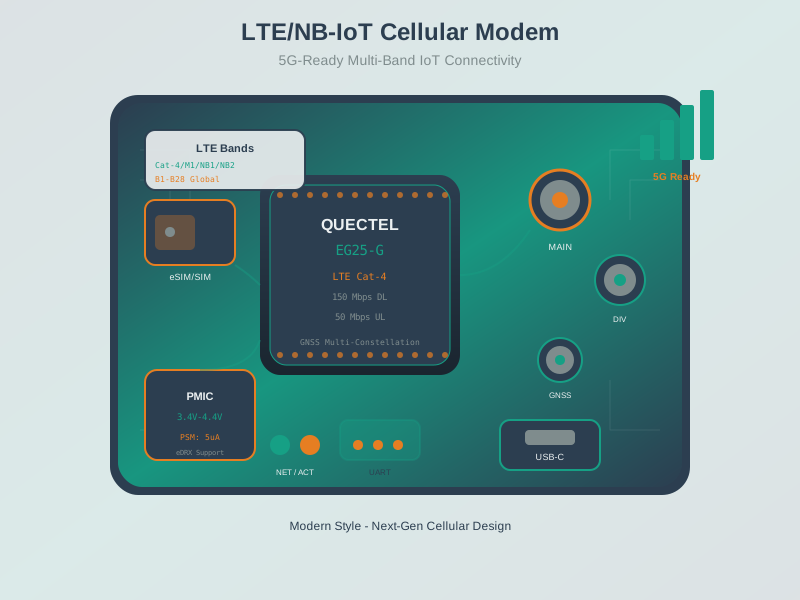
The board alone does not prove a usable radio path: it must be paired with a band-matched antenna, an active service profile, and a supply that survives transmit bursts.
- That ordered inspection leads directly to the setup record below, where each dependency is named without exposing credentials.

Major section
Power And Antenna Evidence
Cellular modems can fail during active network work even when the serial interface appears healthy.
- The two ports support the intended MIMO/diversity arrangement only when both modem ports, cables, and antenna elements are correctly connected.
- The lab does not need a large power-design calculation.

Major section
Common Mistakes
starting with MQTT, HTTP, or cloud tests before proving registration.
- treating one OK response as proof that the modem is ready for data.
- assuming all vendors use the same data-session AT commands.
- hiding command transcripts behind screenshots that cannot be searched.
- leaving secrets, SIM identifiers, APNs, or credentials in shared lab records.
Major section
A Cellular Modem Is an AT-Command Peripheral
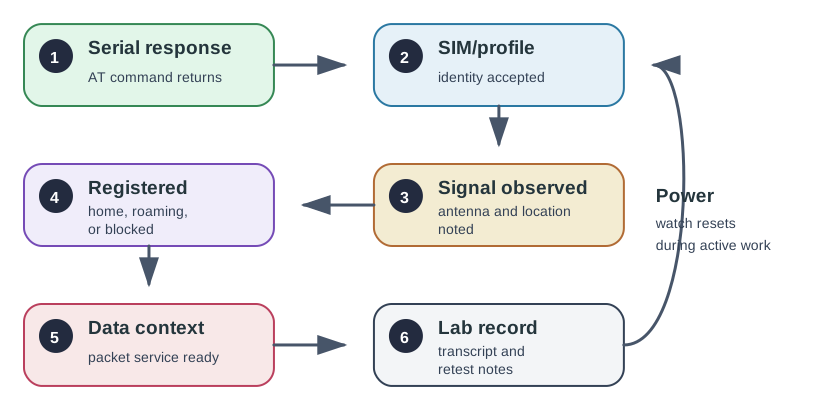
This layered sequence connects AT-command success to actual application reachability.
- Once registered, the module can open a data context and transmit; before that, application traffic simply fails.
- Worked bring-up check.: A reviewer should be able to read the transcript and identify the exact layer that passed.
Major section
A Cellular Modem Is an AT-Command Peripheral (continued)
AT+CPIN? Returning READY proves the SIM or profile is usable enough for registration.
- AT+CESQ or the module's equivalent gives a signal observation tied to antenna and location.
- If the sequence stops, record the stop as the result instead of skipping ahead.
- A clean serial response plus +CPIN: READY and +CEREG: 0,2 is not a failed application; it is a registration-layer problem.
Major section
The Bring-Up Sequence and Reading Signal
Worked example.: A device reports +CEREG: 0,2 — status 2 means “searching, not yet registered,” so any socket open will fail.
- A modem that answers AT on bench power but disappears from serial during registration may be exposing a power rail, cable, or antenna problem.
- If the reset disappears outdoors or with a known-good antenna, the lab has found a propagation or antenna path; if it disappears with a stronger supply, the lab has found a power-design path.
- A compact lab table can prevent false conclusions.
Major section
PSM and eDRX Power-Saving Timers
PSM (Power Saving Mode) lets the modem power down almost completely while staying registered.
- During PSM the device is unreachable for downlink until it wakes to send or to run its periodic TAU.
- A device that must occasionally receive a command instead uses eDRX so the network can page it within one cycle.
- The choice is a reachability-versus-battery decision, set by these timers.
Major section
PSM and eDRX Power-Saving Timers (continued)
A modem can accept a PSM request and receive a different timer from the network, or the network can reject the requested mode.
- The transcript should capture the request, the modem's reported negotiated settings if the module exposes them, and the observed current or wake behavior at a coarse level.
- If the device stays reachable for a short active window and then becomes unavailable until the next uplink or tracking-area update, the observed behavior matches the PSM claim.
- A device that drops registration every cycle may spend more energy reattaching than it saves in sleep.
Major section
Concept Relationships
Cellular spectrum explains why supported bands, operator service, and region matter before the lab starts.
- Propagation design explains why antenna placement, enclosure, location, and coverage affect modem results.
- Coverage planning labs extend modem observations into deployment mapping and acceptance records.
- Wi-Fi spectrum labs use similar evidence discipline for a different radio environment.
Deck summary
Key takeaways
Weather, walls, load, plan limits, and antenna placement can change the result.
- The fault may sit in power, the SIM, the radio link, or the network.
- The mathematical gist.: VSWR 2:1 means a reflection coefficient of 0.333, 11.1% reflected power, and 0.512 dB mismatch loss.
- The board alone does not prove a usable radio path: it must be paired with a band-matched antenna, an active service profile, and a supply that survives transmit bursts.
- Cellular modems can fail during active network work even when the serial interface appears healthy.
Retrieval practice
Recall check 1 of 5

Radio Remi says: answer from memory, then check your reasoning.
Q1In a cellular modem bring-up lab, where should you start?
Show answer
Answer: A Cellular modem bring-up proves power, serial, SIM, signal, and registration before attempting data or cloud publishing.
Retrieval practice
Recall check 2 of 5

Radio Remi says: answer from memory, then check your reasoning.
Q2A modem responds to AT and reports the SIM as ready, but the registration query still reports a searching state. What is the best lab decision?
Show answer
Answer: B A searching registration state means the modem is not yet ready for data; continue checking coverage, antenna, operator, supported band, and service configuration.
Retrieval practice
Recall check 3 of 5

Radio Remi says: answer from memory, then check your reasoning.
Q3How is a typical cellular IoT module controlled by a host microcontroller?
Show answer
Answer: D The module is an AT-driven serial peripheral; the host powers the radio, checks SIM/profile state, registers, configures data, and then sends traffic.
Retrieval practice
Recall check 4 of 5

Radio Remi says: answer from memory, then check your reasoning.
Q4Which AT command gives the most useful signal reading for an LTE/NB-IoT link, and what does it report?
Show answer
Answer: A +CESQ exposes LTE reference-signal quality and power indices; +CSQ only gives a coarse legacy RSSI value.
Retrieval practice
Recall check 5 of 5

Radio Remi says: answer from memory, then check your reasoning.
Q5A cellular sensor only sends data and never needs to receive commands promptly. Which power feature fits, and what is the catch?
Show answer
Answer: A PSM uses T3324/T3412-style timers to keep an uplink-only device registered while sleeping deeply; the trade is downlink latency until it wakes.
Print reference
Answers 1 of 2
Answer key.
- A · Cellular modem bring-up proves power, serial, SIM, signal, and registration before attempting data or cloud publishing.
- B · A searching registration state means the modem is not yet ready for data; continue checking coverage, antenna, operator, supported band, and service configuration.
- D · The module is an AT-driven serial peripheral; the host powers the radio, checks SIM/profile state, registers, configures data, and then sends traffic.
Print reference
Answers 2 of 2
Answer key.
- A · +CESQ exposes LTE reference-signal quality and power indices; +CSQ only gives a coarse legacy RSSI value.
- A · PSM uses T3324/T3412-style timers to keep an uplink-only device registered while sleeping deeply; the trade is downlink latency until it wakes.