Integration & Gateways · Study deck
Practice: Mobile Gateway Protocols
Picture a phone collecting a freezer reading while the cloud link is down.
Gateway Gus is your guide for this deck.
After studying this chapter
Learning objectives
You will be able to:
- Trace a mobile gateway path from nearby device record to upstream upload.
- Write a translation contract for source identity, value, unit, timestamp, quality, and state.
- Apply validation rules that preserve valid records and reject unsafe records.
- Define buffer, retry, stale, duplicate, and rejection behavior during outages.
Major section
In 60 Seconds
When service returns, the same reading may arrive twice or lose its unit.
- The release decision depends on what the phone preserved.
- A gateway means a device or service that joins two message paths.
- A protocol means the shared rules for a message exchange.
- Together they must preserve meaning, not merely move bytes.
Major section
Minimum Viable Understanding
A lab can be evidence-based.: You do not need a working hardware simulator to practice gateway review; source traces and expected outputs are enough to test the important decisions.
- Protocol success is not semantic success.: A source record can be parsed and uploaded while losing unit, timestamp, quality, or identity meaning.
- Failures are part of the lab.: Out-of-range values, stale records, duplicate uploads, rejected payloads, and missing permissions must be tested deliberately.
- The output is a release record.: The lab ends with evidence a reviewer can use, not just a green connection message.
Major section
Lab Scenario
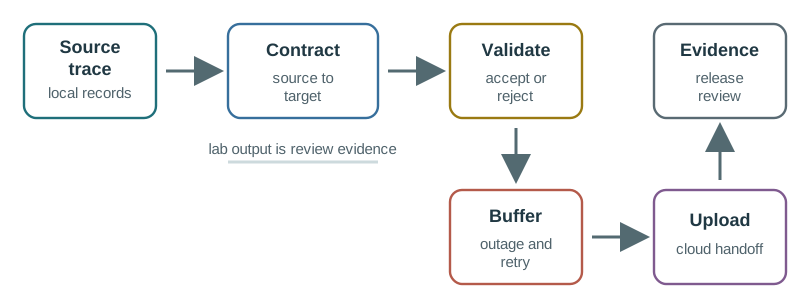
That progression is the mechanism behind Mobile gateway protocol lab workflow showing source trace, translation contract, validation, buffering, upload, and release evidence and the evidence order needed for the “trace”–“local records” decision.
- A managed phone collects nearby equipment-tag records during a field visit.
Try it: Lab Scenario in the chapter
Major section
Part 3: Validate Records
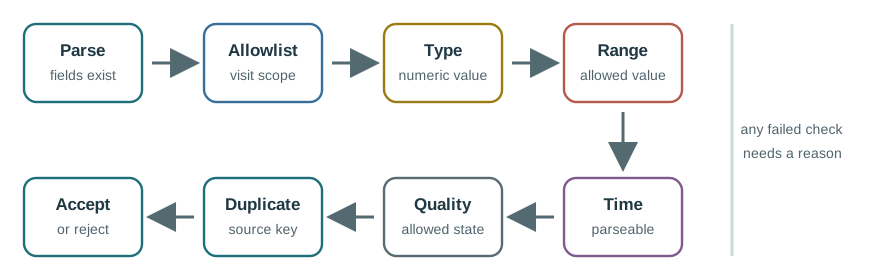
The two comparisons clarify Mobile gateway validation pipeline showing parse, allowlist, type, range, time, quality, duplicate, accept, and reject decisions.
- They also keep “fields exist” in the running decision about the “fields exist”–“allowlist” decision, tied to labelled evidence.
Major section
Part 5: Assemble Release Evidence
The final lab output is a release evidence pack.
- It should be reviewable by someone who did not run the lab.
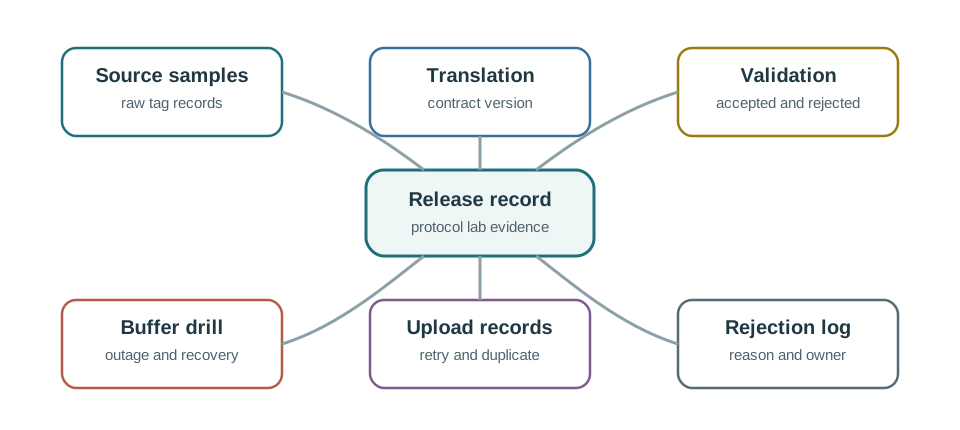
- Its named elements “protocol lab evidence” and “Source samples” frame the claim that Mobile gateway protocol lab release evidence map linking source samples, translation contract, validation results, buffer drill, upload records, rejection log, and release decision.
Major section
Buffer Before You Trust the Upload
It makes “sensor reading” and “Timestamp” separate, inspectable parts of the “sensor reading”–“timestamp” decision.
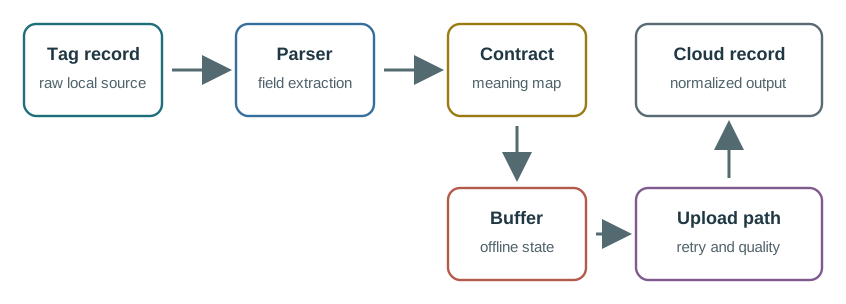
- The move through “sensor and” reaches “gateway time”, making Mobile gateway store-and-forward lifecycle from collection through reconciliation observable.
Deck summary
Key takeaways
When service returns, the same reading may arrive twice or lose its unit.
- A lab can be evidence-based.: You do not need a working hardware simulator to practice gateway review; source traces and expected outputs are enough to test the important decisions.
- That progression is the mechanism behind Mobile gateway protocol lab workflow showing source trace, translation contract, validation, buffering, upload, and release evidence and the evidence order needed for the “trace”–“local records” decision.
- The two comparisons clarify Mobile gateway validation pipeline showing parse, allowlist, type, range, time, quality, duplicate, accept, and reject decisions.
- The final lab output is a release evidence pack.
Retrieval practice
Recall check 1 of 6

Gateway Gus says: answer from memory, then check your reasoning.
Q1A mobile gateway receives value=45 with unit=F, but its translation contract only accepts Celsius records. What should the gateway do?
Show answer
Answer: A A record whose unit is outside the translation contract must be rejected or marked unresolved unless a conversion is explicitly defined.
Retrieval practice
Recall check 2 of 6

Gateway Gus says: answer from memory, then check your reasoning.
Q2Place each mobile-gateway lab record where it lives so you can prove capture, translation, and offline release behavior end to end.
Show answer
Answer: A Separate source capture, translation validation, and release evidence so you can decide whether a mobile gateway preserves meaning through outages and retries.
Retrieval practice
Recall check 3 of 6

Gateway Gus says: answer from memory, then check your reasoning.
Q3A mobile gateway receives metric=temp, value=45, unit=F, but the translation contract only accepts Celsius records. What should the gateway do?
Show answer
Answer: A Silent unit conversion can change meaning.
Retrieval practice
Recall check 4 of 6

Gateway Gus says: answer from memory, then check your reasoning.
Q4Why is a store-and-forward buffer the critical component of a mobile gateway rather than an optional extra?
Show answer
Answer: A A moving gateway loses its cellular uplink in tunnels, dead zones, and handovers.
Retrieval practice
Recall check 5 of 6

Gateway Gus says: answer from memory, then check your reasoning.
Q5Sensors deliver 4 KB/s to a gateway with a 1 MB RAM buffer. How long into an uplink outage before the buffer overflows?
Show answer
Answer: A 1,000 KB / 4 KB/s = 250 s, roughly 4 minutes.
Retrieval practice
Recall check 6 of 6

Gateway Gus says: answer from memory, then check your reasoning.
Q6A gateway uploads a batch, the uplink drops before the acknowledgment, and on reconnect it re-sends the batch. The server ends up with duplicate records. What is the correct fix?
Show answer
Answer: A When an acknowledgment is lost, re-sending is the safe choice for avoiding loss, but it creates duplicates.
Print reference
Answers 1 of 2
Answer key.
- A · A record whose unit is outside the translation contract must be rejected or marked unresolved unless a conversion is explicitly defined.
- A · Separate source capture, translation validation, and release evidence so you can decide whether a mobile gateway preserves meaning through outages and retries.
- A · Silent unit conversion can change meaning.
- A · A moving gateway loses its cellular uplink in tunnels, dead zones, and handovers.
- A · 1,000 KB / 4 KB/s = 250 s, roughly 4 minutes.
Print reference
Answers 2 of 2
Answer key.
- A · When an acknowledgment is lost, re-sending is the safe choice for avoiding loss, but it creates duplicates.