Integration & Gateways · Study deck
Mobile Phone Gateway Fundamentals
A technician scans a pump tag in a basement, reads its temperature and walks upstairs to regain an outside connection.
Gateway Gus is your guide for this deck.

After studying this chapter
Learning objectives
You will be able to:
- separate the three mobile gateway roles a phone can play and keep them distinct
- define the translation contract a phone gateway must keep meaning-preserving
- rate a use case as good fit, caution, or prefer-dedicated for a mobile gateway
- handle duplicate uploads with idempotent behavior and bounded buffering
Major section
A Phone Owns a Managed Boundary
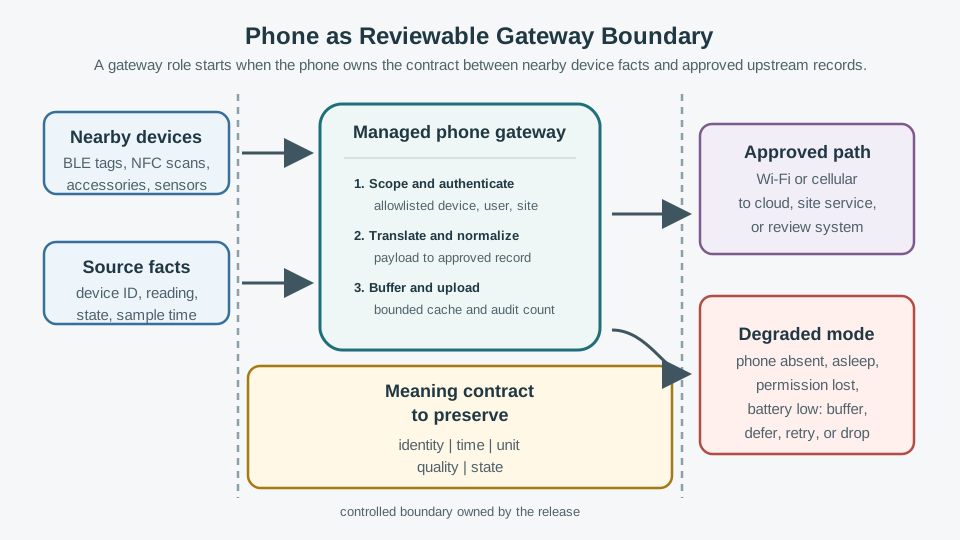
A phone reads a nearby tag and later sends a service record.
- If the phone sleeps, loses permission, or leaves the site, the central system must not invent a healthy pump.
- A gateway is a managed bridge between nearby devices and a wider service.
- A spinning symbol is not enough.
Major section
A Phone Owns a Managed Boundary (continued)
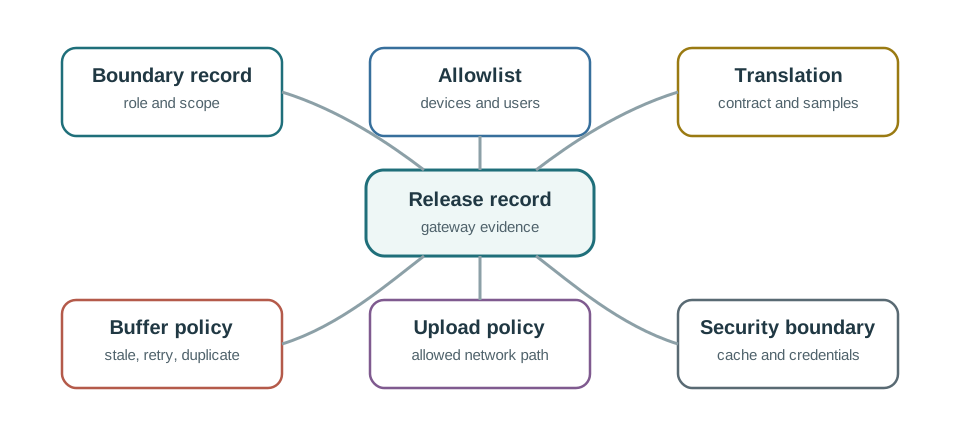
The product owner should name which devices may connect, what each reading means, what the phone changes, and what approved record leaves.
- The phone's user, power state, movement, and software version are part of that promise.
- The worker must know whether it is safe to leave the pump and what to do if the phone cannot finish.
- A phone has many radios, but that does not make it reliable infrastructure.
Major section
Make the Boundary Reviewable
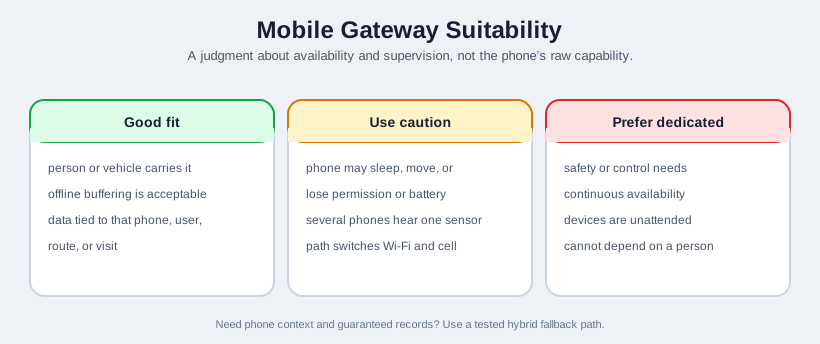
To ground the “good fit”–“person or vehicle carries it” decision through “offline buffering is acceptable” in visible evidence about “Good fit”, inspect Figure: Suitability is a judgment about availability and supervision.
- This ordering shows why Suitability is a judgment about availability and supervision, not about the phone's raw capability.
Major section
Leave the Pump with a Saved Reading, Not a Spinner
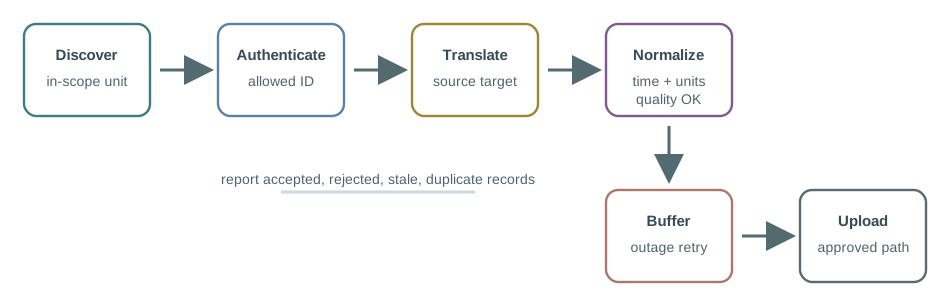
The gateway record should retain the source identifier, raw value, scale, normalized unit and collection time.
- For an illustrative buffer bound, allow 200 saved records at 160 bytes each before database overhead.
- If the app already holds 199 records, it has room for one more under that policy.
Major section
Leave the Pump with a Saved Reading, Not a Spinner (continued)
At the buffer boundary, an explicit full response preserves the distinction between refused collection and a saved pump visit.
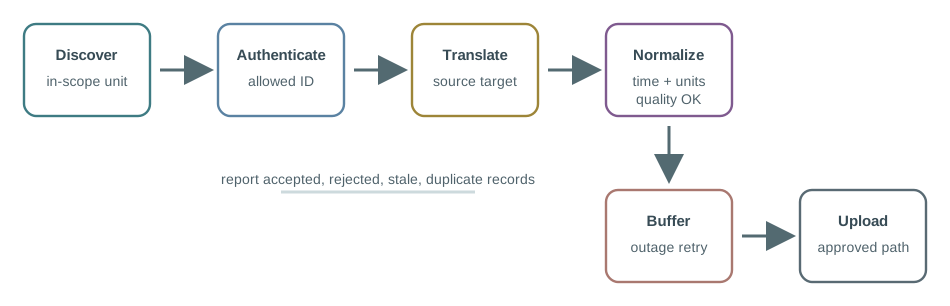
- The pump tag being visible completes only discovery.
- Authentication establishes which nearby source may cross the gateway boundary.
- The phone should show these steps as different worker-visible states.
Major section
Leave the Pump with a Saved Reading, Not a Spinner (continued)
Permission loss is another boundary test.
- If the save is durable, the phone can resume the pending upload later.
- A phone app holding records only in memory does not provide durable-save evidence.
- This module's gateway role is conditional on a person, a device and an operating system.
Major section
Leave the Pump with a Saved Reading, Not a Spinner (continued)
A retry should carry the same record identity so the receiving service can recognize it rather than create a second visit.
- If nearby-device access is revoked, the app should explain that collection cannot continue, while still showing the state of records already saved.
- The example shows why a supervised service round can tolerate delayed upload while an always-on alarm may need fixed infrastructure.
- Background execution and storage behaviour must be tested on the supported phone and app versions; the byte calculation alone does not prove them.
Major section
Summary
The gateway function chain is discover, authenticate, translate, normalize, buffer, upload, and report evidence, and each link can lose meaning or availability.
- Protocol translation is not enough; a translation contract must preserve identity, unit, scale, the correct timestamp, quality, and state, with sample records and rejection rules.
- Suitability is a judgment about availability and supervision: good fit for mobile, supervised workflows; caution for conditional availability; prefer a dedicated gateway for always-on safety and control.
- A hybrid pattern lets a phone add context while a fixed, owned fallback preserves essential records when the phone is absent.
Deck summary
Key takeaways
A phone reads a nearby tag and later sends a service record.
- The product owner should name which devices may connect, what each reading means, what the phone changes, and what approved record leaves.
- To ground the “good fit”–“person or vehicle carries it” decision through “offline buffering is acceptable” in visible evidence about “Good fit”, inspect Figure: Suitability is a judgment about availability and supervision.
- The gateway record should retain the source identifier, raw value, scale, normalized unit and collection time.
- At the buffer boundary, an explicit full response preserves the distinction between refused collection and a saved pump visit.
Retrieval practice
Recall check 1 of 3

Gateway Gus says: answer from memory, then check your reasoning.
Q1When does a mobile phone actually act as an IoT gateway rather than just a nearby device?
Show answer
Answer: C The gateway role is about owning a reviewable boundary between nearby device data and the approved upstream record, not about which radios the phone has.
Retrieval practice
Recall check 2 of 3

Gateway Gus says: answer from memory, then check your reasoning.
Q2Which deployment is the strongest fit for a mobile phone as the primary IoT gateway?
Show answer
Answer: B The gateway role is tied to a supervised mobile workflow with an assigned phone, explicit context, an allowlist, buffering, and reviewable upload behavior.
Retrieval practice
Recall check 3 of 3

Gateway Gus says: answer from memory, then check your reasoning.
Q3A phone gateway receives a nearby sensor value and uploads a cloud record. Which evidence best proves that the gateway preserved the meaning of the value?
Show answer
Answer: D Preserving meaning requires a translation contract with traceable mapping evidence that links the source sample to the uploaded record, not just a successful upload.
Print reference
Answers
Answer key.
- C · The gateway role is about owning a reviewable boundary between nearby device data and the approved upstream record, not about which radios the phone has.
- B · The gateway role is tied to a supervised mobile workflow with an assigned phone, explicit context, an allowlist, buffering, and reviewable upload behavior.
- D · Preserving meaning requires a translation contract with traceable mapping evidence that links the source sample to the uploaded record, not just a successful upload.