Wi-Fi & 802.11 · Study deck
Propagation and Link Budgets
A sound site review starts on paper.
Radio Remi is your guide for this deck.

After studying this chapter
Learning objectives
You will be able to:
- distinguish free-space estimates from deployment-ready propagation evidence
- explain why antenna placement, orientation, enclosure, and mounting affect link performance
- identify how obstacles, Fresnel clearance, multipath, and interference change the link record
- review a link budget as a set of evidence assumptions rather than a single computed result
Major section
Start With the Wireless Story
Under the Hood explains path calculations, fading, interference, and why a clean early estimate must still be checked in the field.
- A sound site review starts on paper.
- Leave room for change.
- Recheck after layout, season, or equipment changes.
- It fails after workers mount it behind a metal beam.
Major section
Start With the Wireless Story (continued)
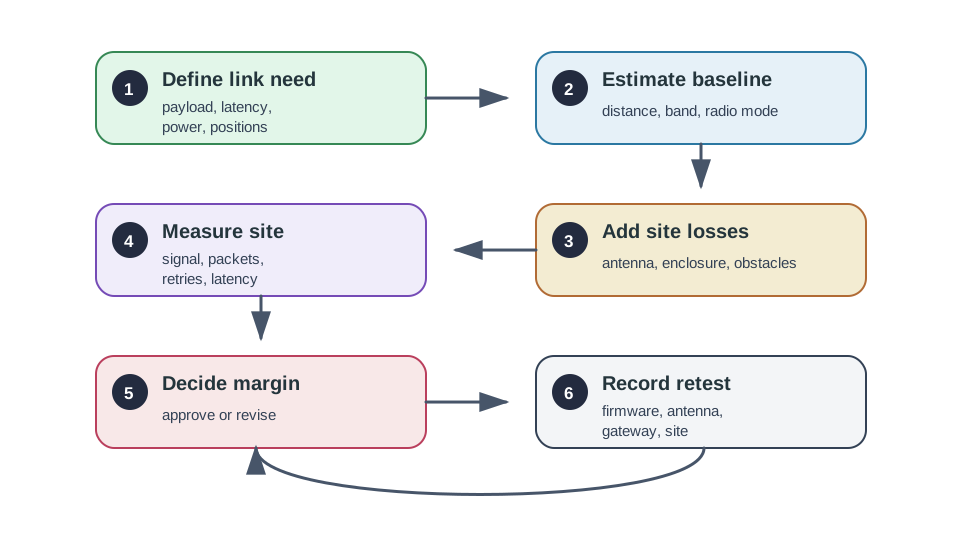
The propagation story follows distance, walls, antenna placement, fading, interference, margin, and retest triggers until the team can explain why packets should still arrive.
- The device did not change.
- The path around it did.
- Wireless design must account for the real place.
- A signal loses strength as it travels.
Major section
In 60 Seconds
Wireless propagation design is the discipline of proving that a radio link will work after the product leaves the lab.
- Free-space calculations are useful early checks, but they are not enough for IoT deployments with walls, people, cabinets, poles, foliage, vehicles, machinery, antenna detuning, interference, and changing gateway placement.
- The goal is not to memorize a path-loss formula.
- The goal is to build a review record that explains why the installed link has enough margin for the actual site.
Major section
Phoebe's Field Notes: How Far Before the Budget Runs Out
The mathematical gist: This link can tolerate 107 dB total path loss.
- Reserving 8 dB leaves 99 dB for propagation and 92.6 m range: 0.541 times the radius and 0.293 times the idealised coverage area.
Major section
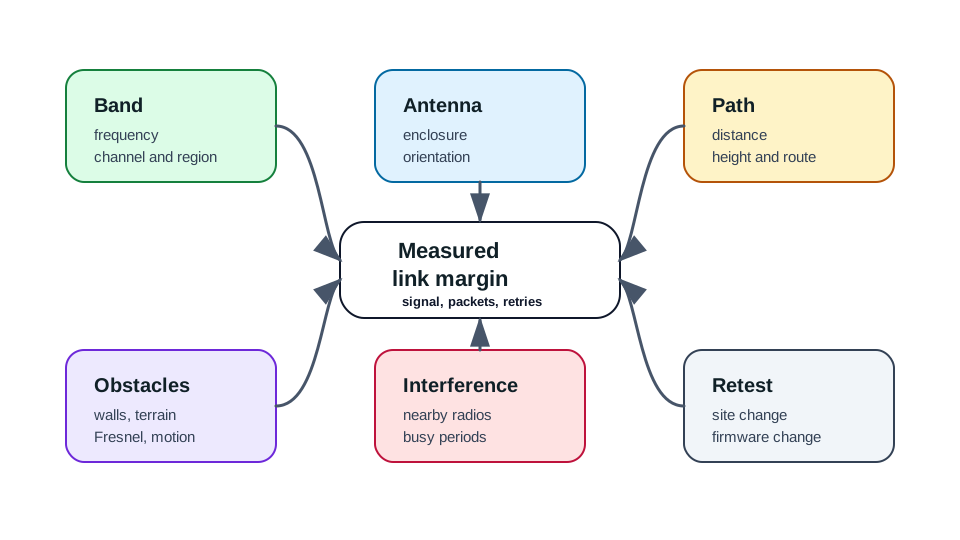
Propagation Evidence Map
A design can pass the formula step and still fail because the antenna is detuned, the gateway is too low, a cabinet blocks the path, or a nearby system occupies the channel.
- The map connects the link budget to field observations and exposes which assumption needs retesting.
Major section
The Link Budget Decides Whether a Link Closes
Propagation is the study of how a signal weakens between transmitter and receiver.
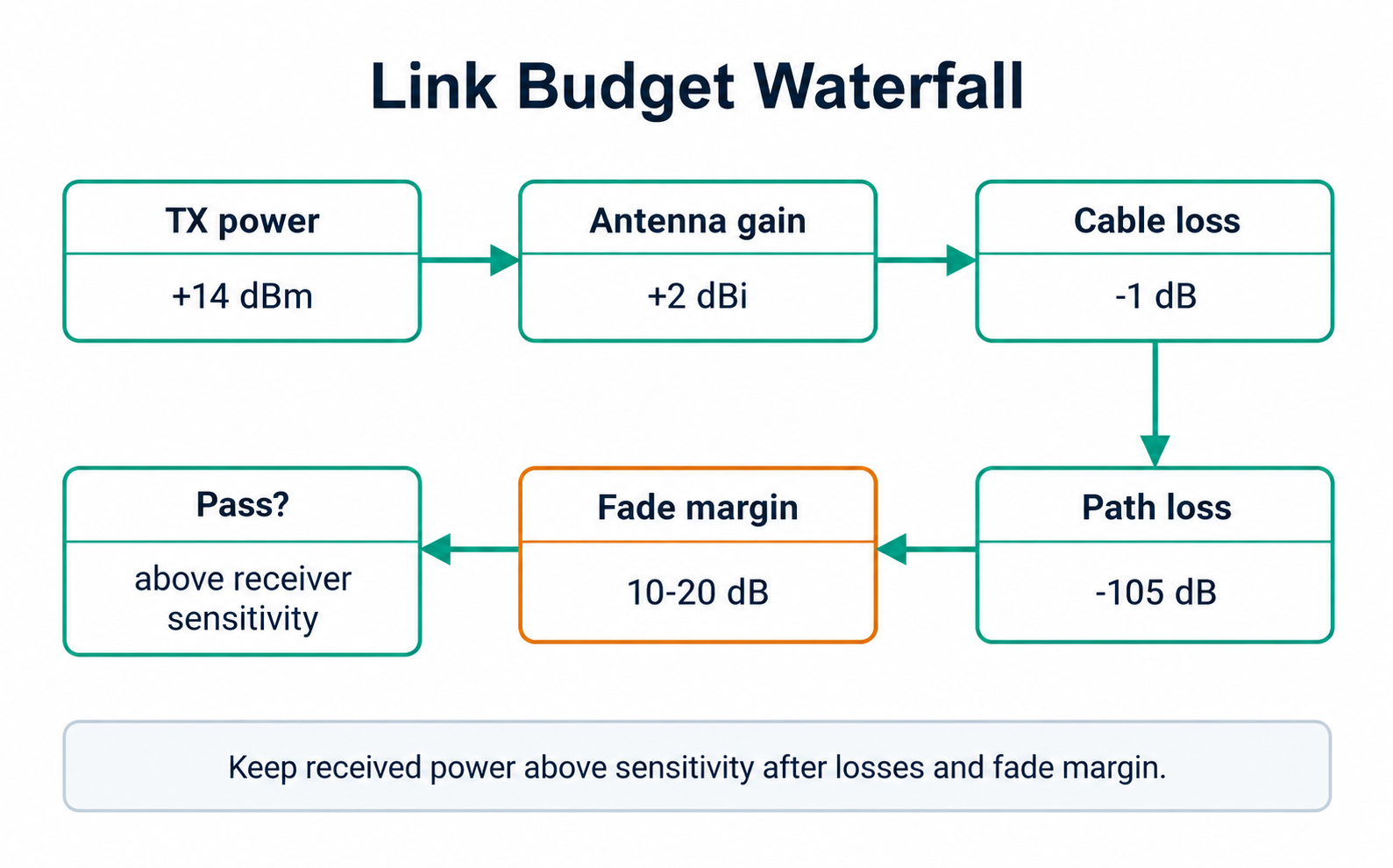
- If received power sits comfortably above sensitivity, the link closes; if not, it drops.
- Path loss is dominated by distance and obstacles.
- The remaining vertical separation is the margin available for fading and installation changes.
Major section
The Link Budget Decides Whether a Link Closes (continued)
This waterfall connects the arithmetic to field validation: every term needs a source, and the final enclosure and location must prove that enough margin remains.
- Free-space loss is about 20 log10(0.1 km) + 20 log10(2400 MHz) + 32.44 ≈ 80 dB.
- Every wireless link is an inequality: received power must exceed sensitivity, with margin to spare.
- RSRP tells a cellular device how that inequality is going.
Major section
Read RSRP, RSRQ, and SINR
RSRP is about strength; RSRQ and SINR are about cleanliness.
- A device can show strong RSRP but poor RSRQ when the cell is congested or interfered — the signal is loud but the channel is noisy.
- Worked example: A meter reports RSRP = −115 dBm and RSRQ = −18 dB.
- Strength is weak and quality is poor — connection may need repetition and deliver low throughput.
Major section
Read RSRP, RSRQ, and SINR (continued)
A better antenna, a different supported band, or relocation may raise RSRP, while poor RSRQ also calls for checking cell load and interference.
- A device with RSRP around -85 dBm but RSRQ near -17 dB probably has enough reference-signal strength but poor quality from load, interference, or neighboring-cell energy.
- Moving the antenna may not solve that if the local cell is busy.
- A different device with RSRP around -110 dBm and RSRQ near -9 dB has a cleaner channel but little strength margin, so placement, antenna efficiency, band choice, or gateway/base-station geometry matter more.
Major section
Maximum Coupling Loss and NB-IoT's +20 dB
That target motivates deep-indoor use, but it is not an installed basement coverage promise or an identical target for every deployment mode.
- Engineers summarise a technology's reach with maximum coupling loss (MCL) — the largest total path loss a link can survive while still delivering data under stated assumptions.
- That extra 20 dB is bought two ways.
- The repeated message takes longer on air and drains more battery per report.
Major section
Maximum Coupling Loss and NB-IoT's +20 dB (continued)
A commonly cited legacy GPRS/LTE comparison is near 144 dB; 3GPP published a 164 dB: NB-IoT target for standalone deployment — a 20 dB or 100× power-ratio difference.
- The price is time and energy — deep-coverage messages are slow and costly, which is why NB-IoT targets tiny, infrequent payloads.
- Worked example: A sensor at the cell edge fails to decode at 150 dB coupling loss with a single transmission.
- Coverage, throughput, and power are the three-way trade every deep-coverage design balances.
- The repeated-copy gain is logarithmic, so it has diminishing returns.
Deck summary
Key takeaways
Under the Hood explains path calculations, fading, interference, and why a clean early estimate must still be checked in the field.
- The propagation story follows distance, walls, antenna placement, fading, interference, margin, and retest triggers until the team can explain why packets should still arrive.
- Wireless propagation design is the discipline of proving that a radio link will work after the product leaves the lab.
- The mathematical gist: This link can tolerate 107 dB total path loss.
- Propagation is the study of how a signal weakens between transmitter and receiver.
Retrieval practice
Recall check 1 of 5

Radio Remi says: answer from memory, then check your reasoning.
Q1Why are free-space path-loss calculations not enough to approve an IoT radio link?
Show answer
Answer: A Free-space math is an early check; real sites add obstacles and interference, so field evidence is required.
Retrieval practice
Recall check 2 of 5
Radio Remi says: answer from memory, then check your reasoning.
Q2What can the design review conclude about the installed radio link?
Show answer
Answer: C A free-space estimate is a useful first filter, but approval still needs final-enclosure antenna checks plus representative site, coexistence, and measurement evidence.
Retrieval practice
Recall check 3 of 5
Radio Remi says: answer from memory, then check your reasoning.
Q3What does a link budget determine?
Show answer
Answer: A The accounting combines transmit power, antenna gains, cable/enclosure losses, path loss, and receiver sensitivity.
Retrieval practice
Recall check 4 of 5
Radio Remi says: answer from memory, then check your reasoning.
Q4A cellular IoT device shows strong RSRP but poor RSRQ. What does that indicate?
Show answer
Answer: A RSRP is raw reference-signal strength; RSRQ includes total received power, so congestion, interference, or load can pull it down.
Retrieval practice
Recall check 5 of 5
Radio Remi says: answer from memory, then check your reasoning.
Q5For NB-IoT's published 164 dB standalone MCL target versus a ~144 dB legacy comparison, how is the ~20 dB gain mainly achieved, and at what cost?
Show answer
Answer: A Repetition gives roughly 10 log10(N) dB and the narrow carrier raises power spectral density; the cost is airtime, latency, and battery energy.
Print reference
Answers 1 of 2
Answer key.
- A · Free-space math is an early check; real sites add obstacles and interference, so field evidence is required.
- C · A free-space estimate is a useful first filter, but approval still needs final-enclosure antenna checks plus representative site, coexistence, and measurement evidence.
- A · The accounting combines transmit power, antenna gains, cable/enclosure losses, path loss, and receiver sensitivity.
- A · RSRP is raw reference-signal strength; RSRQ includes total received power, so congestion, interference, or load can pull it down.
Print reference
Answers 2 of 2
Answer key.
- A · Repetition gives roughly 10 log10(N) dB and the narrow carrier raises power spectral density; the cost is airtime, latency, and battery energy.