Wi-Fi & 802.11 · Study deck

IoT Frequency Bands and Licensing

BLE is a short-range low-power radio system.

Radio Remi is your guide for this deck.

frequency-bandsspectrum-licensingism-bands
Radio Remi, the module guide, in a scene from this chapter.
iotclass.org

After studying this chapter

Learning objectives

You will be able to:

  • compare major IoT frequency-band families without relying on one-size-fits-all range claims
  • distinguish licensed, unlicensed, and shared spectrum responsibilities
  • identify why regional band plans affect hardware, firmware, certification, and deployment records
  • review 2.4 GHz, 5 GHz, 6 GHz, sub-GHz, and cellular choices using evidence
iotclass.org

Major section

Start With the Wireless Story

BLE is a short-range low-power radio system.

  • A payload is the useful data inside a message.
  • A protocol is a shared set of message rules.
  • Zigbee is a low-power radio network system often used for nearby devices.
  • Lower frequencies can often travel farther, but may offer less data and different local rules.

Why it matters

Higher frequencies can carry more data, yet walls and busy channels can reduce useful reach.

iotclass.org

Major section

Start With the Wireless Story (continued)

This basement story cannot pick a product from a band name.

  • Those need device and field evidence.
  • The deeper work adds numbers to the simple scene; it does not make a famous radio the default.
  • A licensed band adds an owner, not a guarantee.
  • A frequency band is a contract with physics and regulators.
iotclass.org

Major section

In 60 Seconds · Phoebe's Field Notes: Why Lower Bands Travel Farther

An IoT frequency-band decision is not a preference for a famous protocol.

  • The review goal is to prove that the band choice is allowed in the target region and works in the installed environment.
iotclass.org

Major section

What A Band Decision Must Prove · IoT Spectrum Families
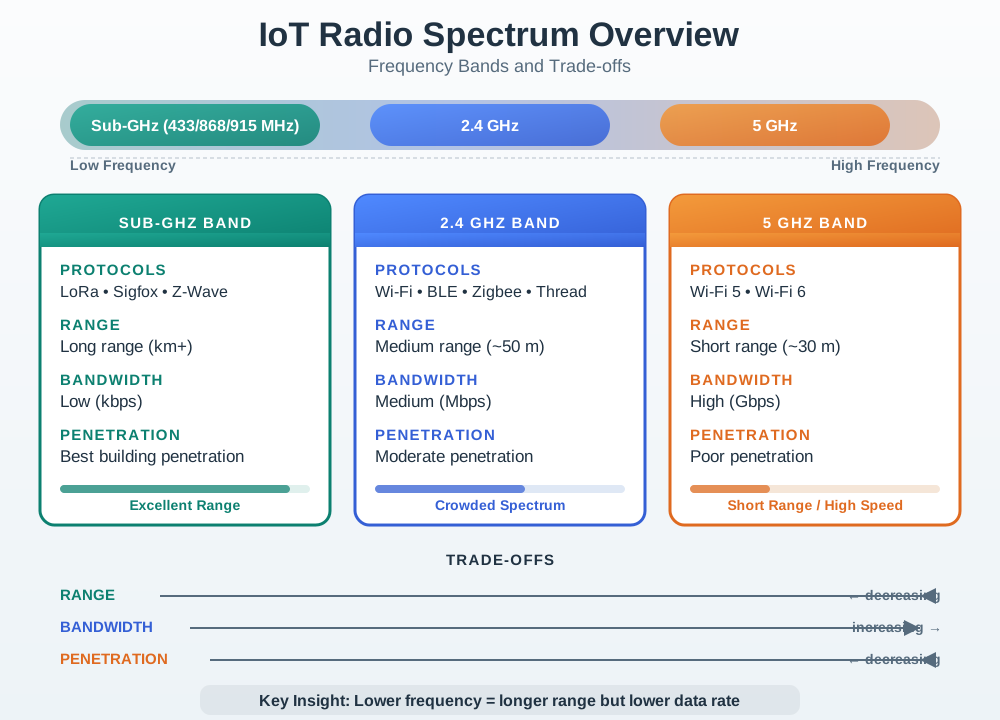
A frequency band controls more than radio range.

  • It affects antenna size, allowed transmit behavior, channel availability, receiver filtering, coexistence, certification, provisioning, and service operations.
  • If the answer is only "this protocol usually works," the review is not complete.
  • Higher frequency may help capacity, but it may also reduce installed margin.

Numbers to remember

2.4 GHzThe 2.4 GHz band can be an excellent choice

Why it matters

The 2.4 GHz band can be an excellent choice, but it should be approved with coexistence evidence rather than assumed to be safe because it is globally familiar.

IoT Radio Spectrum Overview
iotclass.org

Major section

Licensed, Unlicensed, And Shared Spectrum · Regional Configuration Is A Product Requirement

Licensed spectrum grants controlled use rights to an operator or license holder.

  • Shared spectrum may include coordination, listen-before-talk, duty-cycle, power, or database-style requirements depending on the band and country.
  • No category removes the need for regional compliance and field evidence.
  • Regional spectrum differences are not a late documentation detail.

Why it matters

Unlicensed spectrum allows compliant devices to transmit without an individual spectrum license, but only within regional technical rules.

iotclass.org

Major section

Coexistence And Channel Planning · Band Selection Review Flow
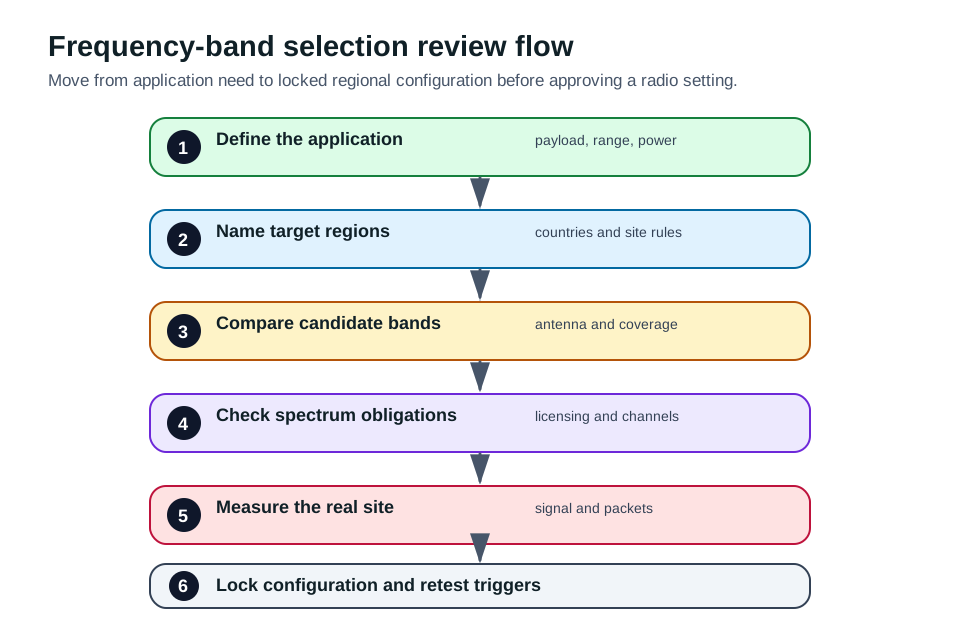
Frequency selection is incomplete without coexistence review.

  • In dense buildings, the useful question is not "is this band common?" It is "what happens to packet success when the real site is busy?".
  • Familiarity is useful, but approval needs a repeatable evidence path.
Evidence-first flow for approving an IoT frequency-band selection.
iotclass.org

Major section

Worked Review: Multi-Region Asset Tracker · Common Mistakes

Accepted answer: "Sub-GHz is not one global setting.

  • A multi-region product needs region-aware hardware, firmware, provisioning, and compliance evidence.".
  • treating a protocol name as proof that the frequency band is suitable.
  • assuming unlicensed means unregulated.
  • assuming licensed cellular removes coverage, roaming, or certification review.

Why it matters

Prompt: "Use one sub-GHz configuration for the global tracker because sub-GHz has long range.".

iotclass.org

Major section

Review Checklist · Two Regimes — Licensed and License-Exempt
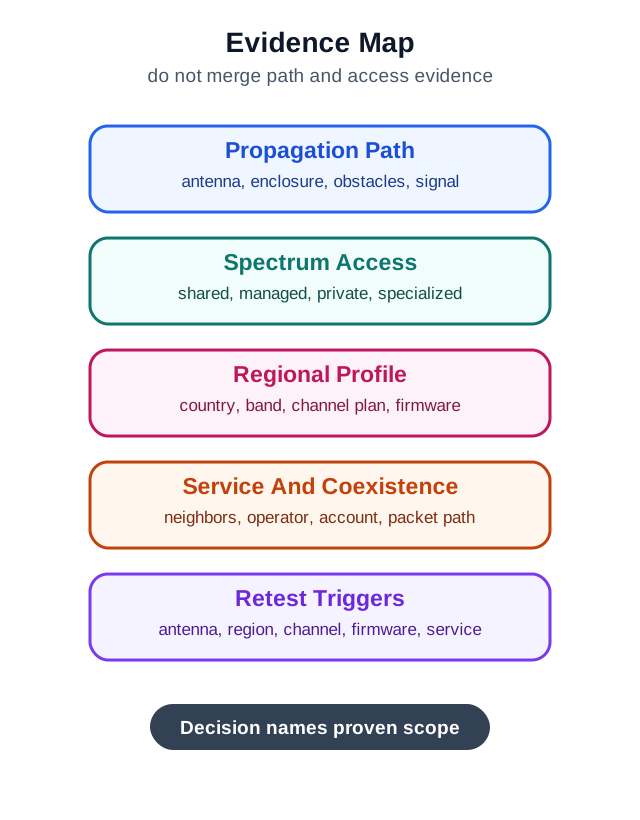
Radio spectrum is a shared, regulated resource, and IoT technologies split across two access regimes.

  • Licensed spectrum is assigned to an operator or license holder — the cellular LTE/5G bands behind NB-IoT and LTE-M.
  • The choice is a bargain.
  • The first review calculation is usually simple.

Numbers to remember

2.4 GHzA 2.4 GHz design may reuse existing gateways
915 MHzA 915 MHz quarter-wave antenna is about 8.2 cm
8.2 cmA 915 MHz quarter-wave antenna is about 8.2 cm
License type is only one column of evidence. A review-ready band decision also names the propagation path, spectrum-access model, regional profile, service and coexistence assumptions, and retest triggers so the approved scope is explicit.
iotclass.org

Major section

Bands, EIRP Caps, and Duty Cycle

An NB-IoT sensor on licensed Band 20 has no such duty-cycle cap — the operator schedules its access — but it needs a SIM and a data plan.

  • The regime, not the radio, sets these constraints.
  • The arithmetic becomes useful when firmware behavior is reviewed.
  • EIRP needs the same discipline.

Numbers to remember

1%At a 1% duty cycle, the hourly airtime budget is 0.01 &times

Why it matters

If a region or band plan allows only 14 dBm EIRP for that mode, the implementation is not compliant even though the radio setting looks acceptable.

iotclass.org

Major section

Bands, EIRP Caps, and Duty Cycle (continued)

At a 1% duty cycle, the hourly airtime budget is 0.01 × 3600 = 36 seconds.

  • If one uplink takes 900 ms on air, a device can send at most 40 such uplinks per hour on that constrained sub-band before protocol overhead, downlinks, retries, or regional sub-band details are considered.
  • A conducted-power setting alone is not enough; radiated power includes antenna gain and losses.
  • If a radio outputs 14 dBm into a 2 dBi antenna with negligible cable loss, the rough EIRP is 16 dBm.
iotclass.org

Major section

Why the Rules Exist, and the Middle Ground

Worked example.: A factory wants dedicated, interference-managed wireless for AGVs but cannot buy a national cellular license.

  • Duty-cycle and EIRP limits are not bureaucracy for its own sake — they are how a commons stays usable.
  • If every device in an unlicensed band could transmit at full power all the time, the band would saturate and nobody's link would close.
  • That ownership question changes failure handling.

Numbers to remember

2.4 GHzIf a shared 2.4 GHz site becomes congested
iotclass.org

Major section

Why the Rules Exist, and the Middle Ground (continued)

Capping airtime and power forces sharing, which is exactly why unlicensed technologies (Wi-Fi's CSMA/CA, LoRaWAN's duty cycle, listen-before-talk) build politeness into the protocol.

  • In an unlicensed commons, each device must limit how much energy and airtime it contributes so other compliant devices can still operate.
  • In shared access, a database or coordinator may decide who may transmit where and with what priority.
  • The engineering review should identify which party enforces the contract: device firmware, local gateway planning, the mobile operator, a site administrator, or a spectrum coordinator.
iotclass.org

Major section

Why the Rules Exist, and the Middle Ground (continued)

If a shared 2.4 GHz site becomes congested, the product team may need channel planning, retries, more gateways, or a different radio.

  • If an operator-managed cellular deployment loses coverage in a basement, the fix may involve antenna placement, an alternate operator profile, a gateway, or a different service.
  • If a light-licensed campus network loses its grant, the operational response is a spectrum-management issue, not just a radio-driver bug.
  • The band decision therefore belongs in product requirements, deployment records, and support playbooks.
iotclass.org

Deck summary

Key takeaways

BLE is a short-range low-power radio system.

  • This basement story cannot pick a product from a band name.
  • An IoT frequency-band decision is not a preference for a famous protocol.
  • A frequency band controls more than radio range.
  • Licensed spectrum grants controlled use rights to an operator or license holder.
iotclass.org

Retrieval practice

Recall check 1 of 5

Radio Remi says: answer from memory, then check your reasoning.

Q1An IoT frequency-band decision should be based on what?

AA preference for the most famous protocol brand available
BWhichever band the first sample radio happens to support
CThe band with the single highest raw data rate on paper
DEvidence that the band fits payload, range, region, enclosure.
Show answer

Answer: D A frequency-band decision rests on evidence the band fits payload, range, region, enclosure, and coexistence.

iotclass.org

Retrieval practice

Recall check 2 of 5

Radio Remi says: answer from memory, then check your reasoning.

Q2A product team says a soil sensor should use the same 2.4 GHz radio as the indoor prototype because the chip is already approved for the firmware. What is the strongest review response?

AApprove it because 2.4 GHz is globally common and therefore always valid.
BReject all 2.4 GHz designs because sub-GHz is always better outdoors.
CAsk for deployment evidence before approving the band.
DApprove it if the data sheet lists a high maximum data rate.
Show answer

Answer: C The comparison must cover payload, range, antenna, region, coexistence, measurements, and retest triggers, not prototype convenience.

iotclass.org

Retrieval practice

Recall check 3 of 5

Radio Remi says: answer from memory, then check your reasoning.

Q3What do you fundamentally trade when choosing licensed cellular spectrum over license-exempt ISM spectrum?

AYou pay a subscription and cannot self-deploy the network.
BLicensed spectrum is always slower than ISM.
CISM bands require a per-device government license.
DLicensed spectrum has no power limits at all.
Show answer

Answer: A Licensed spectrum is controlled and predictable but paid; ISM is free and self-deployable but shared.

iotclass.org

Retrieval practice

Recall check 4 of 5

Radio Remi says: answer from memory, then check your reasoning.

Q4A device on the EU 868 MHz 1% duty-cycle sub-band needs to send frequent large updates and keeps hitting airtime limits. Which statement is correct?

ADuty-cycle limits only apply to licensed cellular bands.
BThe 1% duty cycle caps it near 36 s/hour on that sub-band.
CIt can ignore the limit as long as it stays under the EIRP cap.
DSwitching to a higher transmit power resets the duty-cycle budget.
Show answer

Answer: B Duty-cycle rules are a hard regulatory limit in that band; the design must respect them, unlike scheduled licensed spectrum.

iotclass.org

Retrieval practice

Recall check 5 of 5

Radio Remi says: answer from memory, then check your reasoning.

Q5Why do license-exempt bands impose duty-cycle and EIRP limits?

ATo make unlicensed bands slower than licensed ones on purpose.
BBecause unlicensed bands are reserved for military use.
CTo keep a shared commons usable - without airtime and power caps.
DTo force all devices onto a single channel.
Show answer

Answer: C The limits enforce fair sharing, which is why unlicensed protocols also build in listen-before-talk and backoff.

iotclass.org

Print reference

Answers 1 of 2

Answer key.

  1. D · A frequency-band decision rests on evidence the band fits payload, range, region, enclosure, and coexistence.
  2. C · The comparison must cover payload, range, antenna, region, coexistence, measurements, and retest triggers, not prototype convenience.
  3. A · Licensed spectrum is controlled and predictable but paid; ISM is free and self-deployable but shared.
  4. B · Duty-cycle rules are a hard regulatory limit in that band; the design must respect them, unlike scheduled licensed spectrum.
iotclass.org

Print reference

Answers 2 of 2

Answer key.

  1. C · The limits enforce fair sharing, which is why unlicensed protocols also build in listen-before-talk and backoff.
iotclass.org