Wi-Fi & 802.11 · Study deck

Electromagnetic Waves and Antennas

Picture a phone playing music through a wall.

Radio Remi is your guide for this deck.

electromagnetic-wavesspectrumrf-design
Radio Remi, the module guide, in a scene from this chapter.
iotclass.org

After studying this chapter

Learning objectives

You will be able to:

  • explain how frequency, wavelength, wave speed, and antenna size are related
  • distinguish RF propagation evidence from theoretical free-space calculations
  • compare sub-GHz, 2.4 GHz, 5 GHz, and higher-frequency bands at a design level
  • use dB reasoning without mixing linear and logarithmic units
iotclass.org

Major section

Start With the Wireless Story

Changing electric and magnetic effects carry energy through space, and the phone turns a tiny part of that energy back into information.

  • An electromagnetic wave is this moving pair of electric and magnetic changes.
  • The learner should first connect three ideas.
  • Wavelength is the distance covered by one cycle.
  • Reflection, absorption, and several paths affect what arrives.

Key terms

Frequency
Frequency is measured in cycles per second.

Why it matters

This prevents a clean equation from becoming a coverage promise.

iotclass.org

Major section

Start With the Wireless Story (continued)

This picture links distance and time without pretending that the drawing is the full electric and magnetic field.

  • Frequency is measured in cycles per second.
  • Wavelength is measured in metres.
  • The wall test shows a second lesson.
  • The wave can weaken, bounce, or reach the phone along several paths.
iotclass.org

Major section

Start With the Wireless Story (continued)

A short move may make those paths add or cancel.

  • A lower band may pass some obstacles better, while a higher band may offer other useful channel widths or antenna sizes.
  • The real site still needs a measured check.
  • The result shows why both physical rules and site evidence matter.
iotclass.org

Major section

Start With the Wireless Story (continued)

This prevents a clean equation from becoming a coverage promise.

  • A shorter wave is not simply better or worse.
  • The chapter adds these limits step by step.
  • This simple picture does not show the full fields around an antenna.
  • Practitioner uses it for band and link choices.
iotclass.org

Major section

In 60 Seconds · Phoebe's Field Notes: Where the Path-Loss Formula Comes From

In air, the wave speed is close to the speed of light.

  • Higher frequency means shorter wavelength.
  • Lower frequency means longer wavelength.
  • The mathematical gist.: At 2.4 GHz, wavelength is 0.125 m and ideal isotropic aperture is 0.001243 m².

Numbers to remember

2.4 GHzThe mathematical gist.: At 2.4 GHz, wavelength is 0.125 m
0.125 mwavelength is 0.125 m
0.001243 mideal isotropic aperture is 0.001243 m².
iotclass.org

Major section

Why EM Waves Matter In IoT · Wave Relationship
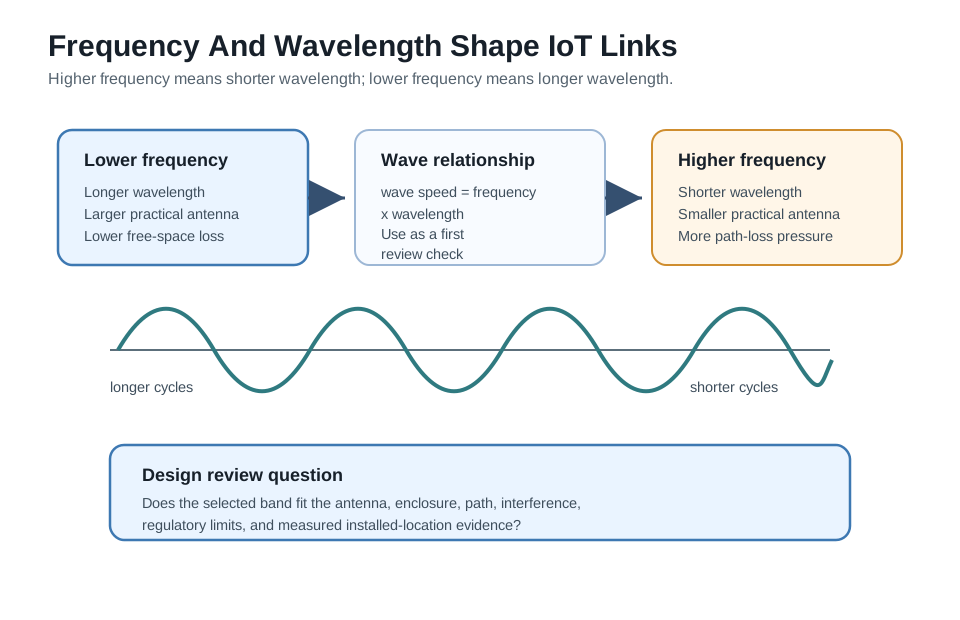
The chain does not predict a deployment by itself, but it establishes the physical constraints that the later propagation evidence must test.

  • A small device can make a high-frequency antenna easier to package, but that does not automatically make the link easier to close.

Why it matters

The physics is not a substitute for field testing, but it prevents obviously weak radio decisions.

Frequency, wavelength, antenna, and path-loss relationships for IoT radio review.
iotclass.org

Major section

Frequency And Wavelength · Antenna Size And Enclosure Reality

A sub-GHz signal has a longer wavelength.

  • A 5 GHz signal has a shorter wavelength.
  • Antennas do not need to be exactly one wavelength long, but wavelength strongly influences practical antenna size.
  • A data sheet antenna result is not enough if the final product packaging changes the RF environment.

Numbers to remember

5 GHzA 5 GHz signal has a shorter wavelength.
iotclass.org

Major section

Spectrum Regions Used By IoT

IoT systems usually use radio and microwave regions of the electromagnetic spectrum.

  • Two practical spectrum reminders keep the classroom diagram tied to deployment evidence.
  • Infrared is also a broad region.
  • The review should name the actual band and region, not just the marketing name of the protocol.

Why it matters

Visible light, infrared, and optical wireless communication can also be useful in specific line-of-sight systems, but general IoT coverage usually depends on radio because radio waves can diffract, reflect, and penetrate some materials.

iotclass.org

Major section

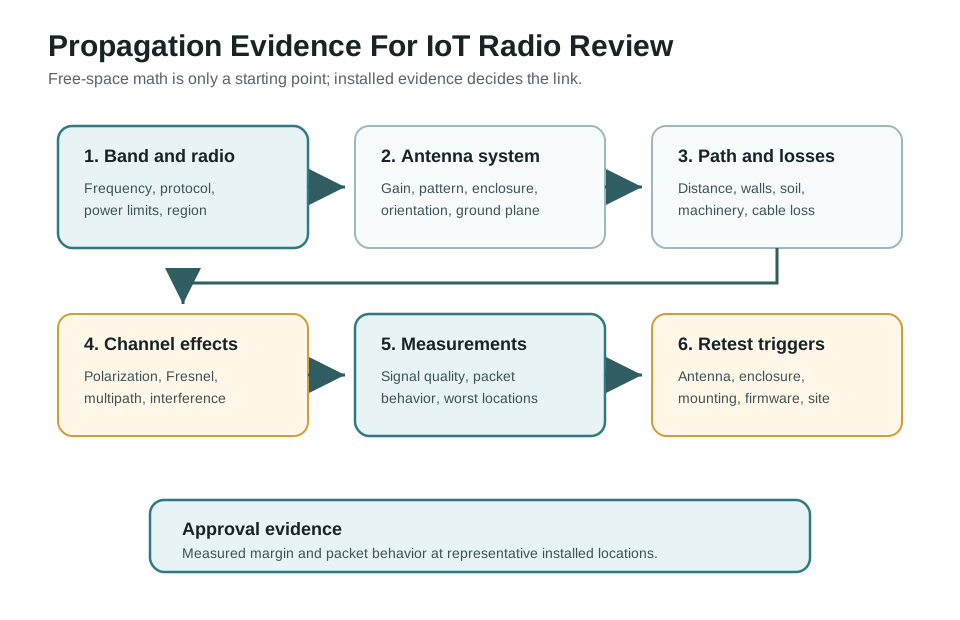
Propagation Evidence Map

The map keeps frequency, geometry, materials, antennas, and observed link behaviour in one review.

  • The evidence record should include the band, antenna, enclosure, path, obstacles, polarization, interference, measurements, and retest triggers.
Propagation evidence map for IoT RF fundamentals.
iotclass.org

Major section

Polarization, Fresnel Zone, And Multipath · Radio Versus Optical Links

A vertically polarized antenna and a horizontally polarized antenna may not couple efficiently.

  • If device orientation changes in use, the review should not assume ideal alignment.
  • The Fresnel zone is the volume around the line-of-sight path that radio energy occupies.
  • Multipath occurs when signals arrive by multiple reflected paths.

Key terms

Visible light and infrared
Visible light and infrared are also electromagnetic waves.

Why it matters

Indoor and industrial environments often need field measurements because reflections and shadowing are hard to predict from a diagram.

iotclass.org

Major section

Worked Review: Outdoor Sensor Link · Common Mistakes

assuming higher frequency is better because it has more bandwidth.

  • Prompt: "The devices have line of sight, so the link budget is solved.".
  • Accepted answer: "Line of sight is useful evidence, but a review-ready outdoor link also needs Fresnel, antenna, loss, measurement, and retest evidence.".
  • using free-space path loss as if walls, floors, bodies, or machinery do not exist.
iotclass.org

Major section

Review Checklist · Frequency Sets Wavelength, Antenna Size, and Range
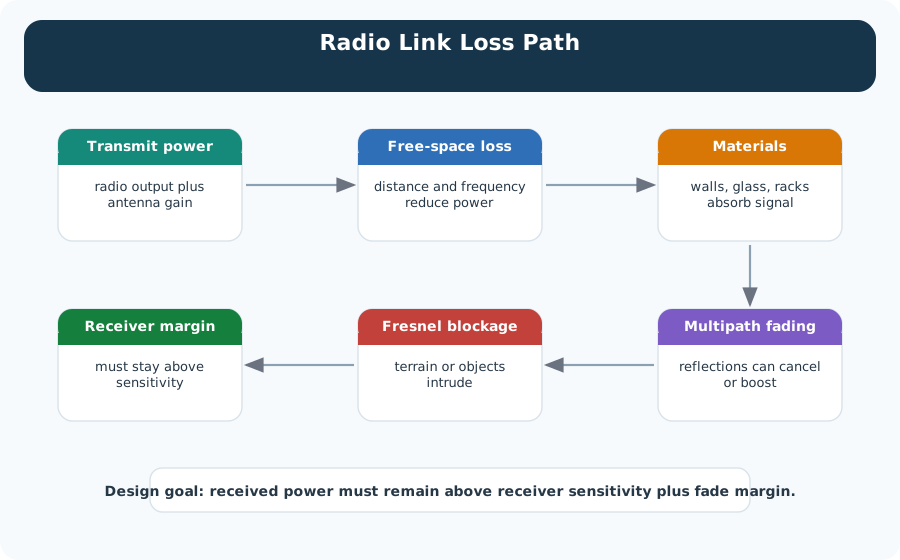
Every wireless choice starts with one equation: λ = c / f, where c is the speed of light.

  • Wavelength λ decides how big an efficient antenna must be and how the signal travels.
  • The gap that remains is fade margin, not spare transmit power promised by wavelength alone.

Numbers to remember

6 GHz6 GHz Wi-Fi) allow tiny antennas
700–900 MHzLower frequencies (700–900 MHz cellular, sub-GHz IoT) need bigger antennas

Why it matters

Higher frequencies (5 and 6 GHz Wi-Fi) allow tiny antennas and wide channels but lose energy faster and penetrate walls poorly.

Wavelength math becomes a link-margin record. Frequency changes the free-space loss term, but release evidence must also include transmit power, antenna gain, materials, Fresnel blockage, multipath fading, receiver sensitivity, and remaining margin.
iotclass.org

Major section

Antenna Sizing and Gain in dBi · Why 5 GHz Costs ~6.4 dB Versus 2.4 GHz

An efficient antenna is sized to the wavelength.

  • A half-wave dipole is λ/2; a quarter-wave monopole is λ/4.
  • Antenna gain is quoted in dBi (decibels over an ideal isotropic radiator).
  • Gain is not amplification — it is focus: a higher-gain antenna concentrates energy into a narrower beam.
  • A simple dipole is about 2.15 dBi.

Numbers to remember

2.4 GHzWorked example.: A dual-band gateway shows solid 2.4 GHz coverage
-72 dBmA received-power sample of -72 dBm is not meaningful by itself
iotclass.org

Deck summary

Key takeaways

Changing electric and magnetic effects carry energy through space, and the phone turns a tiny part of that energy back into information.

  • This picture links distance and time without pretending that the drawing is the full electric and magnetic field.
  • A short move may make those paths add or cancel.
  • This prevents a clean equation from becoming a coverage promise.
  • In air, the wave speed is close to the speed of light.
iotclass.org

Retrieval practice

Recall check 1 of 5

Radio Remi says: answer from memory, then check your reasoning.

Q1For a fixed wave speed, how does a higher frequency relate to wavelength and antenna size?

AHigher frequency means shorter wavelength, allowing a smaller antenna
BHigher frequency means longer wavelength and a larger antenna
CFrequency and wavelength are unrelated to antenna sizing
DWavelength stays constant no matter how frequency changes
Show answer

Answer: A Because wave speed equals frequency times wavelength, higher frequency means shorter wavelength and a smaller antenna.

iotclass.org

Retrieval practice

Recall check 2 of 5

Radio Remi says: answer from memory, then check your reasoning.

Q2A design review says that a 2.4 GHz sensor and a sub-GHz sensor will have the same wavelength because both are radio waves. What is the best correction?

AThey are both electromagnetic waves, but wavelength is inversely related to frequency
BThey have the same wavelength because all radio waves travel through air.
CThe higher-frequency signal has the longer wavelength.
DWavelength is unrelated to antenna design.
Show answer

Answer: A Radio waves share the same wave relationship, but different frequencies produce different wavelengths.

iotclass.org

Retrieval practice

Recall check 3 of 5

Radio Remi says: answer from memory, then check your reasoning.

Q3Why do sub-GHz cellular and IoT radios generally reach farther than 5 GHz Wi-Fi?

ATheir longer wavelengths usually lose less and bend around obstacles better.
BThey are required to transmit far above every 5 GHz Wi-Fi power limit.
CThe ozone layer blocks indoor 5 GHz signals before they reach sensors.
DHigher-frequency radios carry fewer bits, so frames stop sooner.
Show answer

Answer: A Free-space loss rises with frequency, and longer waves bend around and through obstacles more effectively.

iotclass.org

Retrieval practice

Recall check 4 of 5

Radio Remi says: answer from memory, then check your reasoning.

Q4What does an antenna's gain in dBi actually represent?

AAn internal amplifier that boosts transmit power by that many dB.
BThe data rate increase the antenna provides.
CHow much it concentrates radiated energy into a direction.
DThe number of frequency bands the antenna supports.
Show answer

Answer: C Gain redistributes fixed energy into a narrower pattern; regulators cap EIRP = power + gain.

iotclass.org

Retrieval practice

Recall check 5 of 5

Radio Remi says: answer from memory, then check your reasoning.

Q5At the same distance, roughly how much more free-space path loss does a 5 GHz link have than a 2.4 GHz link, and why?

AAbout 6.4 dB more from the 20 log10(f) frequency term.
BAbout 0 dB, because free-space loss ignores radio frequency.
CAbout 60 dB more, which would make every 5 GHz indoor link fail.
DLess loss, because 5 GHz wavelengths penetrate walls more easily.
Show answer

Answer: A About 6.4 dB is roughly 4x the power, which is why 5 GHz cells are smaller than 2.4 GHz cells.

iotclass.org

Print reference

Answers 1 of 2

Answer key.

  1. A · Because wave speed equals frequency times wavelength, higher frequency means shorter wavelength and a smaller antenna.
  2. A · Radio waves share the same wave relationship, but different frequencies produce different wavelengths.
  3. A · Free-space loss rises with frequency, and longer waves bend around and through obstacles more effectively.
  4. C · Gain redistributes fixed energy into a narrower pattern; regulators cap EIRP = power + gain.
iotclass.org

Print reference

Answers 2 of 2

Answer key.

  1. A · About 6.4 dB is roughly 4x the power, which is why 5 GHz cells are smaller than 2.4 GHz cells.
iotclass.org