Wi-Fi & 802.11 · Study deck

Cellular Spectrum for IoT

Picture a basement meter and a tracker on a moving van.

Radio Remi is your guide for this deck.

cellular-iotspectrumnb-iot
Radio Remi, the module guide, in a scene from this chapter.
iotclass.org

After studying this chapter

Learning objectives

You will be able to:

  • explain why licensed cellular spectrum is attractive for some IoT deployments
  • separate band physics from operator availability and device certification
  • compare low-band, mid-band, and high-band cellular choices for IoT use cases
  • describe where NB-IoT, LTE-M, and 5G RedCap fit in cellular spectrum planning
iotclass.org

Major section

Start With the Wireless Story

Both use cellular service, but they may need different bands and network features.

  • The right choice starts with the field job, not the newest label.
  • Radio frequency is the rate at which a radio wave repeats.: Bandwidth means the span of frequencies or data capacity available to a link.
  • A band name does not prove indoor reach.

Key terms

Radio frequency
Radio frequency is the rate at which a radio wave repeats.
Bandwidth
Bandwidth means the span of frequencies or data capacity available to a link.
Cellular spectrum
Cellular spectrum is not just coverage color on a map.
iotclass.org

Major section

Start With the Wireless Story (continued)

Lower bands often reach through walls better, but the result still depends on the site, antenna, case, operator, and service.

  • An operator map does not prove the final mounting point.
  • Practitioner compares band support, service modes, roaming, and lifecycle.
  • Those details can change the choice.
  • They do not replace a site test with the final device.
iotclass.org

Major section

Start With the Wireless Story (continued)

For IoT, the useful story is which band reaches the device, which duplexing and bandwidth model the operator supports, and what evidence shows NB-IoT, LTE-M, or broadband cellular fits the deployment.

  • These needs shape the band choice.
  • A lower band may lose less through walls.
  • A higher band may offer more space.
iotclass.org

Major section

In 60 Seconds · Phoebe's Field Notes: Why Band 20 Reaches The Basement And Band 3 Does Not · Why Spectrum Is A Design Decision

Cellular IoT uses licensed operator spectrum when a design needs wide-area coverage, managed network operation, mobility support, or deep indoor reach that would be difficult to provide with a private unlicensed network.

  • A basement link with 4 dB low-band margin becomes −3.04 dB, while an 18 dB cupboard margin still leaves 10.96 dB.

Key terms

Cellular spectrum
Cellular spectrum is not just a frequency label on a modem data sheet.
iotclass.org

Major section

Cellular Spectrum Review Map · Licensed Spectrum And IoT
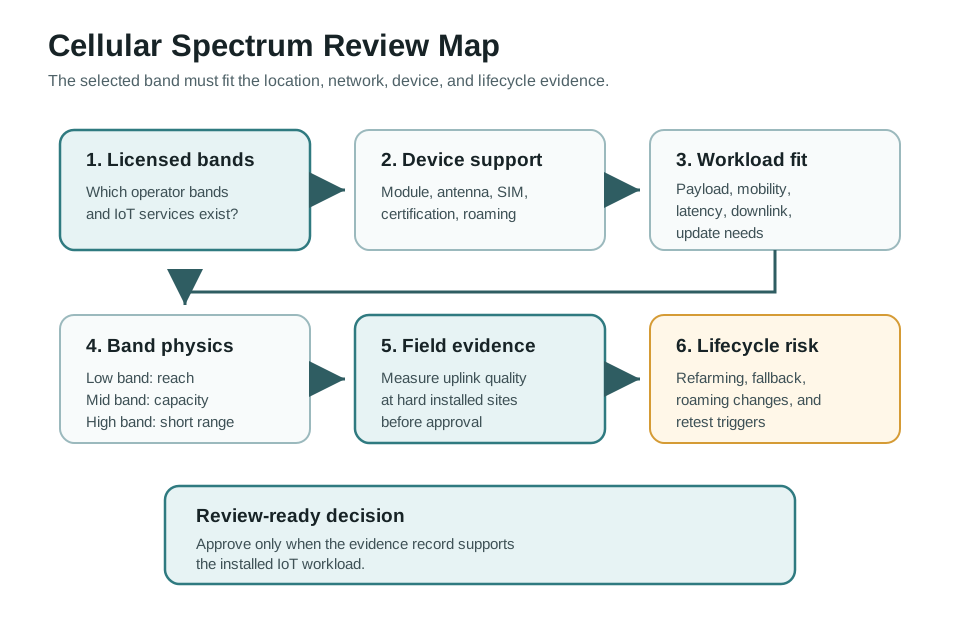
This connects spectrum labels to the network and hardware that can actually use them.

  • The selected technology is only one part of the answer; operator support, device bands, coverage measurements, and operational assumptions must also line up.
  • Licensed cellular bands are assigned to operators by national or regional regulators.
Cellular spectrum review map for IoT deployments.
iotclass.org

Major section

Band Families · Technology Fit

Mid-band spectrum provides more bandwidth and capacity than low-band spectrum, but usually needs denser cell sites for comparable coverage.

  • High-band and mmWave spectrum provide very high bandwidth but short reach and weak obstruction penetration.
  • The useful question is not "which band is best?" The useful question is "which available band leaves enough margin for this device, traffic, location, and lifecycle?".
  • The review should avoid treating these technologies as a ranking.
iotclass.org

Major section

Multiple Access And Spectrum Use · Selection Evidence Flow · What The Review Must Prove
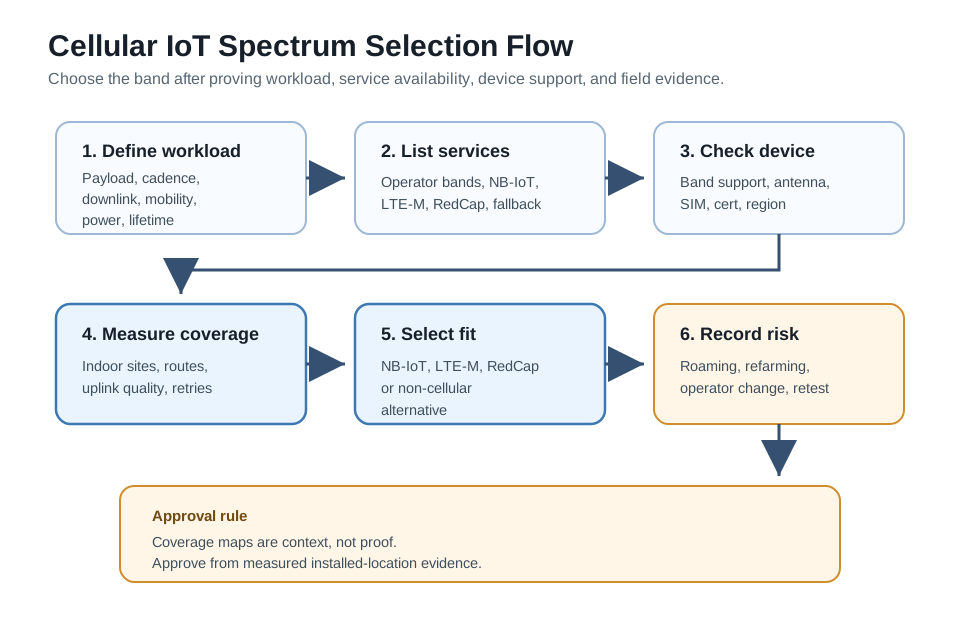
Cellular generations also changed how users share spectrum.

  • The practical design lesson is simple: modern cellular networks can allocate radio resources more flexibly, but device performance still depends on coverage, scheduling, power state, payload size, and network support.

Why it matters

Older 3G and 4G teaching material often shows standards logos because the air interface was also an ecosystem choice.

Evidence flow for selecting cellular IoT spectrum.
iotclass.org

Major section

Spectrum Refarming And Lifecycle · Roaming And Regional Band Support

Operators can retire older services and reuse spectrum for newer generations.

  • Global IoT products need more than a generic "cellular" modem.
  • They need a region and operator plan.
  • Band support differs across countries, and roaming support differs by technology, operator agreement, SIM profile, and network configuration.

Why it matters

This matters for long-lived IoT because a field device may remain deployed for many years while 2G, 3G, LTE, and 5G roadmaps continue to change.

iotclass.org

Major section

Worked Review: Basement Meter · Worked Review: Mobile Asset Tracker · Common Mistakes

The selected spectrum plan must prove both coverage and operational behavior.".

  • Accepted answer: "The design is review-ready only when measured hard-location coverage and module/operator support prove the selected band and service can carry the meter workload with margin.".
  • Prompt: "Use the lowest cellular band because low band gives the best IoT result.".
  • Choosing a cellular technology before checking local operator support.

Why it matters

Prompt: "Use cellular for basement water meters because the operator coverage map shows service in the town.".

iotclass.org

Major section

Review Checklist · Licensed Bands, Duplexing, and NB-IoT's Home
Each band uses one of two duplexing schemes.

  • FDD (frequency-division duplex) gives uplink and downlink their own paired frequencies so a device can send and receive at once.
  • TDD (time-division duplex) shares one frequency, alternating uplink and downlink in time.

Why it matters

Because the operator owns the band, interference is managed and quality is predictable — the trade for a subscription and no self-deployment.

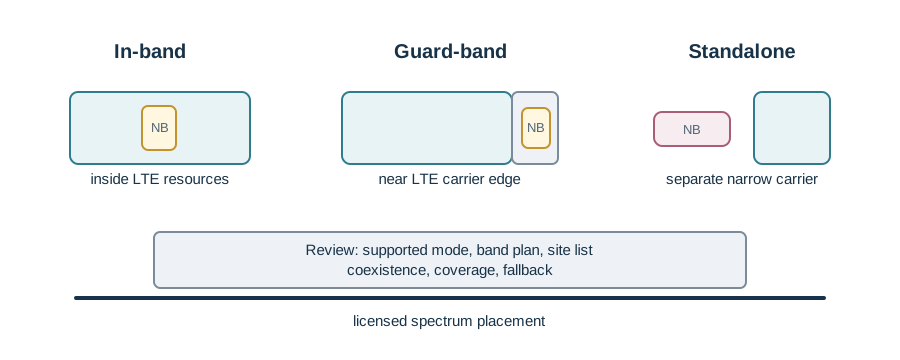
NB-IoT placement is an operator evidence question. The same 180 kHz carrier may sit inside LTE resources, near an LTE carrier edge, or on a separate narrow carrier, so the review must record the supported mode, band plan, site list, coexistence, coverage, and fallback assumptions.
iotclass.org

Major section

The Three NB-IoT Deployment Modes

A rural operator instead refarms an old 200 kHz GSM channel to run NB-IoT standalone, gaining the cleanest link budget for maximum coverage.

  • For a device team, the deployment mode is not usually a setting they control; it is operator evidence they must ask for or infer from the service offer.
  • Field comparison.: Suppose ten meters send a 40-byte reading once per day.
  • Outdoor testing might show all ten attach and send quickly on LTE-M.
iotclass.org

Major section

Half-Duplex FDD and the 180 kHz Choice · Summary

Concentrating the device's limited transmit power into that narrow band also raises power spectral density, which — together with message repetitions — is how NB-IoT buys its famous deep-coverage link budget.

  • NB-IoT devices use half-duplex FDD: uplink and downlink are on paired frequencies (FDD), but the device never transmits and receives at the same instant.
  • The trade-off is time and energy.
  • Half-duplex behavior has a similar review consequence.

Key terms

Cellular spectrum selection
Cellular spectrum selection is an evidence problem, not a slogan about the newest generation or the lowest frequency.
iotclass.org

Major section

Key Takeaway · Concept Relationships

Cellular Spectrum for IoT should tie mobile wireless fundamentals to spectrum, propagation, link budget, coverage planning, licensing, power, and deployment evidence.

  • Electromagnetic waves explain why frequency affects path loss and penetration.
  • Frequency licensing explains the difference between managed cellular bands and shared unlicensed bands.
  • Cellular IoT fundamentals connect bands to NB-IoT, LTE-M, RedCap, power states, and network behavior.
iotclass.org

Deck summary

Key takeaways

Both use cellular service, but they may need different bands and network features.

  • Lower bands often reach through walls better, but the result still depends on the site, antenna, case, operator, and service.
  • For IoT, the useful story is which band reaches the device, which duplexing and bandwidth model the operator supports, and what evidence shows NB-IoT, LTE-M, or broadband cellular fits the deployment.
  • Cellular IoT uses licensed operator spectrum when a design needs wide-area coverage, managed network operation, mobility support, or deep indoor reach that would be difficult to provide with a private unlicensed network.
  • Cellular generations also changed how users share spectrum.
iotclass.org

Retrieval practice

Recall check 1 of 5

Radio Remi says: answer from memory, then check your reasoning.

Q1Why does the cellular band choice matter for an IoT device that must reach a deep basement meter?

ALower-frequency bands penetrate buildings better, aiding deep-indoor reach
BHigher-frequency bands always penetrate concrete more effectively
CThe band has no effect on indoor penetration whatsoever
DOnly the newest cellular generation can reach any basement
Show answer

Answer: A Lower-frequency cellular bands penetrate buildings better, which matters for deep-indoor reach like a basement meter.

iotclass.org

Retrieval practice

Recall check 2 of 5

Radio Remi says: answer from memory, then check your reasoning.

Q2A utility wants cellular meters in basements and underground cabinets. What is the strongest first review question?

AWhich bands, services, and hard-location uplink evidence exist?
BWhich cellular generation has the largest peak data rate?
CCan the device use mmWave for maximum bandwidth?
DDoes the operator advertise outdoor smartphone coverage in the town?
Show answer

Answer: A The review must connect available bands and service support to measured evidence from the difficult installed locations.

iotclass.org

Retrieval practice

Recall check 3 of 5

Radio Remi says: answer from memory, then check your reasoning.

Q3What is the key difference between FDD and TDD duplexing?

AFDD uses paired uplink and downlink frequencies
BFDD is licensed and TDD is always unlicensed.
CFDD is only for 5G and TDD only for LTE.
DTDD doubles the data rate of FDD automatically.
Show answer

Answer: A FDD needs paired spectrum and can support simultaneous uplink and downlink; TDD uses one frequency and time-shares the two directions.

iotclass.org

Retrieval practice

Recall check 4 of 5

Radio Remi says: answer from memory, then check your reasoning.

Q4Why do many operators deploy NB-IoT in-band first?

AIt reuses one 180 kHz resource block inside an existing LTE carrier.
BIn-band NB-IoT delivers gigabit speeds unavailable in other modes.
CIn-band mode needs no license because it hides inside LTE.
DIn-band is the only mode that supports FDD.
Show answer

Answer: A In-band NB-IoT reuses one LTE resource block inside the operator carrier, so rollout can be faster than clearing separate spectrum.

iotclass.org

Retrieval practice

Recall check 5 of 5

Radio Remi says: answer from memory, then check your reasoning.

Q5Why does NB-IoT use half-duplex FDD and a narrow 180 kHz carrier?

ATo achieve full-duplex gigabit throughput on a single frequency.
BHalf-duplex simplifies the modem front end.
CBecause 180 kHz is the only bandwidth allowed in unlicensed spectrum.
DBecause a duplexer is illegal in cellular bands.
Show answer

Answer: B Half-duplex avoids simultaneous transmit and receive hardware, while 180 kHz matches one LTE resource block and concentrates device power for coverage.

iotclass.org

Print reference

Answers 1 of 2

Answer key.

  1. A · Lower-frequency cellular bands penetrate buildings better, which matters for deep-indoor reach like a basement meter.
  2. A · The review must connect available bands and service support to measured evidence from the difficult installed locations.
  3. A · FDD needs paired spectrum and can support simultaneous uplink and downlink; TDD uses one frequency and time-shares the two directions.
  4. A · In-band NB-IoT reuses one LTE resource block inside the operator carrier, so rollout can be faster than clearing separate spectrum.
iotclass.org

Print reference

Answers 2 of 2

Answer key.

  1. B · Half-duplex avoids simultaneous transmit and receive hardware, while 180 kHz matches one LTE resource block and concentrates device power for coverage.
iotclass.org