Connected Health and Wearables · Study deck
Medication IoT: Device and Workflow Boundaries
A smart dispenser cannot prove that a patient took a dose.
Ada is your guide for this deck.

After studying this chapter
Learning objectives
You will be able to:
- Map medication devices to care-workflow roles
- Set claim boundaries for dispense and adherence events
- Explain: A bottle may know that its lid opened.
- Explain: The medication-adherence story is about timely evidence and humane escalation: sense the event, reduce false assumptions, protect privacy, and support care without turning reminders into noise.
Major section
Start With the Story
A bottle may know that its lid opened.
- The care path must keep that limit clear.
- Latency means the time from an event to the result that needs it: Bandwidth means the data capacity available on a link.
- A protocol is an agreed set of rules for how devices exchange data.
- A reminder aid is not a diagnosis.
Major section
Start With the Story (continued)
The medication-adherence story is about timely evidence and humane escalation: sense the event, reduce false assumptions, protect privacy, and support care without turning reminders into noise.
- A sensor result is not perfect proof of use.
- Practitioner compares devices, care links, records, and cost.
- Under the Hood covers source accuracy, system links, privacy, regulation, and return measures.
Major section
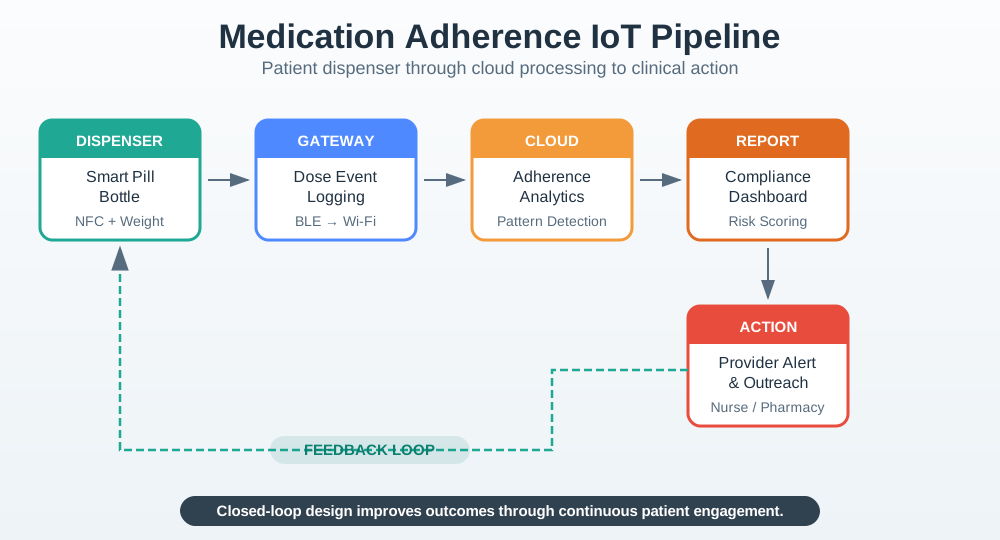
Medication IoT Care Workflow
A smart bottle may know that the lid opened or the weight changed, but it does not know with certainty that the patient swallowed the medication.
- An ingestible sensor can provide stronger ingestion evidence, but it also raises consent, privacy, usability, and clinical-workflow burdens.
- The system must present these limits honestly.
Major section
Medication IoT Care Workflow (continued)
Preserve its source and time, then keep late, repeated, or missing context visible as the event becomes an adherence summary.
- The clinical report must link to the current prescription and defined care plan before a clinician or caregiver decides whether to act.
- The evidence boundary remains explicit throughout: an observed bottle event is not confirmed swallowing, so the system must not collapse every signal into a single “taken” flag.
- The user experience also has to protect dignity.
Major section
Medication IoT Care Workflow (continued)
A useful design therefore asks what evidence level is appropriate for the medication and harm model.
- A low-risk vitamin reminder may only need a local notification and a patient-edited history.
- A transplant immunosuppressant, tuberculosis course, antipsychotic depot program, or high-risk clinical trial may justify stronger verification, faster escalation, and tighter audit trails.
- In every case, the product should state whether it observed access, removal, ingestion-linked activation, or patient self-report.
Major section
Medication IoT Care Workflow (continued)
The design boundary matters because adherence data can easily become surveillance.
- Missed doses can reflect side effects, cost, confusion, dexterity limits, travel, depression, or distrust of monitoring.
- Good systems make corrections easy, separate supportive nudges from punitive reporting, and summarize patterns so care teams can discuss barriers instead of treating every exception as noncompliance.
- Workflow boundary: Route adherence summaries into the care workflow only when they are actionable, attributable, and tied to the current medication order.
Major section
Start With Roles, Orders, and Exceptions
A weekly pill organizer for an independent older adult may prioritize refill visibility and caregiver summary reports.
- Design the adherence path around patient, prescriber, pharmacist, caregiver, payer, and support-team responsibilities.
- The device should not change medication dosing on its own.
- A lockable opioid dispenser may prioritize tamper evidence, local access control, and pharmacy reconciliation.
Deck summary
Key takeaways
A bottle may know that its lid opened.
- The medication-adherence story is about timely evidence and humane escalation: sense the event, reduce false assumptions, protect privacy, and support care without turning reminders into noise.
- A smart bottle may know that the lid opened or the weight changed, but it does not know with certainty that the patient swallowed the medication.
- Preserve its source and time, then keep late, repeated, or missing context visible as the event becomes an adherence summary.
- A useful design therefore asks what evidence level is appropriate for the medication and harm model.
Retrieval practice
Recall check 1 of 2

Ada says: answer from memory, then check your reasoning.
Q1A bottle reports a weight change after a reminder. What should the app tell a caregiver?
Show answer
Answer: D The chapter separates reminders, openings, removal, and inferred or confirmed ingestion.
Retrieval practice
Recall check 2 of 2
Ada says: answer from memory, then check your reasoning.
Q2A dispenser detects an event that conflicts with its stored schedule. What should the workflow use before escalation?
Show answer
Answer: C The chapter compares observations with current orders and uses explicit escalation responsibilities.
Print reference
Answers
Answer key.
- D · The chapter separates reminders, openings, removal, and inferred or confirmed ingestion.
- C · The chapter compares observations with current orders and uses explicit escalation responsibilities.