Connected Health and Wearables · Study deck
Medication IoT: Adherence Evidence and Verification
A lid-open event is not the same as a swallowed dose.
Ada is your guide for this deck.
After studying this chapter
Learning objectives
You will be able to:
- Explain: It may send events through BLE to a phone, Wi-Fi to a home router, cellular for independent operation, or MQTT/HTTPS over TLS to a cloud service.
- Explain: A smart dispenser can combine load cells, lid switches, beam-break sensors, RFID/NFC tray identity, motor encoders, real-time clocks, tamper switches, local storage, and battery state.
- Explain: It still does not prove that the medicine was absorbed or had the intended effect, and every relay adds consent, privacy, usability, and workflow duties.
- Explain: The family was worried, so they got him a Smart Pill Bottle.
Major section
Adherence Data Provenance
The system should record those states rather than silently converting them into adherence or non-adherence.
- A smart dispenser can combine load cells, lid switches, beam-break sensors, RFID/NFC tray identity, motor encoders, real-time clocks, tamper switches, local storage, and battery state.
- EHR integration is a reconciliation problem.
- The event store should be append-only and idempotent.
Major section
Adherence Data Provenance (continued)
It may send events through BLE to a phone, Wi-Fi to a home router, cellular for independent operation, or MQTT/HTTPS over TLS to a cloud service.
- Each event needs a device id, compartment id, medication id, schedule version, timestamp source, sequence number, confidence, and offline-sync status.
- Missing patch contact, delayed activation, phone offline state, patient refusal, duplicate ingestion signals, and portal acknowledgement are all different states.
- A FHIR or HL7 interface must match device events to the current order, patient identity, encounter context, and clinician workflow.
- Security and privacy controls sit in the data model, not only at the login screen.

Major section
For Kids: Meet the Sensor Squad!
Medication adherence means taking your medicine at the right time, in the right dose, every single day.
- It sounds simple, but millions of people forget -- and smart sensors are here to help!
- The family was worried, so they got him a Smart Pill Bottle.
- If the weight doesn't change when it should, I know he forgot!".
- If you gave 6 out of 7 days, that is about 86% in this story!
Major section
Smart Medication Dispenser Architecture
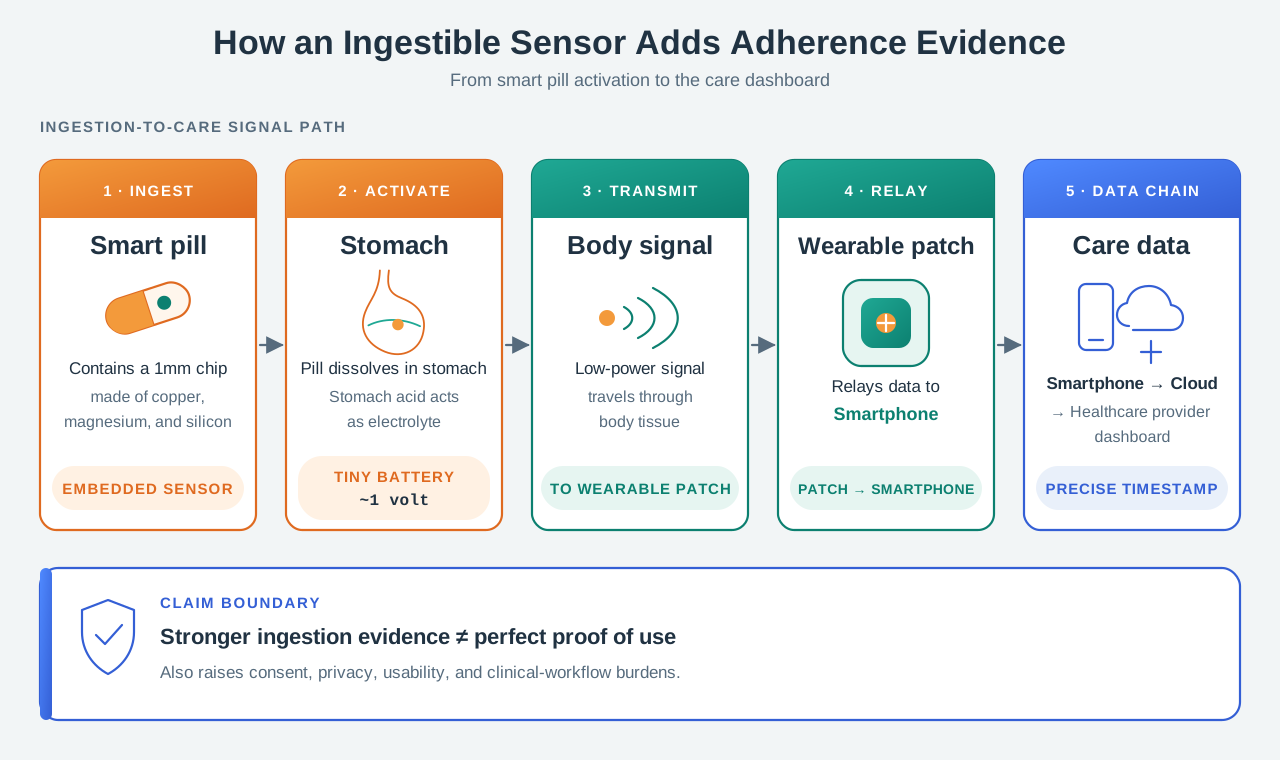
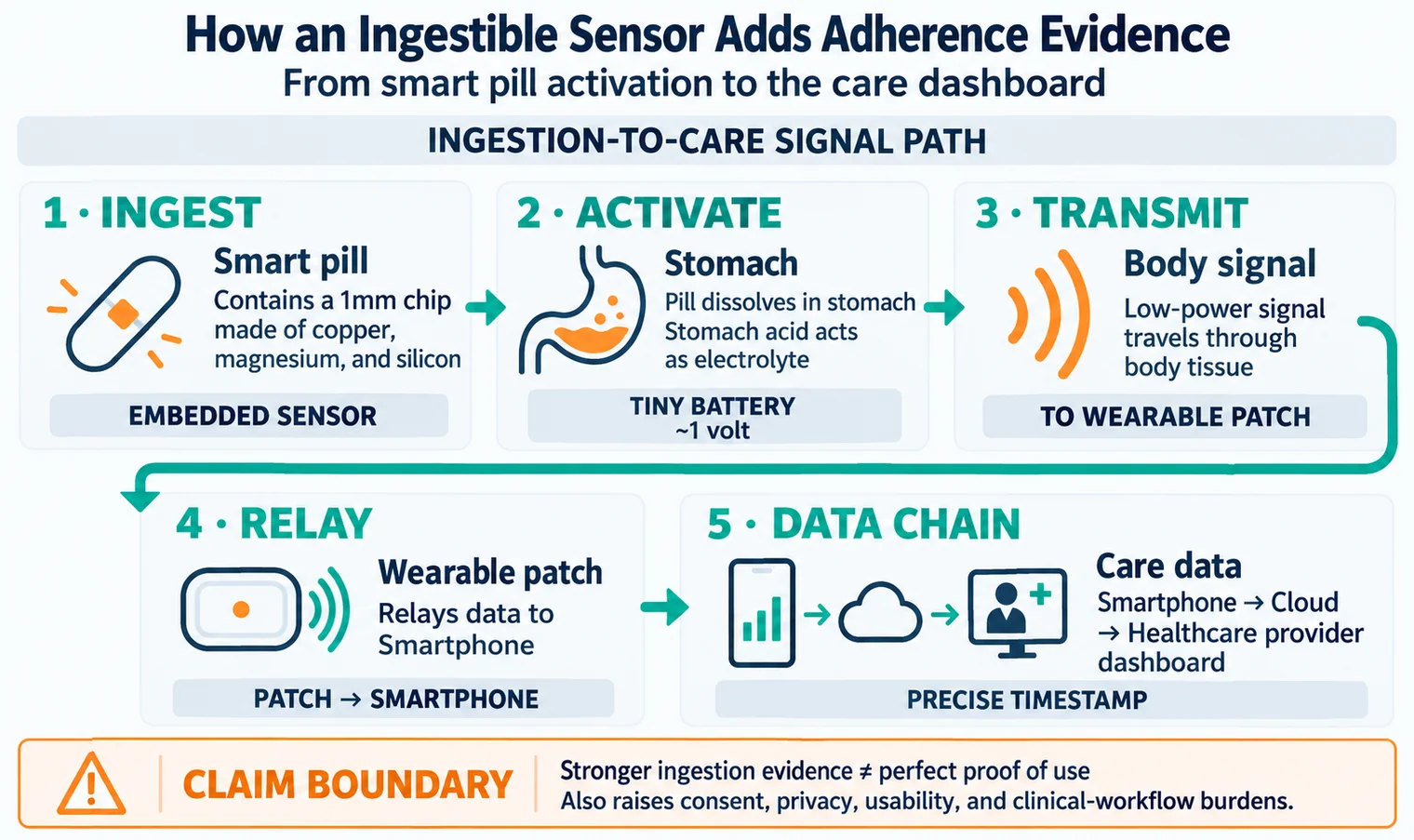
The low-power body signal reaches a wearable patch, then a phone relays the event through the cloud to a provider dashboard.
- That chain can add a precise ingestion timestamp, stronger evidence than a reminder or opened bottle.
- It still does not prove that the medicine was absorbed or had the intended effect, and every relay adds consent, privacy, usability, and workflow duties.
- The dispenser at the top holds four kinds of hardware, and each one produces a different fact: which tray was opened, how much weight left it, whether the carousel moved, and whether a prompt was given.
Major section
Chronic Monitoring Value
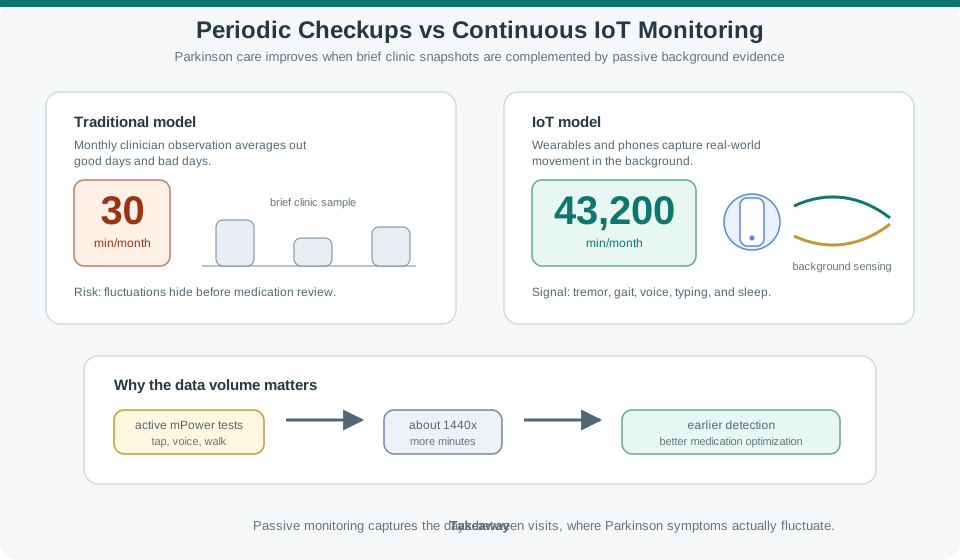
Patients with chronic neurological conditions like Parkinson's disease experience daily symptom fluctuations that monthly doctor visits cannot capture.
- By the time a patient sees their neurologist, the "good days" and "bad days" have averaged out, making medication optimization nearly impossible.
- "Instead of patients actively performing certain tasks, could we monitor disease progression passively in the background?".
- The gain is the days between visits, not a better measurement on the day itself.
Deck summary
Key takeaways
The system should record those states rather than silently converting them into adherence or non-adherence.
- It may send events through BLE to a phone, Wi-Fi to a home router, cellular for independent operation, or MQTT/HTTPS over TLS to a cloud service.
- Medication adherence means taking your medicine at the right time, in the right dose, every single day.
- The low-power body signal reaches a wearable patch, then a phone relays the event through the cloud to a provider dashboard.
- Patients with chronic neurological conditions like Parkinson's disease experience daily symptom fluctuations that monthly doctor visits cannot capture.
Retrieval practice
Recall check 1 of 5

Ada says: answer from memory, then check your reasoning.
Q1An ingestible-sensor patch loses contact and the portal shows no new signal. What should the care record say?
Show answer
Answer: B Separate the device fault from the still-unknown medication event.
Retrieval practice
Recall check 2 of 5

Ada says: answer from memory, then check your reasoning.
Q2A dispenser reconnects and uploads repeated door-open events. What should the event store preserve?
Show answer
Answer: A The chapter distinguishes sequence, schedule, and offline state rather than treating repeated uploads as new adherence.
Retrieval practice
Recall check 3 of 5

Ada says: answer from memory, then check your reasoning.
Q3A pill bottle reports its lid opening to a care system. What is the device’s directly observed event?
Show answer
Answer: C The basic example describes a sensor that detects lid opening and sends the event.
Retrieval practice
Recall check 4 of 5

Ada says: answer from memory, then check your reasoning.
Q4A patch loses contact after a patient takes a sensor-enabled pill. Which claim can the app safely make?
Show answer
Answer: C Lost contact is a device state; it cannot prove that a dose was taken or missed.
Retrieval practice
Recall check 5 of 5

Ada says: answer from memory, then check your reasoning.
Q5A care team wants to compare a planned tapping test with background movement sensing. What is the key difference?
Show answer
Answer: A Active tests need a deliberate task, while passive sensing can capture daily behavior.
Print reference
Answers
Answer key.
- B · Separate the device fault from the still-unknown medication event.
- A · The chapter distinguishes sequence, schedule, and offline state rather than treating repeated uploads as new adherence.
- C · The basic example describes a sensor that detects lid opening and sends the event.
- C · Lost contact is a device state; it cannot prove that a dose was taken or missed.
- A · Active tests need a deliberate task, while passive sensing can capture daily behavior.