Zigbee, Thread & Matter · Study deck
Matter Transport and Platform
Picture a tenant adding a new window sensor to a home controller.
Radio Remi is your guide for this deck.

After studying this chapter
Learning objectives
You will be able to:
- Separate Matter application behavior from operational transport behavior.
- Choose between Thread, Wi-Fi, and Ethernet using evidence about power, workload, installation, and network role.
- Explain why BLE commissioning is not the same thing as operational Matter transport.
- Review Thread border-router evidence without confusing a border router with a Matter bridge.
Major section
Start With the Device Experience
Setup succeeds beside the controller, yet the sensor stops reporting after it is moved upstairs.
- The support team must find whether the break is in setup, network reach, the border device, account state, or the controller's view.
- Matter is a shared application model for connected devices from different makers.
- Practitioner builds the platform fit record.
Major section
Start With the Device Experience (continued)
Bluetooth Low Energy is a short-range radio method often used during setup.
- Thread, Wi-Fi, and wired Ethernet can carry ordinary traffic, but reachability alone does not grant trust or prove correct device behavior.
- Under the Hood explains addresses, setup channels, border routing, trust-group membership, bridges, and the limits that appear when platforms or versions differ.
- Matter Transport and Platform is the evidence route for deciding whether that expectation is realistic.
Major section
Matter Transport and Platform Evidence
Matter is easiest to review when transport, commissioning, platform, and fabric claims are kept separate.
- A device can use the same Matter application model over different IP networks, but each transport still has different power, reach, deployment, and platform evidence.
- This chapter replaces transport folklore with review records.
- The goal is not to rank vendors, predict future platform releases, or memorize throughput numbers.
Major section
In 60 Seconds
Matter operational traffic uses IP-based paths over Thread, Wi-Fi, or Ethernet.
- Bluetooth Low Energy is a commissioning channel for many devices, not a normal operational transport for Matter fabric traffic.
- Thread needs a border router to route IPv6 packets between the Thread mesh and the rest of the home IP network.
- Wi-Fi and Ethernet can be strong choices for powered devices, controllers, bridges, appliances, and infrastructure, but they do not automatically solve platform or fabric readiness.
Major section
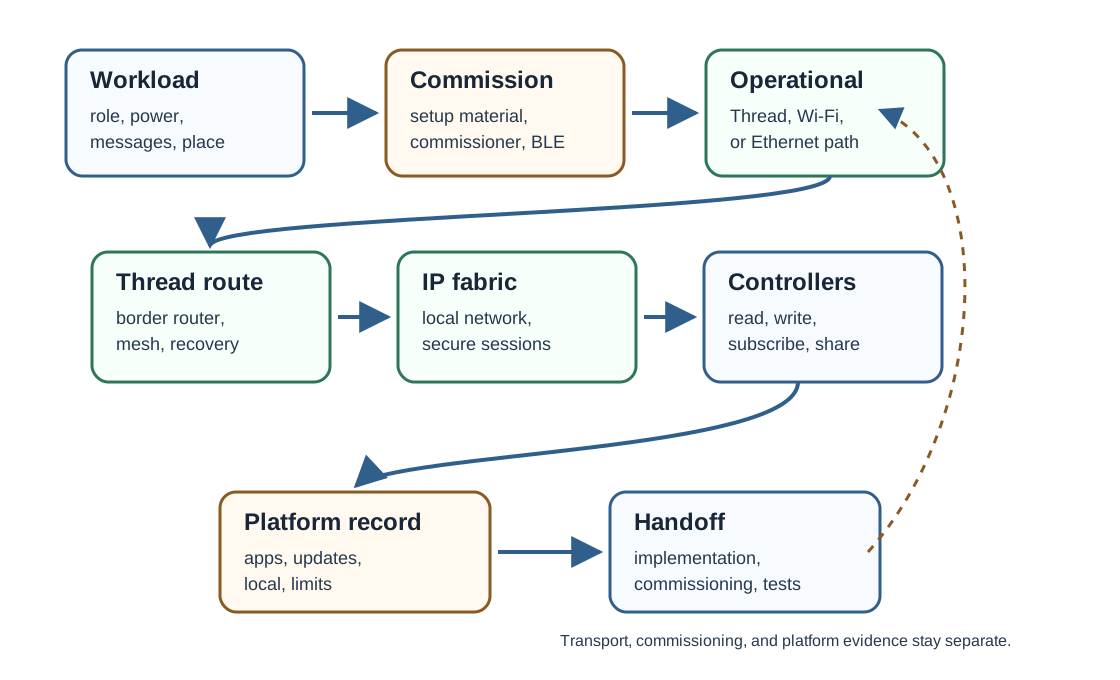
Transport Boundary Map
The first figure shows the boundary that should stay visible during review.
- The operational transport carries normal Matter traffic after commissioning.
- The commissioning channel helps establish the device on a fabric.
- The platform record explains which controllers, commissioners, border routers, apps, updates, and sharing flows are actually available in the deployment.
Major section
IPv6 Application Boundary
Matter is an application layer that runs over IP.
- Operationally it uses IPv6 over Thread, Wi-Fi, or Ethernet, while many devices use Bluetooth Low Energy only as a commissioning channel to receive setup material and network credentials.
- The transport is therefore an evidence lane in the review record, not the identity of the device or proof that every deployment condition has been met.
- Because Matter sits above IPv6, the same application behavior can be exposed by a Thread door lock, a Wi-Fi plug, or an Ethernet bridge.
Major section
Operational Transports
Matter operational traffic is IP-based.
- Thread: Low-power mesh transport for small messages, battery-aware devices, and devices that benefit from mesh reach.
- It needs a working Thread network and a border router for communication with non-Thread IP devices.
- Matter gives these transports a common application model, not identical physical behavior.
Major section
Operational Transports (continued)
Wi-Fi: IP transport for powered devices that can tolerate Wi-Fi power behavior and may need more bandwidth, direct LAN reach, or existing wireless infrastructure.
- Ethernet: Wired IP transport for fixed infrastructure, controllers, bridges, appliances, panels, or other devices where a cable and power are available.
- Commissioning channel: Many devices use BLE during onboarding, but this does not make BLE the normal operational transport once the device is on the Matter fabric.
- A Thread contact sensor, a Wi-Fi appliance, and an Ethernet bridge can share Matter concepts while still having different network evidence.
Major section
Multi-Admin and Fabric Scope
Multi-admin can let more than one ecosystem administer the same device, but it should be reviewed as fabric evidence, not as a transport feature.
- Each platform ecosystem, such as Apple Home, Google Home, Amazon Alexa, or SmartThings, runs a Matter fabric: a trust domain with its own credentials.
- Multi-admin lets a single device belong to several fabrics at once, so one lock can be controlled from more than one ecosystem without changing its operational transport.
- Two edge roles are easy to confuse.
Major section
Record 2: Powered Display Device
Scenario: A powered display needs Matter control plus other high-data product features.
- Evidence found: Wi-Fi fits the powered installation and LAN reach.
- The Matter claim is limited to control and status.
- Media, account services, and firmware update behavior are recorded as separate product evidence.
Major section
Summary
Matter transport review is not a ranking table.
- Thread, Wi-Fi, and Ethernet can all carry Matter operational traffic in the right deployment.
- BLE can support commissioning, but it should not be counted as normal operational fabric transport.
- A platform claim should be proved through controller, commissioner, border-router, sharing, update, and local-control evidence instead of vendor assumptions.
Deck summary
Key takeaways
Setup succeeds beside the controller, yet the sensor stops reporting after it is moved upstairs.
- Bluetooth Low Energy is a short-range radio method often used during setup.
- Matter is easiest to review when transport, commissioning, platform, and fabric claims are kept separate.
- Matter operational traffic uses IP-based paths over Thread, Wi-Fi, or Ethernet.
- The first figure shows the boundary that should stay visible during review.
Retrieval practice
Recall check 1 of 6

Radio Remi says: answer from memory, then check your reasoning.
Q1A bridged legacy sensor appears in a Matter app. What limit belongs in the release claim?
Show answer
Answer: A Visibility does not prove every legacy feature or local workflow.
Retrieval practice
Recall check 2 of 6
Radio Remi says: answer from memory, then check your reasoning.
Q2Why does a Matter-over-Thread device need a Thread border router?
Show answer
Answer: A A Thread border router routes IPv6 between the Thread mesh and the rest of the home IP network.
Retrieval practice
Recall check 3 of 6
Radio Remi says: answer from memory, then check your reasoning.
Q3Which statement correctly describes Matter's use of transports?
Show answer
Answer: A Matter is an IPv6 application layer.
Retrieval practice
Recall check 4 of 6
Radio Remi says: answer from memory, then check your reasoning.
Q4A battery-powered Matter door lock uses Thread. What infrastructure must the home have for it to reach a Wi-Fi phone controller?
Show answer
Answer: A Thread fits low-power devices, but cross-network reachability depends on a Thread border router.
Retrieval practice
Recall check 5 of 6
Radio Remi says: answer from memory, then check your reasoning.
Q5A team chooses Thread for a battery contact sensor. The review confirms commissioning from one phone, but it does not identify a Thread border router, does not test controller reach after commissioning, and does not record recovery after the border router is restarted. What is the right review decision?
Show answer
Answer: B Thread may fit the device, but approval depends on evidence that the Thread network, border router, controller reach, interaction path, and recovery behavior work in the deployment.
Retrieval practice
Recall check 6 of 6
Radio Remi says: answer from memory, then check your reasoning.
Q6What is the role of a Thread border router in a Matter deployment?
Show answer
Answer: A A Thread border router is an IPv6 routing edge, a bridge is a translation edge, and a fabric is the trust domain.
Print reference
Answers 1 of 2
Answer key.
- A · Visibility does not prove every legacy feature or local workflow.
- A · A Thread border router routes IPv6 between the Thread mesh and the rest of the home IP network.
- A · Matter is an IPv6 application layer.
- A · Thread fits low-power devices, but cross-network reachability depends on a Thread border router.
- B · Thread may fit the device, but approval depends on evidence that the Thread network, border router, controller reach, interaction path, and recovery behavior work in the deployment.
Print reference
Answers 2 of 2
Answer key.
- A · A Thread border router is an IPv6 routing edge, a bridge is a translation edge, and a fabric is the trust domain.