Zigbee, Thread & Matter · Study deck
What Matter Is and Isn't
Imagine buying a smart bulb and choosing which home app will control it.
Radio Remi is your guide for this deck.

After studying this chapter
Learning objectives
You will be able to:
- Explain Matter as an application layer rather than a radio technology.
- Separate Matter evidence from Thread, Wi-Fi, Ethernet, BLE, Zigbee, bridge, cloud, and controller claims.
- Review how device type, endpoints, clusters, attributes, commands, and events support a Matter product claim.
- Describe fabrics, multi-admin, PASE, CASE, and commissioning at an overview level without turning them into a tool manual.
Major section
Start With the Device Experience
Matter gives supported devices a shared way to describe features, join a trusted home, and exchange commands.
- Internet Protocol is the common addressing and delivery system beneath Matter.
- Matter does not replace the radio or prove that every product supports every feature.
- End the fit check in plain words.
- Say which user action works.
Major section
Start With the Device Experience (continued)
Say which network it needs.
- Say what remains a product test.
- This keeps the shared device behavior separate from product claims and network limits.
- A shared logo or message format does not prove a smooth setup.
- This bulb story leaves out many device types and trust steps.
Major section
Matter Protocol Overview Evidence
Matter is an IP-based smart-home application layer.
- It defines how a device describes its capabilities, joins a secure fabric, exchanges commands and attributes, and can be administered by more than one controller ecosystem.
- It uses those network paths to carry a common application model.
- This overview is not a version-history page, product catalog, or vendor recommendation.
Major section
In 60 Seconds
Matter is a smart-home application layer built around a shared data model, interaction model, commissioning process, and security fabric.
- Matter runs over IP networks such as Thread, Wi-Fi, and Ethernet; Bluetooth Low Energy can assist onboarding but is not the normal operational transport.
- A Matter device is reviewed by its device type, endpoints, clusters, attributes, commands, events, fabrics, commissioning path, and operational behavior.
- It needs bounded protocol, data-model, security, and interaction evidence.
Major section
Matter Evidence Map
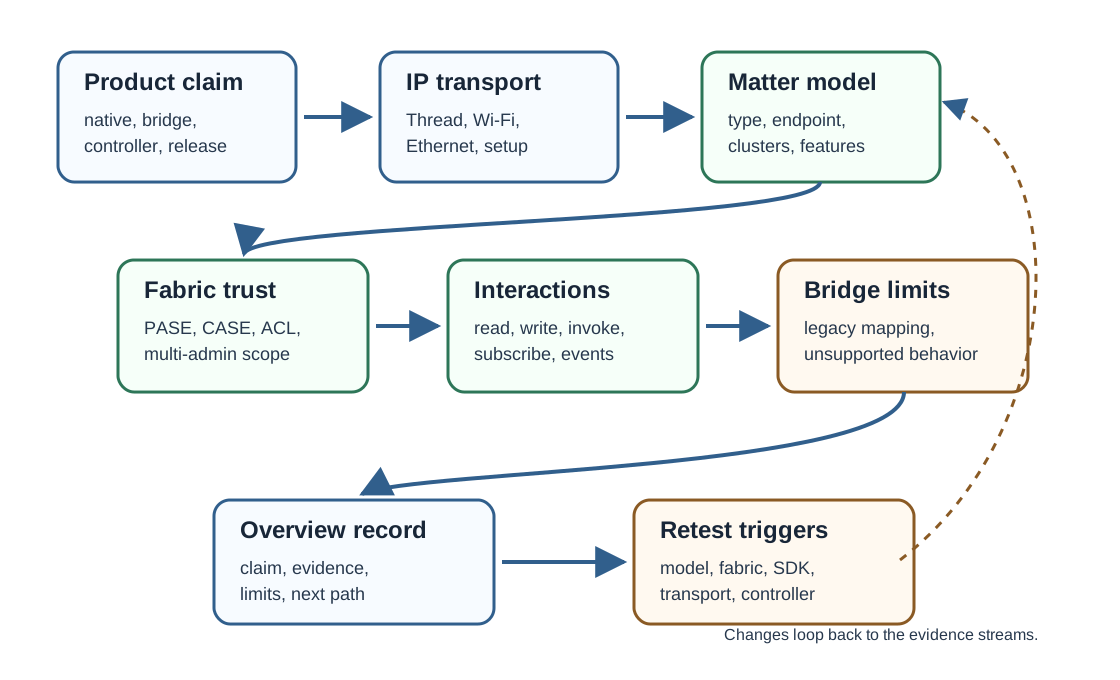
The first figure shows the minimum evidence streams behind a Matter overview claim.
- The map is intentionally broad.
- Later chapters inspect each stream in more detail, but the overview should already make the boundaries visible.
Major section
Architecture Evidence Boundary
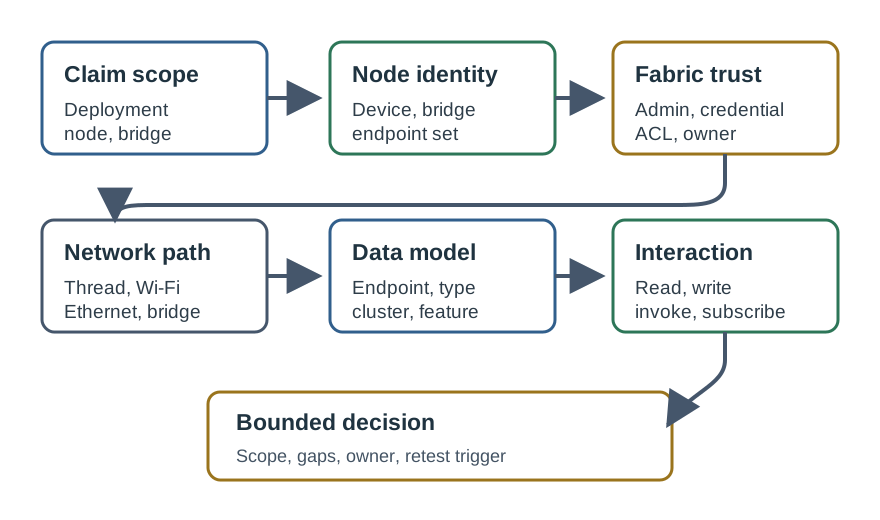
Matter, standardized by the Connectivity Standards Alliance, is reviewed at the application and trust layer, not at the radio layer.
- A product can use Thread, Wi-Fi, Ethernet, BLE setup, a vendor cloud, or a bridge and still need separate Matter evidence.
Major section
What Matter Is
Matter defines a common smart-home application model over IP.
- Multi-admin: More than one fabric may administer the same device when supported, with separate trust and authorization records.
- Certification and release evidence: PICS alignment, conformance evidence, interoperability evidence, known limits, and retest triggers.
- Matter is therefore reviewed as a product behavior contract, not just as a network connection.
Major section
Scope Ledger
Layer: Matter is an application layer, data model, interaction model, and security model; it is not a physical or radio technology.
- Network: Matter is carried over IP paths such as Thread, Wi-Fi, and Ethernet; it does not replace IPv6 or the underlying access network.
- Operation: Matter supports local controller-device operation inside a fabric; cloud services around the product are adjacent evidence.
- Goal: Matter targets cross-vendor smart-home interoperability; it is not proof that every vendor UI exposes every optional behavior identically.
Major section
Transport Boundary
The transport question is therefore not "Which ecosystem owns this device?" but "Which IP path carries the Matter interaction for this product claim?".
- Thread path: Useful when the product needs low-power mesh behavior and can operate through Thread border-router infrastructure.
- Wi-Fi path: Useful when the product has the power budget and bandwidth expectations of a Wi-Fi device.
- BLE setup path: Useful for discovery or onboarding support, but not the normal operational Matter transport.
Major section
IP Reuse and Transport Inheritance
That choice is why the same application model can run over Thread for low-power mesh devices, Wi-Fi for higher-power devices, and Ethernet for fixed infrastructure.
- Bluetooth Low Energy appears during commissioning as a short-range setup channel, then the device operates over its real IP network.
- The benefit is shared tooling and mixed-network interoperability under the same controller and fabric model.
- The cost is inherited transport evidence.
Major section
Native Device, Bridge, and Controller Claims
Matter overview records should distinguish roles.
- Native device claim: The product exposes Matter endpoints directly and can be reviewed through its own data model, commissioning, fabric, and interaction behavior.
- The review must separate bridge endpoint behavior from the legacy device's native behavior.
- Controller claim: A controller commissions or operates Matter devices.
Major section
Fit Decision Record
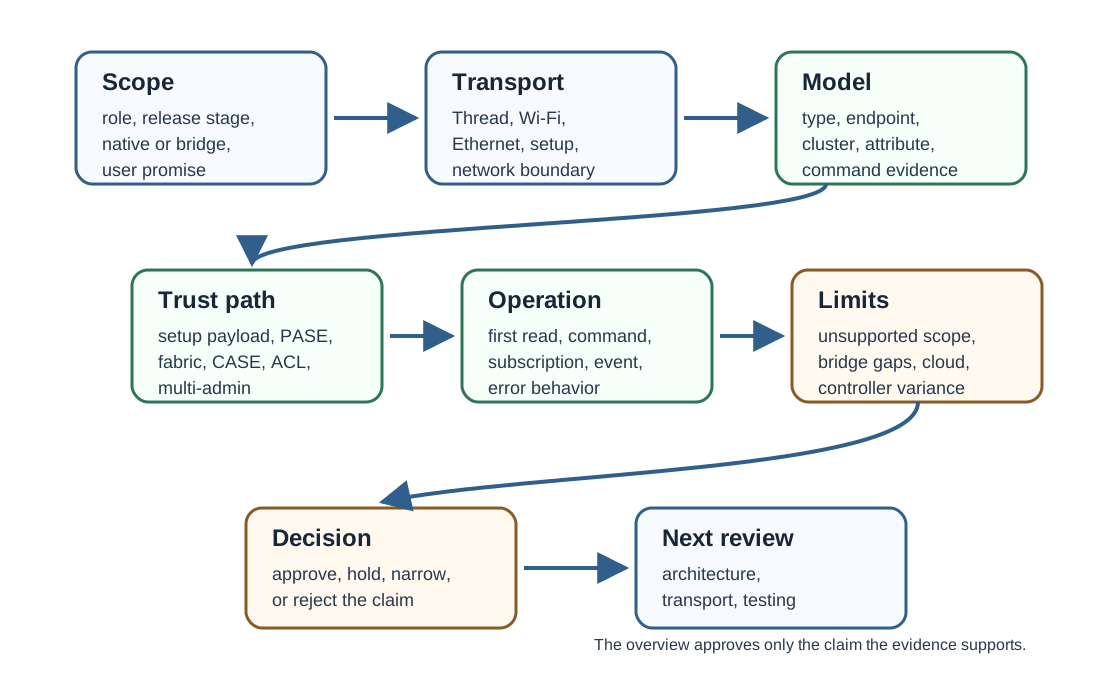
The decision record should be short enough to maintain, but specific enough to prevent broad claims from drifting across chapters.
- The second figure shows how to turn an overview into a decision record.
Major section
Summary
Matter should be introduced as a bounded evidence claim.
- It uses transports such as Thread, Wi-Fi, and Ethernet, but it is not the same thing as those transports.
- The most useful overview does not overpromise.
- That keeps the platform understandable without drifting into vendor lists, stale version timelines, or unsupported interoperability guarantees.
Deck summary
Key takeaways
Matter gives supported devices a shared way to describe features, join a trusted home, and exchange commands.
- Say which network it needs.
- Matter is an IP-based smart-home application layer.
- Matter is a smart-home application layer built around a shared data model, interaction model, commissioning process, and security fabric.
- The first figure shows the minimum evidence streams behind a Matter overview claim.
Retrieval practice
Recall check 1 of 4
Radio Remi says: answer from memory, then check your reasoning.
Q1In Matter, what role does Bluetooth Low Energy normally play?
Show answer
Answer: A BLE can assist Matter commissioning, but operational traffic runs over IP transports like Thread, Wi-Fi, or Ethernet.
Retrieval practice
Recall check 2 of 4
Radio Remi says: answer from memory, then check your reasoning.
Q2A team says its new device is a Matter device because it uses a Thread radio and a controller app can see it during setup. What should an overview reviewer require before accepting the Matter claim?
Show answer
Answer: B A Matter overview claim should connect transport, application data model, commissioning, fabric security, interactions, and exclusions.
Retrieval practice
Recall check 3 of 4
Radio Remi says: answer from memory, then check your reasoning.
Q3Why can the same Matter application model run over Thread, Wi-Fi, and Ethernet?
Show answer
Answer: A Matter reuses IP as the common substrate, which lets one application model run over Thread, Wi-Fi, or Ethernet while inheriting each transport's evidence requirements.
Retrieval practice
Recall check 4 of 4
Radio Remi says: answer from memory, then check your reasoning.
Q4A mains-powered smart-home device has Wi-Fi and a cloud app. The team wants to market it as Matter compatible, but there is no reviewed Matter data model, no commissioning evidence, and no local controller interaction record. What should the overview decision be?
Show answer
Answer: B A Matter overview decision should approve, hold, narrow, or reject the Matter claim based on Matter-specific evidence, not on adjacent smart-home features.
Print reference
Answers 1 of 2
Answer key.
- A · BLE can assist Matter commissioning, but operational traffic runs over IP transports like Thread, Wi-Fi, or Ethernet.
- B · A Matter overview claim should connect transport, application data model, commissioning, fabric security, interactions, and exclusions.
- A · Matter reuses IP as the common substrate, which lets one application model run over Thread, Wi-Fi, or Ethernet while inheriting each transport's evidence requirements.
Print reference
Answers 2 of 2
Answer key.
- B · A Matter overview decision should approve, hold, narrow, or reject the Matter claim based on Matter-specific evidence, not on adjacent smart-home features.