Zigbee, Thread & Matter · Study deck
Matter Testing and Certification
Picture a lamp that joins one app but fails when a second owner tries to use it.
Radio Remi is your guide for this deck.

After studying this chapter
Learning objectives
You will be able to:
- Explain: The review chain is simple but strict: product scope defines the PICS, PICS selects applicable tests, and the test harness produces evidence for conformance, interoperability, commissioning, security, and failure recovery.
- Explain: Matter certification, run under the Connectivity Standards Alliance, is what lets a product carry the Matter mark and enter the ecosystem interoperability program.
- Explain: Unsupported features are explicit: Out-of-scope behavior is named so reviewers do not expect evidence for features the product does not claim.
- Explain: The first figure shows how a Matter team moves from product intent to a bounded certification-readiness decision.
Major section
Start With the Device Experience
One happy path is not enough to support the full product claim.
- More tests can find more faults, but they also cost time and lab work.
- A narrow test is quick, yet it can miss real joins, updates, and mixed-device use.
- The later steps show how scope, proof, and release fit together.
- Retest after code change.
Major section
In 60 Seconds
Declaring features that are not implemented creates avoidable failures.
- Development tests, conformance tests, interoperability tests, commissioning tests, security tests, and manufacturing checks answer different questions.
- A passing happy path is not enough.
- Failure recovery, multi-admin behavior, reset behavior, access control, persistent storage, and transport disruption must be reviewed.
Major section
Certification Evidence Flow
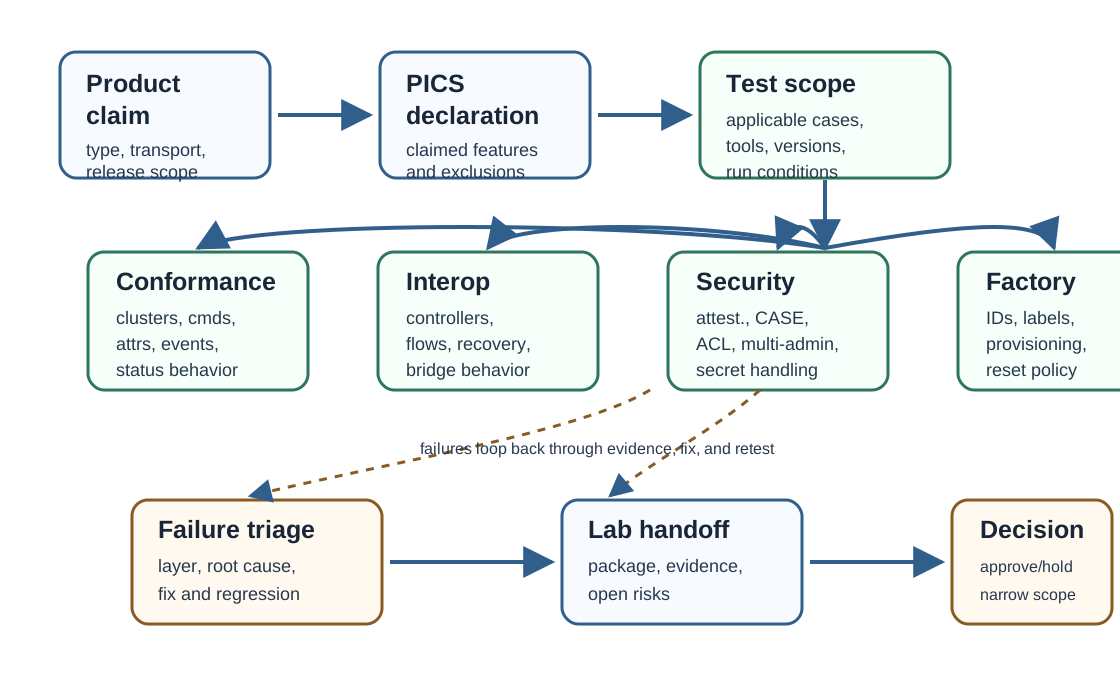
The first figure shows how a Matter team moves from product intent to a bounded certification-readiness decision.
- The important review habit is sequence.
- If the product claim is vague, the PICS declaration is unstable.
- If PICS is unstable, the test scope is unstable.
- If the test scope is unstable, a pass or failure result is hard to interpret.
Major section
PICS Is a Test Contract
The Protocol Implementation Conformance Statement is not paperwork at the edge of the project.
- If the PICS says the product supports a feature, the test plan should expect that feature to be exercised.
- Declared features match implementation: Every claimed feature has an implementation record, test evidence, and owner.
- Unsupported features are explicit: Out-of-scope behavior is named so reviewers do not expect evidence for features the product does not claim.
Major section
Commissioning and Security Evidence
Matter testing cannot be separated from commissioning and security.
- A device that accepts a command only after insecure shortcuts, stale credentials, or unreviewed provisioning is not ready for certification work.
- Setup payload: Setup code, discriminator, QR code or manual code, and secret-handling records match the reviewed device state.
- Security evidence is strongest when it includes negative tests.
Major section
Commissioning and Security Evidence (continued)
Attestation: Development and production attestation material are separated, and the device identity path is documented.
- Operational credentials: NOC installation, fabric table behavior, CASE readiness, and message-counter persistence are reviewed after reset and reboot.
- Access control: ACL behavior is tested for allowed and denied operations, not only successful administrator actions.
- Multi-admin: Commissioning-window behavior, fabric coexistence, controller removal, and session persistence are tested if the product claims multi-admin support.
Major section
Failure Triage Evidence
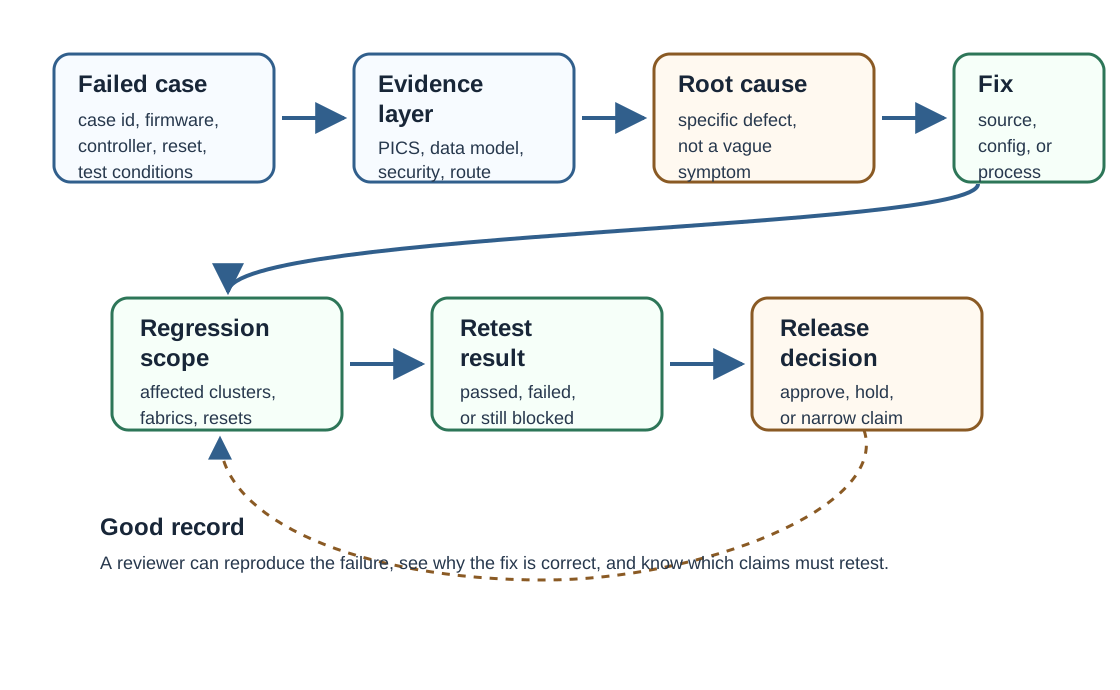
The second figure shows how to turn a failed test into a useful release decision instead of a vague bug list.
- A failure record should be specific enough that another engineer can reproduce the problem.
- If the only evidence is "controller did not work," the team has not yet created reviewable certification evidence.
Major section
Failure Triage Path
Fix with retest scope.: State which source, configuration, manufacturing data, or process changed and which tests must repeat because of that change.
- Preserve the evidence.: Keep firmware identity, reset state, controller identity, test configuration, logs, captures, timestamps, and failed case identifiers.
- The key is not speed.
- The key is avoiding ambiguous fixes that hide one failure while introducing another.
Major section
Certification Contract Chain
Matter certification, run under the Connectivity Standards Alliance, is what lets a product carry the Matter mark and enter the ecosystem interoperability program.
- The review chain is simple but strict: product scope defines the PICS, PICS selects applicable tests, and the test harness produces evidence for conformance, interoperability, commissioning, security, and failure recovery.
- That makes certification a contract.
Major section
Conformance, Interoperability, and Retest
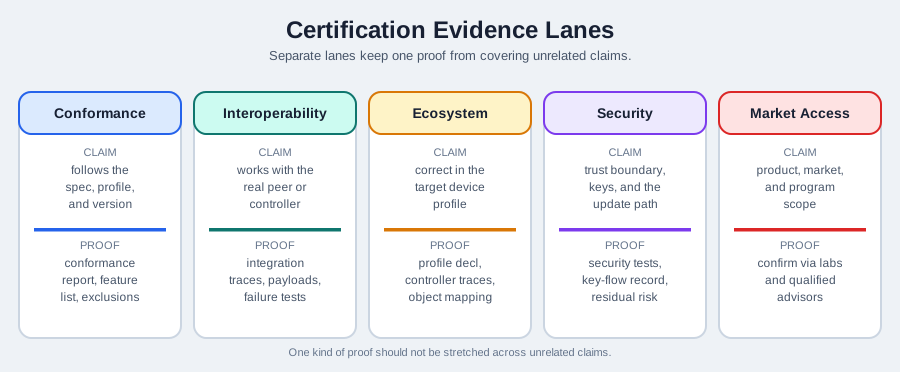
Conformance and interoperability are related but distinct.
- Interoperability tests the device against real implementations: commissioning with representative controllers, cross-vendor control, multi-admin behavior, persistence, recovery, and user flows.
- A device can pass conformance but still fail interoperability.
- For example, a spec-legal timing choice may expose a controller assumption.
Major section
Summary
Matter testing and certification readiness is an evidence alignment problem.
- Product scope defines the PICS declaration.
- PICS defines the relevant tests.
- Tests expose conformance, interoperability, commissioning, security, and provisioning evidence.
- Failures become useful only when they are tied to a layer, fixed with a retest scope, and preserved in a decision record.
Deck summary
Key takeaways
One happy path is not enough to support the full product claim.
- Declaring features that are not implemented creates avoidable failures.
- The first figure shows how a Matter team moves from product intent to a bounded certification-readiness decision.
- The Protocol Implementation Conformance Statement is not paperwork at the edge of the project.
- Matter testing cannot be separated from commissioning and security.
Retrieval practice
Recall check 1 of 6

Radio Remi says: answer from memory, then check your reasoning.
Q1A Matter plug declares an optional feature in its PICS that the firmware does not correctly implement. What should happen before certification?
Show answer
Answer: A PICS declarations drive the test scope, so a declared feature must be implemented and tested or removed from scope.
Retrieval practice
Recall check 2 of 6

Radio Remi says: answer from memory, then check your reasoning.
Q2A Matter plug declares an optional measurement feature in its PICS because the product team wants the feature listed, but the firmware does not yet update the related attributes correctly. What should the reviewer require before certification readiness is approved?
Show answer
Answer: B PICS declarations drive the applicable certification test scope.
Retrieval practice
Recall check 3 of 6

Radio Remi says: answer from memory, then check your reasoning.
Q3A Matter device passes basic command tests, but after a factory reset it intermittently fails to establish an operational session on the same fabric. Which evidence is most important before certification readiness can be approved?
Show answer
Answer: B A basic command pass does not prove operational-session readiness after reset.
Retrieval practice
Recall check 4 of 6

Radio Remi says: answer from memory, then check your reasoning.
Q4What is a PICS in the Matter certification process?
Show answer
Answer: A The certification chain is product scope to PICS declaration to applicable tests to evidence from the test harness.
Retrieval practice
Recall check 5 of 6

Radio Remi says: answer from memory, then check your reasoning.
Q5Why must product scope be settled before the test plan in Matter certification?
Show answer
Answer: A Scope drives PICS, and PICS drives applicable tests; over-declaring creates failures while under-declaring hides supported behavior.
Retrieval practice
Recall check 6 of 6

Radio Remi says: answer from memory, then check your reasoning.
Q6A Matter device passes conformance tests but fails with one ecosystem controller. What does this reveal?
Show answer
Answer: A Conformance is device versus specification; interoperability is device versus real implementations, and fixes need scoped retest records.
Print reference
Answers 1 of 2
Answer key.
- A · PICS declarations drive the test scope, so a declared feature must be implemented and tested or removed from scope.
- B · PICS declarations drive the applicable certification test scope.
- B · A basic command pass does not prove operational-session readiness after reset.
- A · The certification chain is product scope to PICS declaration to applicable tests to evidence from the test harness.
- A · Scope drives PICS, and PICS drives applicable tests; over-declaring creates failures while under-declaring hides supported behavior.
Print reference
Answers 2 of 2
Answer key.
- A · Conformance is device versus specification; interoperability is device versus real implementations, and fixes need scoped retest records.