Zigbee, Thread & Matter · Study deck
Matter Device Commissioning
Picture a new door sensor appearing in a home app.
Radio Remi is your guide for this deck.

After studying this chapter
Learning objectives
You will be able to:
- Separate setup payload, discovery, PASE, device attestation, network commissioning, operational credentials, and CASE evidence.
- Explain why PASE success does not prove operational fabric readiness by itself.
- Review device attestation without turning it into a broad product-quality or network-health claim.
- Scope Thread, Wi-Fi, Ethernet, and multi-admin commissioning evidence correctly.
Major section
Start With the Trust Boundary · Matter Device Commissioning Evidence · In 60 Seconds
Seeing it is only the first step.
- The owner must know which device it is, why it is trusted, which home it joins, and what happens if setup fails.
- A payload is the useful data carried in a setup code or message.
- Practitioner records each step, fault, and release choice.
Major section
Commissioning Review Claim · Commissioning Evidence Flow
The claim is deliberately narrow.
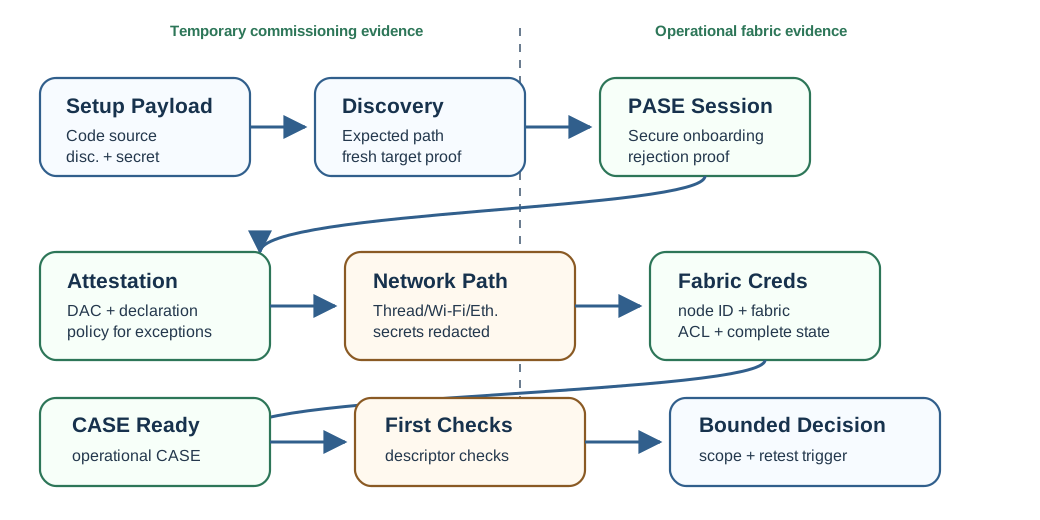
- The first figure shows the review path from an uncommissioned device to an operational fabric member.
- The flow separates temporary onboarding evidence from operational evidence.
- PASE protects the commissioning session.
- CASE proves the later operational session after credentials and fabric membership are in place.
Major section
Commissioning Sequence Trace · Evidence Families
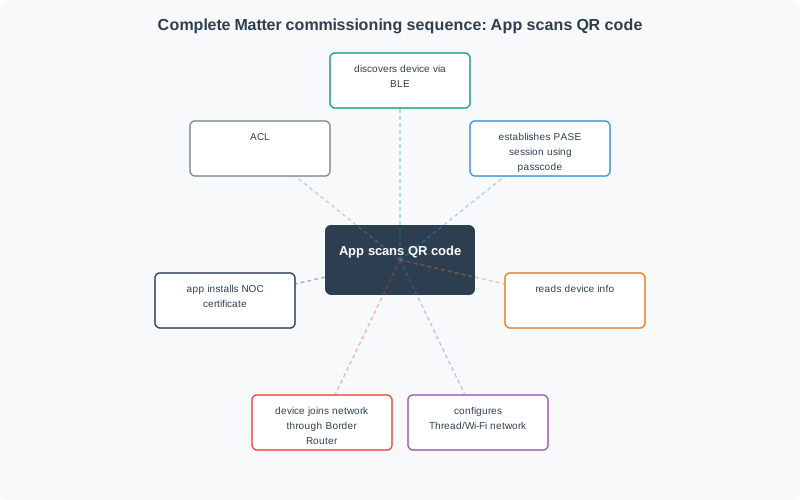
The commissioning sequence starts with setup evidence and ends with operational Matter evidence.
- Establish PASE: The commissioner and device use the setup passcode in a password-authenticated key exchange to protect the temporary commissioning channel without sending the passcode itself.
- Redact secrets from published records.
Major section
Setup Payload and Discovery Evidence · PASE Session Evidence
The setup payload is the first boundary in the commissioning record.
- A review should record the source of the setup payload and whether the device being discovered matches the expected identity and commissioning state.
- Discovery only starts the review.
- PASE protects the initial commissioning session using the setup passcode.
Major section
PASE Passcode Proof · Device Attestation Evidence
PASE uses SPAKE2+, a password-authenticated key exchange, so the commissioner and device can prove knowledge of the setup passcode without transmitting the passcode over the air.
- Capturing the exchange should not reveal the passcode.
- PASE also has strict scope.
- It protects temporary onboarding before operational credentials exist.
- Those later transitions need separate evidence.
Major section
Attestation Trust Chain · PASE and CASE Boundary Check · Network Commissioning Evidence
Network commissioning evidence depends on the transport and device state.
- The step that separates Matter onboarding from simple password pairing is device attestation.
- It may be printed on a label or packaging, so it can be photographed or copied.
- The reviewer should state what path was actually used.
Major section
Operational Credentials and Fabric Evidence · CASE and First Operational Checks
Operational credentials are the point where the device becomes a Matter fabric member.
- The review should tie credentials to the device, commissioner, fabric, and operational identity being approved.
- Credentials are fabric-scoped.
- After commissioning completes, the reviewer should prove that the device can operate outside the temporary commissioning channel.
Major section
Multi-Admin Commissioning Evidence · Commissioning Failure Handling
Commissioning failures are evidence, not noise.
- Multi-admin commissioning lets a commissioned device be shared with another administrator through an additional fabric.
- A review should treat that as a second commissioning claim, not as an automatic consequence of the first one.
- A release review should preserve enough failure detail to decide whether the issue blocks approval, requires retest, or stays outside the approved scope.
Major section
Record 2: Attestation Hold · Record 3: Multi-Admin Handoff
Scenario: A development plug can complete PASE and network commissioning, but device attestation does not match the release policy.
- Evidence found: PASE, Wi-Fi join, and operational credential installation were repeatable in a lab build, but the attestation record was marked development-only and not acceptable for production release.
- Scenario: A commissioned lighting device is shared with a second administrator for household control.
- Retest after ACL changes, fabric removal, controller replacement, or firmware changes affecting commissioning.
Major section
Commissioning Review Record · Release Checklist
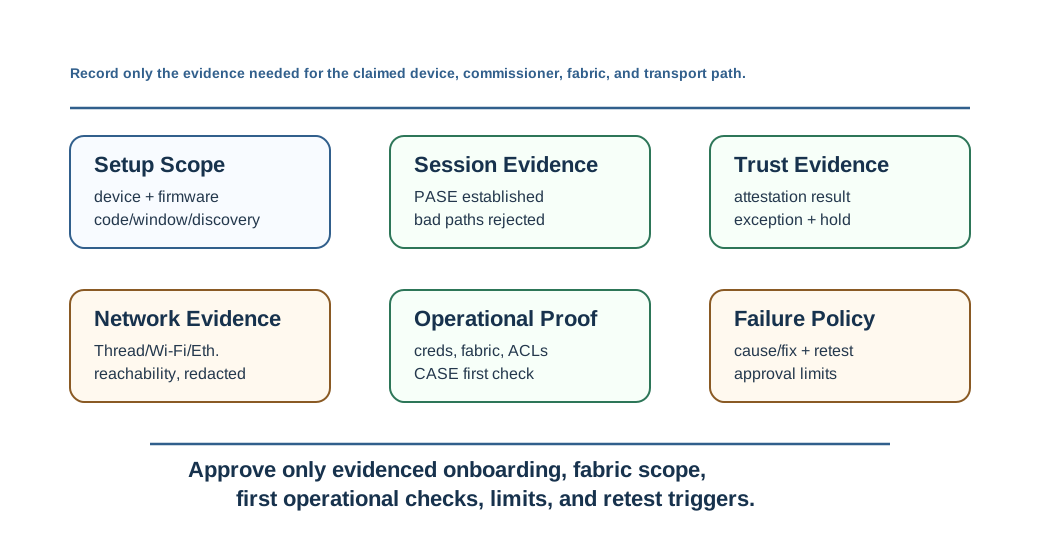
The second figure shows the minimum review record needed before accepting a commissioning claim.
- The record keeps onboarding evidence, operational evidence, and open limitations visible.
- Device scope: The reviewed device, firmware, setup payload, commissioning window, and commissioner are identified.
- Trust scope: Device attestation evidence and exception policy support the release decision.
Major section
Key Takeaway · Concept Relationships
Matter Device Commissioning Evidence should prove commissioning through identity, fabric membership, credential exchange, network setup, recovery paths, and deployment evidence.
- Matter Fabric Security Evidence explains the fabric, PASE, CASE, operational credential, and ACL boundaries behind commissioning.
- Matter Interaction Evidence shows how post-commissioning reads, writes, subscribes, invokes, and timed interactions are reviewed.
- Matter Device Types and Clusters Evidence explains how endpoint behavior is approved after a device has joined a fabric.
Deck summary
Key takeaways
Seeing it is only the first step.
- The claim is deliberately narrow.
- The commissioning sequence starts with setup evidence and ends with operational Matter evidence.
- The setup payload is the first boundary in the commissioning record.
- PASE uses SPAKE2+, a password-authenticated key exchange, so the commissioner and device can prove knowledge of the setup passcode without transmitting the passcode over the air.
Retrieval practice
Recall check 1 of 6

Radio Remi says: answer from memory, then check your reasoning.
Q1What does device attestation evidence verify during Matter commissioning?
Show answer
Answer: A Device attestation checks product identity and certification signals before the device is trusted into a fabric.
Retrieval practice
Recall check 2 of 6
Radio Remi says: answer from memory, then check your reasoning.
Q2During commissioning, how does Matter's PASE step prove the setup passcode without transmitting it?
Show answer
Answer: A PASE uses SPAKE2+ so both sides prove knowledge of the setup passcode and derive a shared key without sending the passcode.
Retrieval practice
Recall check 3 of 6
Radio Remi says: answer from memory, then check your reasoning.
Q3What does Matter device attestation with DAC and PAI evidence verify during commissioning?
Show answer
Answer: A Device attestation verifies DAC and PAI evidence against an accepted trust policy before the commissioner grants operational trust.
Retrieval practice
Recall check 4 of 6
Radio Remi says: answer from memory, then check your reasoning.
Q4A test log shows that a commissioner established PASE with a device, but there is no record of operational credential installation or CASE reachability. What should the reviewer conclude?
Show answer
Answer: B The commissioning record must separate temporary PASE evidence from operational CASE evidence.
Retrieval practice
Recall check 5 of 6
Radio Remi says: answer from memory, then check your reasoning.
Q5A device joins after a factory reset, but the earlier commissioning attempt failed. What should release review require?
Show answer
Answer: B A later success cannot erase a failed path.
Retrieval practice
Recall check 6 of 6
Radio Remi says: answer from memory, then check your reasoning.
Q6What can reviewers approve for the newly added fabric?
Show answer
Answer: B Multi-admin commissioning is not inherited automatically from the first fabric.
Print reference
Answers 1 of 2
Answer key.
- A · Device attestation checks product identity and certification signals before the device is trusted into a fabric.
- A · PASE uses SPAKE2+ so both sides prove knowledge of the setup passcode and derive a shared key without sending the passcode.
- A · Device attestation verifies DAC and PAI evidence against an accepted trust policy before the commissioner grants operational trust.
- B · The commissioning record must separate temporary PASE evidence from operational CASE evidence.
- B · A later success cannot erase a failed path.
Print reference
Answers 2 of 2
Answer key.
- B · Multi-admin commissioning is not inherited automatically from the first fabric.