Zigbee, Thread & Matter · Study deck
The Smart-Home Fragmentation Problem
Imagine a home with a lamp, lock, and motion sensor from different makers.
Radio Remi is your guide for this deck.

After studying this chapter
Learning objectives
You will be able to:
- Explain: The fragmentation problem was visible to users as a row of separate control islands: one app for lights, another for thermostats, another for locks, another for cameras, and another for media devices.
- Explain: A reviewer should check whether the required controller, fabric, network path, border router, endpoint, command, and subscription behavior work without relying on a remote cloud path for the reviewed operation.
- Explain: Matter standardizes the layer where controllers and devices need to agree: nodes, endpoints, device types, clusters, attributes, commands, events, commissioning, fabrics, secure sessions, and interaction patterns.
- Map Matter mechanisms to specific fragmentation symptoms
Major section
Start With the Device Experience · Matter Fragmentation Evidence
Each device works in its own app, yet one shared "leave home" action cannot control all three.
- The problem is not only the radio.
- The devices may use different setup steps, names, trust rules, and cloud services.
- Matter gives products a shared application language and setup path.
Major section
In 60 Seconds · Fragmentation Review Claim · Fragmentation Evidence Map
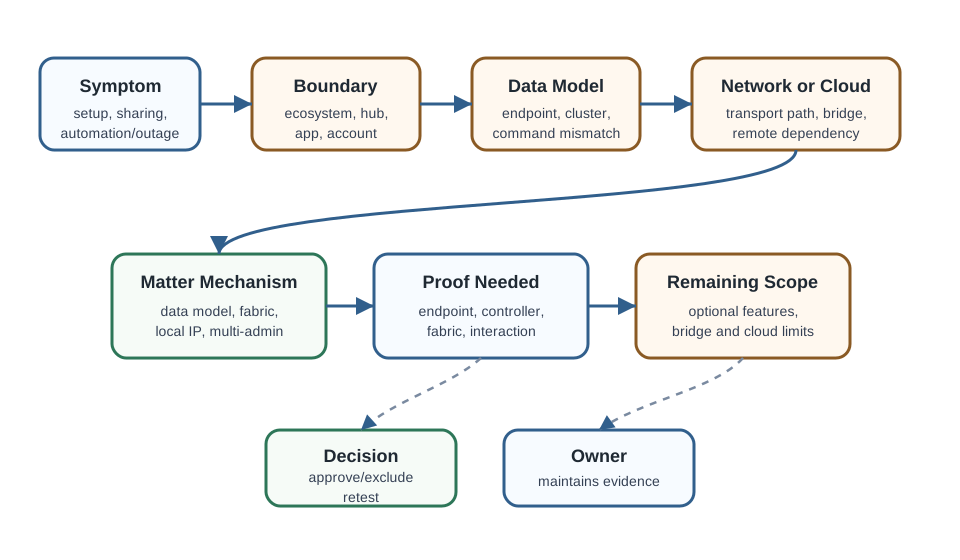
Fragmentation can appear as setup friction, controller lock-in, duplicated automations, missing cross-vendor control, cloud dependency, or stale bridge mappings.
- Matter does not make every product support every feature, remove the need for Thread border routers, or automatically fix legacy bridge behavior.
- The claim is deliberately bounded.
Major section
Pre-Matter Control Islands · Evidence Families
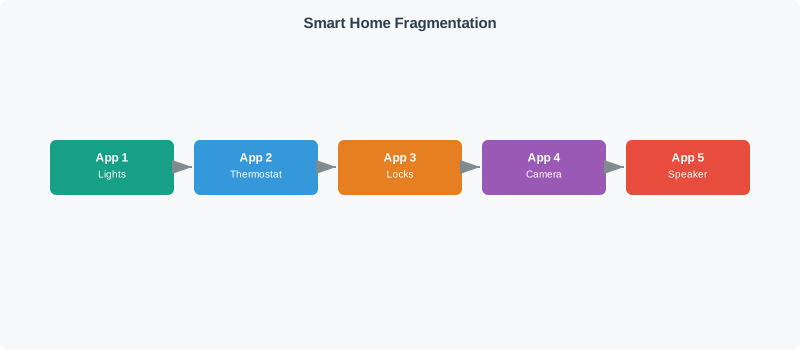
The fragmentation problem was visible to users as a row of separate control islands: one app for lights, another for thermostats, another for locks, another for cameras, and another for media devices.
- The deeper issue was that each island also carried its own data model, onboarding path, trust domain, cloud dependency, and operations record.
Major section
Separate Commissioning Paths · Separate Trust Domains
Many devices were onboarded through ecosystem-specific apps or hubs.
- Setup could work well inside one ecosystem while remaining difficult to transfer or share with another.
- Each ecosystem had its own account, credential, permission, and owner model.
- A device controlled in one app was not automatically safe or authorized in another.
Major section
What Matter Changes · Before and After Matter
Secure commissioning helps onboarding.
- Common data model: Matter defines nodes, endpoints, device types, clusters, attributes, commands, and events so controllers and devices have a shared behavior vocabulary.
- Secure commissioning: Matter defines a common onboarding and trust path so a device can be added to a fabric with verifiable credentials and permissions.
- Local operation helps resilience.
Major section
Why the Application Layer Is the Fix
Matter does not solve fragmentation by replacing every radio.
- A common radio alone would still leave incompatible device models and trust records.
- Matter standardizes the layer where controllers and devices need to agree: nodes, endpoints, device types, clusters, attributes, commands, events, commissioning, fabrics, secure sessions, and interaction patterns.
- A Thread light and a Wi-Fi light can therefore present comparable Matter behavior to a controller even though their transport paths differ.
Major section
What Matter Does Not Prove Alone · Interoperability Scope Check
Matter is not a universal guarantee.
- Matter support does not mean every optional device feature is supported.
- A Thread border router is network infrastructure, not a proprietary application hub replacement for every scenario.
- A bridge can expose legacy devices through Matter, but the bridge can still hide, remap, or limit child-device behavior.
Major section
Before-Matter Evidence · Matter Response Record
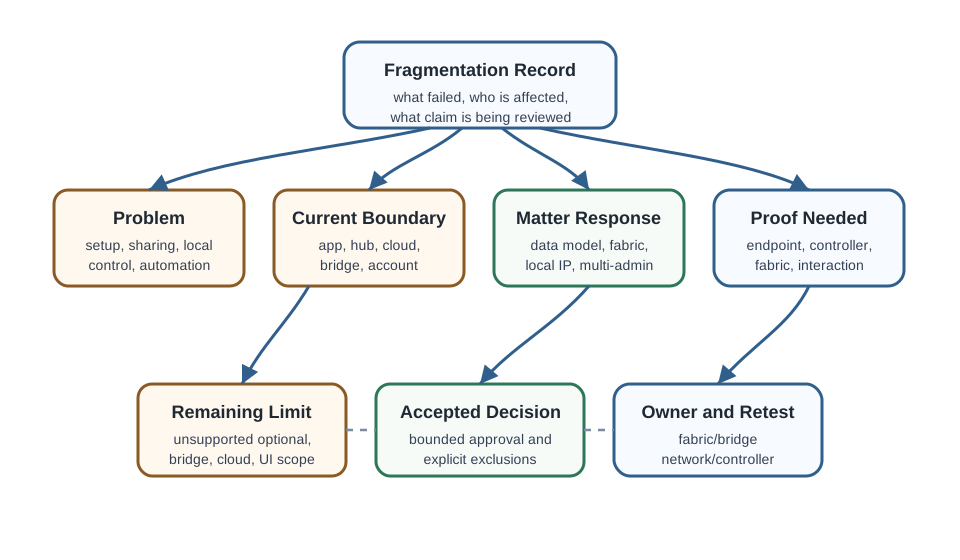
A pre-Matter review should describe the actual fragmentation symptom, not just the brand names involved.
- The second figure shows the review record for connecting a fragmentation symptom to a Matter response.
- The record should make the accepted scope and the remaining boundary visible.
Major section
Multi-Admin Is Not a Shortcut · Bridges and Legacy Devices
The strongest statement is not "the device works everywhere." It is "the reviewed device, fabric, endpoint, and interaction worked for these controllers under these conditions.".
- Matter can reduce fragmentation for legacy devices through bridges.
- A bridge can represent devices that use another technology as Matter endpoints.
- Bridge approval should not say that the legacy device became fully native Matter.
Major section
Local Control and Cloud Boundaries · Worked Review Records · Record 1: Cross-Ecosystem Light Control
Matter is designed for local operation over IP, but local control still needs evidence.
- A reviewer should check whether the required controller, fabric, network path, border router, endpoint, command, and subscription behavior work without relying on a remote cloud path for the reviewed operation.
- Cloud services may still provide account features, remote access, updates, analytics, voice integration, or vendor-specific functions.
- Those features should remain separate from the local Matter control claim.
- Scenario: A household wants one lighting device to be controlled from two ecosystems without replacing the device for each platform.
Major section
Common Mistakes · Match the Fragmentation Evidence · Order the Fragmentation Review
Saying Thread support proves Matter support.
- Saying Matter support proves every optional feature, UI behavior, automation, or vendor extension.
- Treating one controller's success as proof that every ecosystem, fabric, and administrator will behave the same way.
- Ignoring cloud services that still support remote access, accounts, updates, analytics, or vendor-specific behavior.
Major section
Release Checklist
Boundary: The blocker is classified as ecosystem, data-model, commissioning, trust, transport, bridge, cloud, or operations related.
- Evidence: Endpoint, device type, cluster, interaction, fabric, ACL, controller, and transport evidence match the claim.
- Remaining limit: Optional features, vendor extensions, remote services, unsupported controllers, and bridge limitations are excluded unless evidenced.
- Retest: Firmware, bridge mapping, controller enrollment, fabric removal, ACL changes, network changes, and cloud dependency changes have retest triggers.
Major section
Key Takeaway · Concept Relationships
Matter Fragmentation Evidence should align Matter protocol stack, fabrics, commissioning, clusters, transports, interoperability, certification, and deployment evidence.
- Matter Architecture Evidence explains the node, controller, fabric, bridge, and endpoint boundaries behind interoperability decisions.
- Matter Protocol Stack Evidence explains how transport, secure session, interaction, and data-model evidence fit together.
- Matter Device Types and Clusters Evidence shows how endpoint behavior is approved through device types, clusters, features, and interactions.
Deck summary
Key takeaways
Each device works in its own app, yet one shared "leave home" action cannot control all three.
- Fragmentation can appear as setup friction, controller lock-in, duplicated automations, missing cross-vendor control, cloud dependency, or stale bridge mappings.
- The fragmentation problem was visible to users as a row of separate control islands: one app for lights, another for thermostats, another for locks, another for cameras, and another for media devices.
- Many devices were onboarded through ecosystem-specific apps or hubs.
- Secure commissioning helps onboarding.
Retrieval practice
Recall check 1 of 5
Radio Remi says: answer from memory, then check your reasoning.
Q1The pre-Matter 'fragmentation problem' in smart homes was mainly caused by what?
Show answer
Answer: A Smart-home fragmentation came from devices split across separate apps, hubs, clouds, and data models, which Matter's common model targets.
Retrieval practice
Recall check 2 of 5
Radio Remi says: answer from memory, then check your reasoning.
Q2What does Matter's multi-admin capability let a single reviewed device do?
Show answer
Answer: A Multi-admin lets one compatible Matter device be commissioned into multiple fabrics, but each fabric, controller, endpoint, permission, and interaction remains part of the evidence record.
Retrieval practice
Recall check 3 of 5
Radio Remi says: answer from memory, then check your reasoning.
Q3Why did standardizing the application layer, rather than mandating one radio, help Matter reduce smart-home fragmentation?
Show answer
Answer: A Matter reduces fragmentation by standardizing the data model, commissioning, security, and interaction layer while allowing multiple IP transports and bridge paths.
Retrieval practice
Recall check 4 of 5
Radio Remi says: answer from memory, then check your reasoning.
Q4A reviewer says Matter will solve a home's fragmentation because the new devices will use Thread. What is the best response?
Show answer
Answer: B Thread can support Matter by providing an IPv6 mesh path, but Thread does not prove device-type, cluster, fabric, ACL, interaction, or multi-admin behavior.
Retrieval practice
Recall check 5 of 5
Radio Remi says: answer from memory, then check your reasoning.
Q5A team wants to advertise that a bridged legacy sensor is now fully interoperable because it appears in a Matter controller. What is the strongest approval decision?
Show answer
Answer: B A Matter bridge can reduce fragmentation, but the approval must stay scoped to the represented endpoint behavior that was actually exposed, tested, and maintained by the bridge.
Print reference
Answers 1 of 2
Answer key.
- A · Smart-home fragmentation came from devices split across separate apps, hubs, clouds, and data models, which Matter's common model targets.
- A · Multi-admin lets one compatible Matter device be commissioned into multiple fabrics, but each fabric, controller, endpoint, permission, and interaction remains part of the evidence record.
- A · Matter reduces fragmentation by standardizing the data model, commissioning, security, and interaction layer while allowing multiple IP transports and bridge paths.
Print reference
Answers 2 of 2
Answer key.
- B · Thread can support Matter by providing an IPv6 mesh path, but Thread does not prove device-type, cluster, fabric, ACL, interaction, or multi-admin behavior.
- B · A Matter bridge can reduce fragmentation, but the approval must stay scoped to the represented endpoint behavior that was actually exposed, tested, and maintained by the bridge.