Zigbee, Thread & Matter · Study deck

Matter Device Types and Clusters

Start with a user expecting a Matter device to join, advertise, and respond through a controller without caring which vendor built each piece.

Radio Remi is your guide for this deck.

matterdevice-typesclusters
Radio Remi, the module guide, in a scene from this chapter.
iotclass.org

After studying this chapter

Learning objectives

You will be able to:

  • Review a Matter endpoint without confusing node identity, endpoint identity, device type, and product category.
  • Explain how Descriptor evidence supports device-type and cluster discovery.
  • Distinguish required clusters, optional clusters, feature-gated behavior, and unsupported assumptions.
  • Evaluate attributes, commands, events, FeatureMap, and ClusterRevision as conformance evidence.
iotclass.org

Major section

Start With the Device Experience · Matter Device Types and Clusters Evidence · In 60 Seconds

Optional clusters and features need explicit evidence before they can be approved.

  • Matter Device Types and Clusters is the evidence route for deciding whether that expectation is realistic.
  • The advanced details are useful when they explain where that story can break.
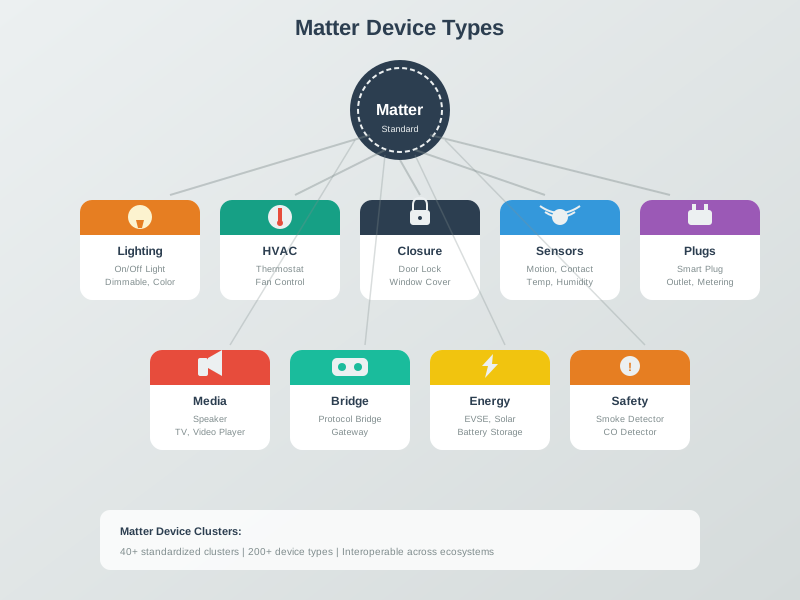
  • Matter device types are not product names.

Why it matters

Bridge and multi-function devices need endpoint-by-endpoint evidence because one node can represent several logical devices.

iotclass.org

Major section

Device Type Review Claim · Device Type Evidence Map
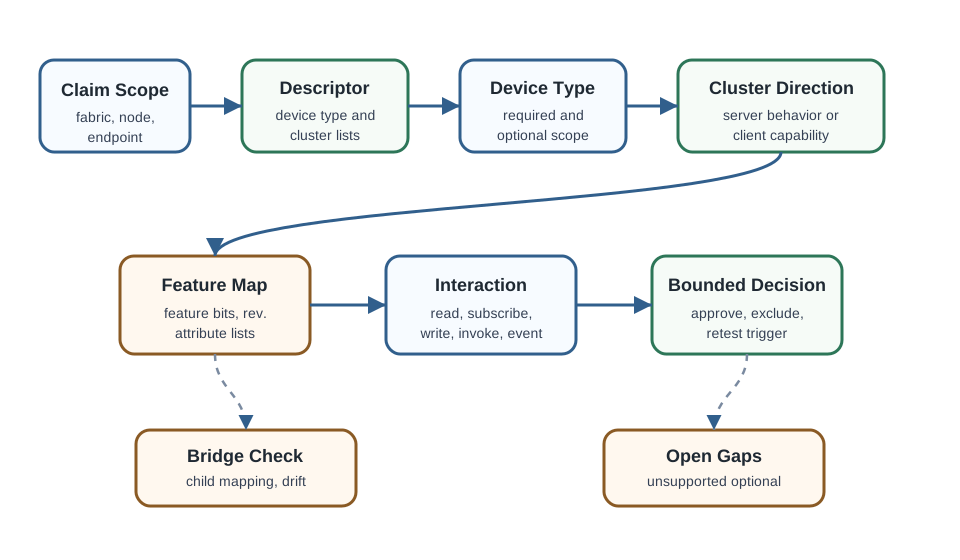
The claim does not say that a product works with every controller or every future feature.

  • It says the reviewed endpoint has enough evidence for the device type and cluster behavior being approved.
  • The first figure shows the path from a device-type claim to a bounded approval.

Key terms

Discovery
Discovery is the start of evidence, not the end of review.
Matter device type evidence map.
iotclass.org

Major section

Evidence Families · Why Device Types Are Evidence · Product Category Is Not Enough

A device type gives a controller a stable interpretation of an endpoint.

  • The controller does not need to guess whether endpoint 1 is a dimmable light, lock, thermostat, switch, or sensor.
  • It reads descriptor evidence and then expects a cluster contract that matches the device type.
  • That contract has limits.

Key terms

Marketing names
Marketing names are often broader than Matter device types.
iotclass.org

Major section

One Node Can Carry Many Functions · Direction Matters · Endpoint and Root Node Evidence

A single Matter node can expose more than one application function.

  • A ceiling fan with an integrated light may use separate endpoints for fan control and lighting.
  • A bridge may expose many legacy child devices as separate endpoints.
  • Approving one endpoint does not automatically approve the others.

Key terms

Cluster direction
Cluster direction is part of the evidence.
iotclass.org

Major section

Descriptor Evidence · Cluster Evidence · Required and Optional Capabilities · Device Type Scope Check

The Descriptor cluster is the starting point for endpoint review.

  • It tells the reviewer what the endpoint claims to be and which clusters are exposed.
  • Descriptor evidence can become stale.
  • Firmware updates, bridge reconfiguration, factory reset, fabric migration, and child-device replacement can change the endpoint map.

Why it matters

Matter device types describe minimum expected behavior, then allow optional additions.

iotclass.org

Major section

FeatureMap and ClusterRevision Evidence · Attributes, Commands, and Events

FeatureMap records which optional cluster features the endpoint says it supports.

  • A cluster may exist while only a subset of its feature set is present.
  • If the feature bit is not present, do not approve feature-dependent attributes, commands, events, or user-facing promises.
  • ClusterRevision records the cluster revision exposed by the endpoint.

Why it matters

FeatureMap and ClusterRevision help prevent overclaiming.

iotclass.org

Major section

Device Type Families · Lighting · Sensors · HVAC and Fans

Device type families help organize review work, but each endpoint still needs its own evidence.

  • The reviewer should avoid assuming that every light supports dimming or color temperature.
  • The review should check reporting behavior and subscription behavior, not only a single cached value in a controller app.
  • Thermostats, room air conditioners, and fans need careful separation between temperature control, operating mode, fan behavior, and UI configuration.
iotclass.org

Major section

Locks and Access Devices · Switches and Controllers

Locks and access devices need stronger authorization evidence.

  • Device-type review should be paired with fabric, ACL, command status, event, and user-management scope.
  • A visible lock tile does not prove every lock operation or user-code feature.
  • Switch and controller endpoints can send or represent actions without directly exposing the controlled load.
iotclass.org

Major section

Record 2: Bridge Child Sensor · Record 3: Thermostat With Optional Fan Control

Scenario:: A thermostat endpoint controls heating and cooling, and a product page says it has fan support.

  • After a bridge update, the controller still shows the sensor in the same room.
  • The old endpoint record is stale.
  • The UI can request fan-only operating mode, but not independent fan speed.
iotclass.org

Major section

Cluster Conformance Record · Release Checklist · Approval Decision Check · Node, Endpoint, Cluster Taxonomy
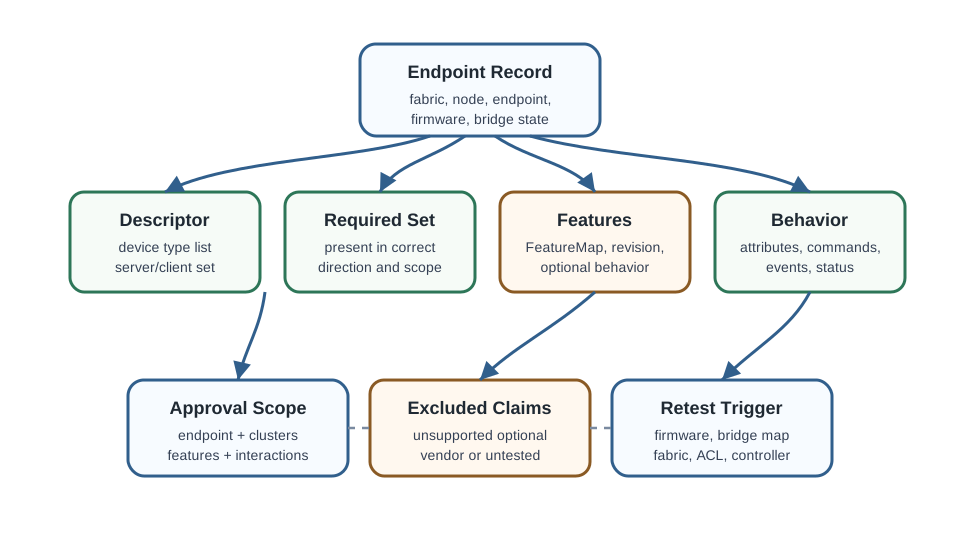
The second figure shows the record a reviewer should leave behind after checking an endpoint.

  • This record makes the review reusable.
  • Another reviewer should be able to see exactly which endpoint was approved, which features were excluded, and what change would require retest.
  • A node is the device.

Key terms

Endpoint 0
Endpoint 0 is the root; application endpoints carry reviewed functions.
Matter cluster conformance review record.
iotclass.org

Major section

From Clusters to a Device-Type Claim · Cluster Contract and Zigbee Heritage · Summary

The reason a Matter light from one vendor behaves like a light from another is that a cluster is a strict interoperability contract.

  • The data model needs to be recorded at the same grain as the approval.
  • That heritage is why Matter and Zigbee share cluster terminology and why a Zigbee-to-Matter bridge can often map device behavior between similar cluster concepts.
  • The most important discipline is scope.

Why it matters

A product-level statement is weaker than an endpoint-level ledger because Matter behavior is exposed by endpoints and clusters.

iotclass.org

Major section

Key Takeaway · Concept Relationships

Matter Device Types and Clusters Evidence should map device types, clusters, attributes, commands, events, subscriptions, user behavior, and deployment evidence.

  • Matter Protocol Stack Evidence explains where endpoints, clusters, attributes, commands, and events sit in the Matter stack.
  • Matter Interaction Evidence explains how Read, Write, Subscribe, Invoke, and Timed Request records prove behavior.
  • Matter Architecture Evidence explains why node, fabric, controller, bridge, and endpoint boundaries matter.
iotclass.org

Deck summary

Key takeaways

Optional clusters and features need explicit evidence before they can be approved.

  • The claim does not say that a product works with every controller or every future feature.
  • A device type gives a controller a stable interpretation of an endpoint.
  • A single Matter node can expose more than one application function.
  • The Descriptor cluster is the starting point for endpoint review.
iotclass.org

Retrieval practice

Recall check 1 of 6

Radio Remi says: answer from memory, then check your reasoning.

Q1In a Matter node's endpoint model, what is endpoint 0?

AThe root endpoint, while application endpoints represent device functions
BThe first light or sensor function exposed by the device
CA reserved endpoint that must always be left completely empty
DThe border router's own endpoint on the Thread mesh
Show answer

Answer: A Endpoint 0 is the root endpoint; application endpoints represent the device's functions such as a light or lock.

iotclass.org

Retrieval practice

Recall check 2 of 6

Radio Remi says: answer from memory, then check your reasoning.

Q2A Matter node exposes endpoint 1 as a dimmable light and endpoint 2 as a fan. The review record only includes Descriptor and Level Control evidence for endpoint 1. What is the strongest approval decision?

AApprove both endpoints together, because they belong to the same Matter node and share one commissioning record.
BApprove endpoint 1 only for the reviewed light behavior, and keep the fan endpoint open until endpoint 2 evidence is reviewed.
CApprove the fan as well, because Level Control and Fan Control are both control clusters, so evidence for one effectively proves the other.
DApprove the fan after checking endpoint 0's list of application endpoints, since that would confirm the fan is present on the node.
Show answer

Answer: B Matter approval is endpoint-scoped.

iotclass.org

Retrieval practice

Recall check 3 of 6

Radio Remi says: answer from memory, then check your reasoning.

Q3A reviewed endpoint exposes the required clusters for its claimed device type, but the optional cluster needed for a dashboard feature is absent. How should the approval be written?

AReject the whole device-type claim, because a single missing optional cluster invalidates the endpoint's conformance.
BApprove the device type for the required behavior that was evidenced, and explicitly exclude the optional dashboard feature.
CApprove the dashboard feature from the device-type label, since the controller can offer a familiar interface for that class of endpoint.
DUse another endpoint's optional cluster as support for the dashboard feature, since both endpoints share the same node and fabric.
Show answer

Answer: B Optional Matter capabilities should be included only when evidenced.

iotclass.org

Retrieval practice

Recall check 4 of 6

Radio Remi says: answer from memory, then check your reasoning.

Q4How is a Matter device's functionality organized?

AAs a tree: a node has endpoints, and each endpoint hosts clusters with attributes, commands, and events.
BAs a single flat list of settings, with every capability exposed as one key-value entry directly on the node.
CAs raw sensor byte streams that each controller parses using its own vendor-supplied schema.
DAs web pages served by the device, which each controller scrapes to discover features.
Show answer

Answer: A Matter models a device as node to endpoints to clusters; a device type requires a defined cluster set on an endpoint.

iotclass.org

Retrieval practice

Recall check 5 of 6

Radio Remi says: answer from memory, then check your reasoning.

Q5Why can any Matter controller operate any 'Dimmable Light' without device-specific code?

AThe Dimmable Light device type mandates a fixed set of standard clusters.
BThe commissioning app translates the controller's commands into the light vendor's private protocol.
CBecause the controller downloads a driver for each device.
DIPv6 discovery tells the controller how the light implements its dimming behavior.
Show answer

Answer: A A device type mandates standard clusters, such as On/Off and Level Control for a dimmable light, so a controller can use the same interaction logic across vendors.

iotclass.org

Retrieval practice

Recall check 6 of 6

Radio Remi says: answer from memory, then check your reasoning.

Q6What makes 'brightness' mean the same thing across every vendor's Matter light?

AThe Level Control cluster fixes standardized attribute and command IDs and their semantics.
BEach vendor publishes its own brightness attribute IDs, which controllers look up per product.
CControllers discover the brightness field by trial and error when first pairing with each light.
DA cloud service normalizes each vendor's brightness scale into one common range.
Show answer

Answer: A Matter clusters fix standardized attribute and command identifiers and semantics, so conformant implementations expose the same interaction contract.

iotclass.org

Print reference

Answers 1 of 2

Answer key.

  1. A · Endpoint 0 is the root endpoint; application endpoints represent the device's functions such as a light or lock.
  2. B · Matter approval is endpoint-scoped.
  3. B · Optional Matter capabilities should be included only when evidenced.
  4. A · Matter models a device as node to endpoints to clusters; a device type requires a defined cluster set on an endpoint.
iotclass.org

Print reference

Answers 2 of 2

Answer key.

  1. A · A device type mandates standard clusters, such as On/Off and Level Control for a dimmable light, so a controller can use the same interaction logic across vendors.
  2. A · Matter clusters fix standardized attribute and command identifiers and semantics, so conformant implementations expose the same interaction contract.
iotclass.org