Zigbee, Thread & Matter · Study deck
Matter Protocol Stack
Matter interoperability depends on two connected review surfaces: the protocol stack that carries protected messages, and the data model that names what those messages mean.
Radio Remi is your guide for this deck.

After studying this chapter
Learning objectives
You will be able to:
- Review Matter stack evidence without collapsing transport, session, message, interaction, and data-model responsibilities.
- Explain how the same application model can run over different IP-capable network paths.
- Evaluate data-model evidence for nodes, endpoints, clusters, attributes, commands, events, and device types.
- Identify wrong-layer, wrong-endpoint, unsupported-cluster, stale-descriptor, and overbroad-conformance claims.
Major section
Start With the Device Experience
The product owner must find which layer accepted the device and which layer failed the action.
- A lock, heater, or alarm must retain its safe rule when a phone or remote account is unavailable.
- This opening does not certify two products or cover every stack detail.
- If any answer is no, stop and repair the record.
Major section
In 60 Seconds
Matter separates application behavior from the underlying Thread, Wi-Fi, or Ethernet network path.
- IPv6 reachability is necessary but not enough.
- MRP adds reliability behavior for Matter messages over UDP paths, but the approval should still be bounded by retry, duplicate, timeout, and sleepy-device evidence.
- Endpoint 0 is the root and utility area; application endpoints expose device functions.
Major section
Protocol Stack Review Claim
The claim is intentionally narrow.
- Evidence that a device has an IPv6 address does not prove cluster conformance.
- Evidence that a controller established a secure session does not prove the requested command exists.
- Evidence that one endpoint works does not prove a bridge or multi-endpoint device is modeled correctly.
Major section
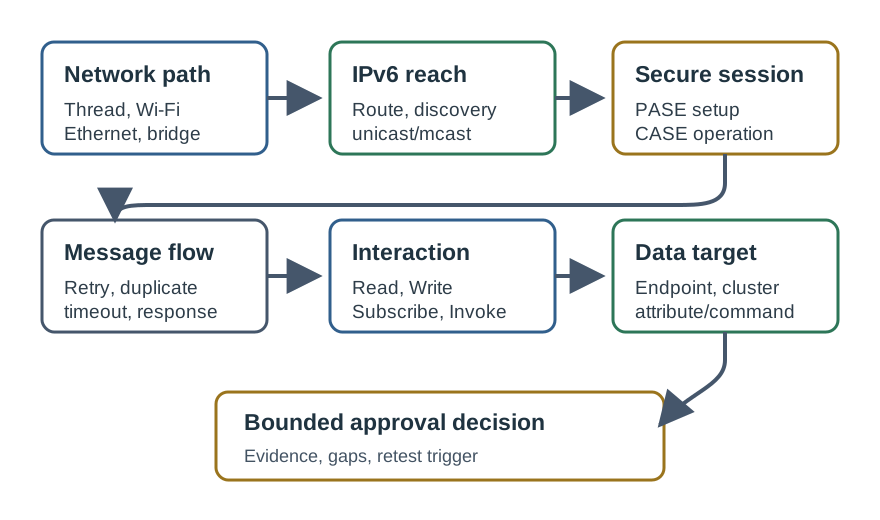
Stack Evidence Map
The first figure shows the evidence path from network transport to application approval.
- The reviewer needs to know which layer supplied which evidence and which layer remains unproven.
Major section
Portable Layer Stack
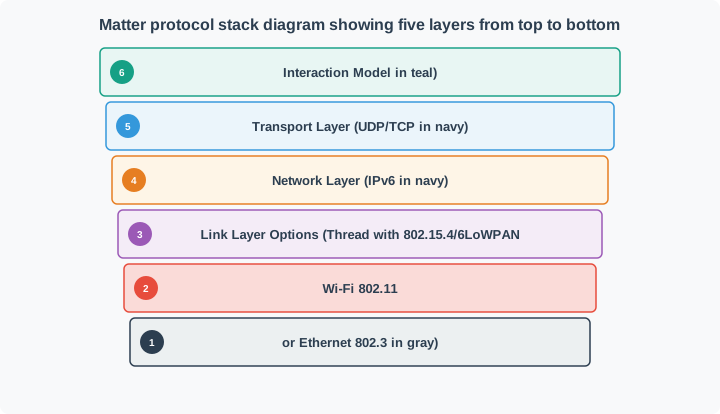
The useful portability question is not whether Thread, Wi-Fi, Ethernet, and bridge paths behave identically.
- The question is whether the upper Matter layers keep the same meaning while each lower path supplies its own reachability, timing, reliability, and retest evidence.
- Message and session: Matter frames, secures, pairs, acknowledges, retransmits, and times the reviewed operation.
Major section
Portable Layer Stack (continued)
Transport path: The selected IPv6 path carries the messages; BLE commissioning traffic is not the operational control path.
- Operational Matter traffic uses the selected IP-capable network path.
- In practice that usually means Matter messages over IPv6/UDP with Matter reliability behavior; Bluetooth transport is commissioning evidence, not proof that the device remains controlled over BLE after it joins a fabric.
- Layer separation is what makes the same application model portable.
Major section
Security Layer Evidence
Matter security should be reviewed at the right layer.
- PASE is commissioning bootstrap evidence.
- CASE is operational-session evidence.
- Link-layer security and Wi-Fi security may protect the network path, but they do not replace Matter secure-session evidence.
- Likewise, a CASE session does not replace ACL evidence for a command.
Major section
Security Layer Evidence (continued)
Commissioning session: PASE evidence is appropriate when the device does not yet have operational credentials and is being commissioned.
- Operational session: CASE evidence is appropriate for normal operation after fabric membership and operational credentials are installed.
- Authorization boundary: ACL privilege still has to match the interaction.
- Secure channel success alone does not approve a write, invoke, or management action.
Major section
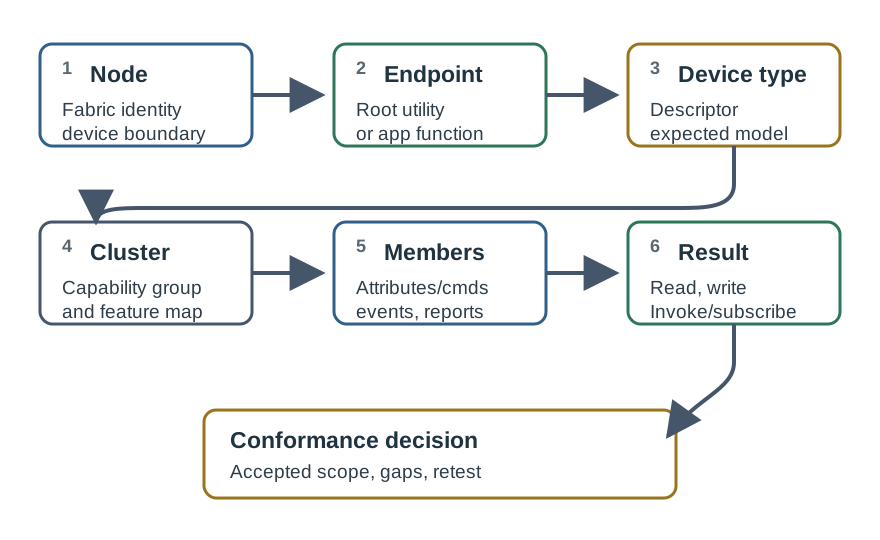
Data Model Evidence Path
The second figure shows the review path from node identity to exact data-model target.
- Data-model review should be precise enough that another reviewer can reproduce the target path.
- A product name, room name, or marketing device category is not enough.
Major section
Node and Endpoint Evidence
A Matter node is the addressable device identity within a fabric.
- Endpoint 0: Endpoint 0 is the root and utility area.
- It should not be confused with a controllable light, plug, sensor, lock, or bridged endpoint.
- Application endpoints: Endpoints above 0 should map to controllable or reportable functions.
- Multi-outlet, bridge, and composite devices need separate endpoint evidence.
Major section
Failure Signatures
Wrong layer: The review uses network reachability as proof of command support, or secure-session success as proof of ACL authorization.
- Unsupported cluster: The expected cluster is absent, client/server direction is wrong, or an optional feature is assumed without feature evidence.
- Attribute misuse: The review treats a read-only attribute as writable, ignores value constraints, or accepts cached state as current device evidence.
- Command mismatch: The controller sends an invoke to the wrong command path, missing feature-dependent arguments, or omits a timed requirement.
Major section
Review Checklist
Layer evidence: Network, secure session, message behavior, interaction, and data-model evidence are not substituted for one another.
- Descriptor evidence: Endpoint lists, device types, cluster lists, feature maps, and cluster revisions are current for the reviewed firmware or bridge state.
- Operation evidence: Attributes, commands, events, reports, and statuses are tied to exact paths and expected access rules.
- Failure handling: Unsupported path, unsupported cluster, wrong privilege, stale descriptor, duplicate, retry, and timeout cases are classified.
Major section
Concept Relationships
Network Path and Application Model: The same Matter data model can run over different IP-capable paths, but each path still needs evidence.
- PASE and CASE: PASE supports commissioning bootstrap; CASE supports operational sessions.
- MRP and UDP: MRP adds Matter-level reliability behavior for relevant UDP message exchanges.
- Device Type and Conformance: Device type expectations should be supported by descriptor, cluster, feature, and behavior evidence.
Deck summary
Key takeaways
The product owner must find which layer accepted the device and which layer failed the action.
- Matter separates application behavior from the underlying Thread, Wi-Fi, or Ethernet network path.
- The claim is intentionally narrow.
- The first figure shows the evidence path from network transport to application approval.
- The useful portability question is not whether Thread, Wi-Fi, Ethernet, and bridge paths behave identically.
Retrieval practice
Recall check 1 of 5

Radio Remi says: answer from memory, then check your reasoning.
Q1What does Matter's Message Reliability Protocol (MRP) add for messages carried over UDP?
Show answer
Answer: A MRP adds reliability (retries, duplicate detection, timeouts) to Matter messages sent over UDP.
Retrieval practice
Recall check 2 of 5
Radio Remi says: answer from memory, then check your reasoning.
Q2What transport evidence belongs in an operational Matter review after commissioning is complete?
Show answer
Answer: A Operational Matter runs over IPv6 on the selected IP-capable path; BLE is commissioning evidence, not the normal post-commissioning control transport.
Retrieval practice
Recall check 3 of 5
Radio Remi says: answer from memory, then check your reasoning.
Q3Why can one Matter controller use the same On/Off interaction logic for a Thread light and a Wi-Fi light?
Show answer
Answer: A Matter keeps the data model and interaction model above the selected IP-capable transport, so controller logic can stay stable while transport evidence changes.
Retrieval practice
Recall check 4 of 5
Radio Remi says: answer from memory, then check your reasoning.
Q4A Matter device is reachable over IPv6 and establishes a CASE session, but a controller cannot invoke a command on endpoint 2. How should reviewers diagnose the failed endpoint command?
Show answer
Answer: C Matter stack review separates layer evidence.
Retrieval practice
Recall check 5 of 5
Radio Remi says: answer from memory, then check your reasoning.
Q5A bridge exposes three physical devices, but the review record only shows one endpoint and one cluster list. What is the strongest approval decision?
Show answer
Answer: B Matter data-model approval must be scoped to the endpoint and cluster evidence actually reviewed.
Print reference
Answers 1 of 2
Answer key.
- A · MRP adds reliability (retries, duplicate detection, timeouts) to Matter messages sent over UDP.
- A · Operational Matter runs over IPv6 on the selected IP-capable path; BLE is commissioning evidence, not the normal post-commissioning control transport.
- A · Matter keeps the data model and interaction model above the selected IP-capable transport, so controller logic can stay stable while transport evidence changes.
- C · Matter stack review separates layer evidence.
Print reference
Answers 2 of 2
Answer key.
- B · Matter data-model approval must be scoped to the endpoint and cluster evidence actually reviewed.