Zigbee, Thread & Matter · Study deck
Matter Interaction Model
Matter interactions are the evidence trail between a controller's intent and a device's accepted state change.
Radio Remi is your guide for this deck.

After studying this chapter
Learning objectives
You will be able to:
- Review Matter interaction evidence using data-model paths, session state, ACL privilege, and response status.
- Distinguish Read, Write, Subscribe, Invoke, and Timed Request evidence without collapsing them into generic message exchange.
- Evaluate subscription choices for constrained and mains-powered devices without relying on brittle traffic arithmetic.
- Trace commissioning from discovery through operational interaction approval.
Major section
Start With the Device Experience
A delayed remote action should end safely rather than arrive after its meaning has changed.
- The lock is online, but the request names the wrong endpoint and arrives after the window.
- The controller must reject it for the right reasons and leave evidence the resident can understand.
- Practitioner turns read, write, watch, and act flows into tests.
Major section
Start With the Device Experience (continued)
If any answer is no, do not report a good user result.
- Reachability does not grant authority, and a sent request does not prove that the physical state changed.
- This opening does not cover every device function or approve a lock.
- Matter Interaction Model is the evidence route for deciding whether that expectation is realistic.
Major section
In 60 Seconds
A clean review separates transport reachability from Matter authorization.
- Matter controllers use Read, Write, Subscribe, and Invoke operations against paths in the data model.
- Timed Request is a protective interaction pattern used when a following Write or Invoke must arrive within a short accepted window.
- A reachable device can still reject an operation correctly.
Major section
Interaction Evidence Map
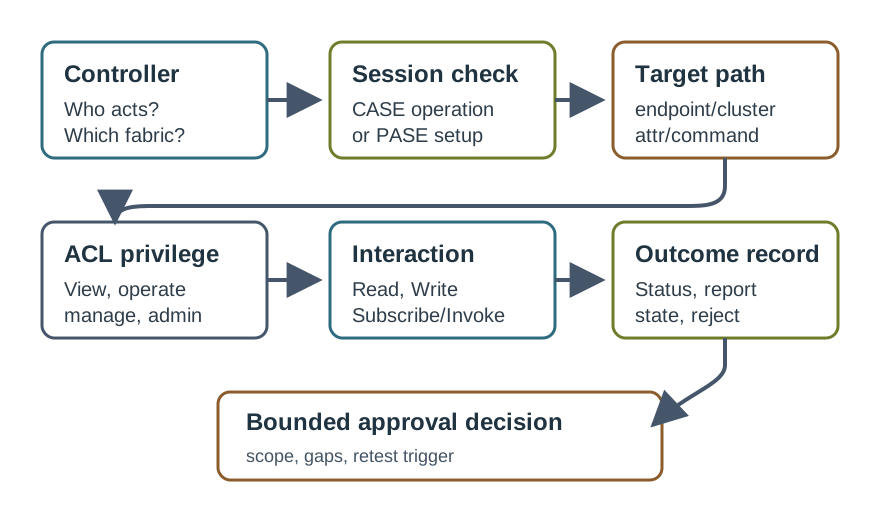
The first figure shows how an interaction record should connect intent to an approval decision.
- The approval needs the device path, privilege, protocol state, and outcome record that explain why the interaction succeeded or failed.
Major section
Evidence Families
Matter interaction review uses several evidence families.
- Missing evidence usually means the decision should stay open.
- A connected controller is not automatically allowed to write or invoke.
- Outcome record: Preserve accepted values, rejected status, subscription reports, event records, retry behavior, or timed-window failure evidence.
Major section
Subscribe Evidence
Initial report: The subscription should produce an initial report or equivalent evidence so the controller begins from a known state.
- Change reports: The review should show that relevant attribute or event changes produce reports without uncontrolled flooding.
- Heartbeat behavior: The max interval should support liveness without forcing a sleepy or battery device to wake more often than the scenario requires.
- Lifecycle: The record should show when the subscription was created, refreshed, dropped, or canceled, and how the controller handled loss.
Major section
Subscription Report Lifecycle
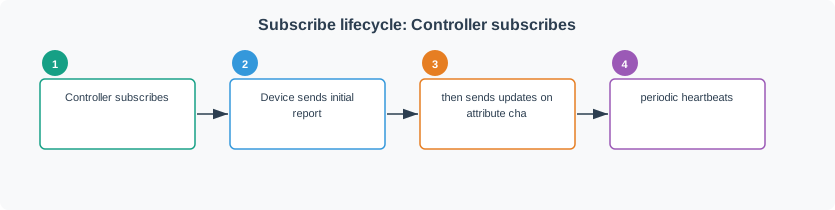
If a controller kept fifty devices current by polling, it would repeatedly read values whether or not anything changed.
- That wastes bandwidth, wakes sleepy devices, and can flood a low-power mesh with repeated reads that mostly return the same value.
- The device sends an initial report, then reports selected attribute or event changes.
Major section
Commissioning Review Path
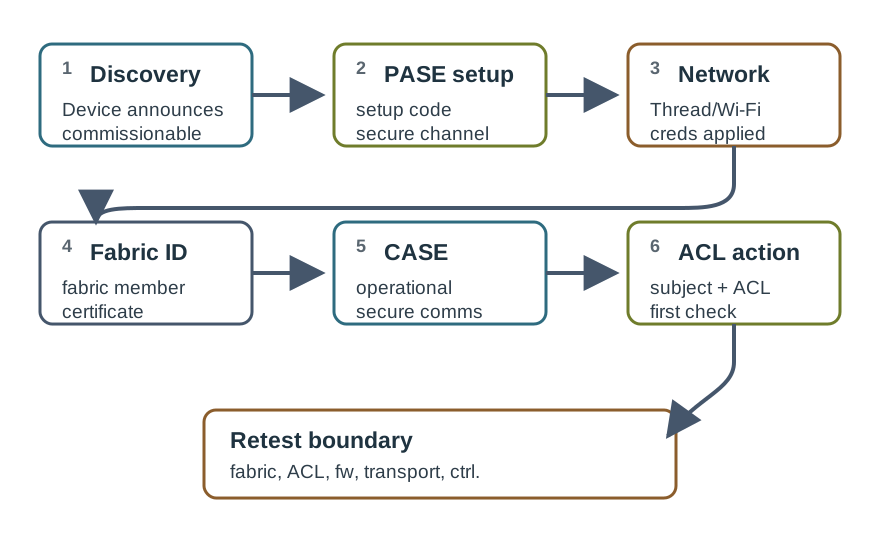
The second figure keeps commissioning evidence connected to the first approved Matter operation.
- The evidence should show how the device was found, how setup information established the commissioning session, how operational credentials were installed, which ACL entry was created, and which first interaction proves the intended operational state.
Major section
Failure Signatures
Matter failures are easier to debug when the reviewer classifies the failure by evidence family.
- Wrong path: The endpoint, cluster, attribute, command, or event target does not exist on the device, or the bridge endpoint changed after a firmware update.
- Wrong privilege: The subject can connect but does not have the required ACL privilege for write, invoke, management, or administration.
- Wrong session: The record confuses PASE commissioning with CASE operation, or uses commissioning evidence to approve an operational command.
Major section
Common Mistakes
Replacing subscription evidence with polling screenshots that do not prove report lifecycle behavior.
- Ignoring rejected statuses even when the rejection is the security behavior the device should enforce.
- Approving a timed operation without checking what happens after the accepted window expires.
- Keeping tool commands in learner-facing content instead of reviewing the evidence those commands should produce.
Major section
Review Checklist
Authorization: The required privilege is identified and matched to the ACL record for the subject and target.
- Outcome: The record includes response status, returned value, report data, resulting state, or expected rejection.
- Lifecycle: Subscriptions, timed windows, commissioning windows, session renewal, and controller replacement have clear boundaries.
- Retest: The decision states what change invalidates the evidence and requires a new review.
Major section
Concept Relationships
Timed Request and Security-Sensitive Commands: Timed Request adds a temporal boundary to protected writes or invokes.
- PASE and CASE: PASE bootstraps commissioning before operational credentials exist; CASE protects operational interactions after commissioning.
- ACL and Interaction Outcome: ACL privilege explains why an operation is accepted or rejected.
- Fabric and Multi-Admin: Each fabric needs separate interaction evidence even when the physical device is the same.
Deck summary
Key takeaways
A delayed remote action should end safely rather than arrive after its meaning has changed.
- If any answer is no, do not report a good user result.
- A clean review separates transport reachability from Matter authorization.
- The first figure shows how an interaction record should connect intent to an approval decision.
- Matter interaction review uses several evidence families.
Retrieval practice
Recall check 1 of 6

Radio Remi says: answer from memory, then check your reasoning.
Q1A controller still shows an old lock state after a subscription stopped reporting. What should the review inspect?
Show answer
Answer: A A visible old value is not proof of a live subscription.
Retrieval practice
Recall check 2 of 6
Radio Remi says: answer from memory, then check your reasoning.
Q2What is a Matter Timed Request used for in the interaction model?
Show answer
Answer: A A Timed Request requires a following Write or Invoke to arrive within a short accepted time window.
Retrieval practice
Recall check 3 of 6
Radio Remi says: answer from memory, then check your reasoning.
Q3A controller wants to run the Toggle command on a light's On/Off cluster. Which interaction is that?
Show answer
Answer: A Cluster commands are executed with Invoke.
Retrieval practice
Recall check 4 of 6
Radio Remi says: answer from memory, then check your reasoning.
Q4In a Matter subscription, what does the maximum reporting interval accomplish?
Show answer
Answer: A The maximum reporting interval forces a periodic heartbeat so a controller can distinguish an unreachable device from one that simply has no changes.
Retrieval practice
Recall check 5 of 6
Radio Remi says: answer from memory, then check your reasoning.
Q5A Matter controller can read a door lock's state attribute, but its unlock command is rejected. What is the strongest review interpretation?
Show answer
Answer: C Matter reviews should distinguish interaction type and privilege.
Retrieval practice
Recall check 6 of 6
Radio Remi says: answer from memory, then check your reasoning.
Q6A device was commissioned successfully yesterday, but today's review only includes a screenshot showing the app can still see the device name. What evidence is still needed before approving an operational Matter interaction?
Show answer
Answer: C A commissioning record is not enough to approve a later interaction.
Print reference
Answers 1 of 2
Answer key.
- A · A visible old value is not proof of a live subscription.
- A · A Timed Request requires a following Write or Invoke to arrive within a short accepted time window.
- A · Cluster commands are executed with Invoke.
- A · The maximum reporting interval forces a periodic heartbeat so a controller can distinguish an unreachable device from one that simply has no changes.
- C · Matter reviews should distinguish interaction type and privilege.
Print reference
Answers 2 of 2
Answer key.
- C · A commissioning record is not enough to approve a later interaction.